

A spring capsule wardrobe 2027 is not a shopping list. It is a small set of clothes — about 30 pieces — that all work together, chosen from what you already own, in a colour palette you decided on purpose. Spring is the best season to start one: the weather asks for layers rather than bulk, and one good trench does the work of three winter coats. If you built our winter capsule wardrobe, this is its sequel: the same method, lighter fabrics, brighter light.
Spring capsule wardrobe 2027: the quick answer
Pick 30 pieces you already own: 9 tops, 3 knits, 5 bottoms, 2 dresses, 3 outer layers, 4 pairs of shoes and 4 bags and accessories. Choose them inside one palette — three neutrals plus two accent colours — so that every top goes with at least two bottoms. Box up everything else, out of sight, for the season. Then dress from the 30 for three months, and at the end of spring open the boxes and notice what you missed and what you never wore. What matters is the rule that every piece earns its place by mixing with the others.
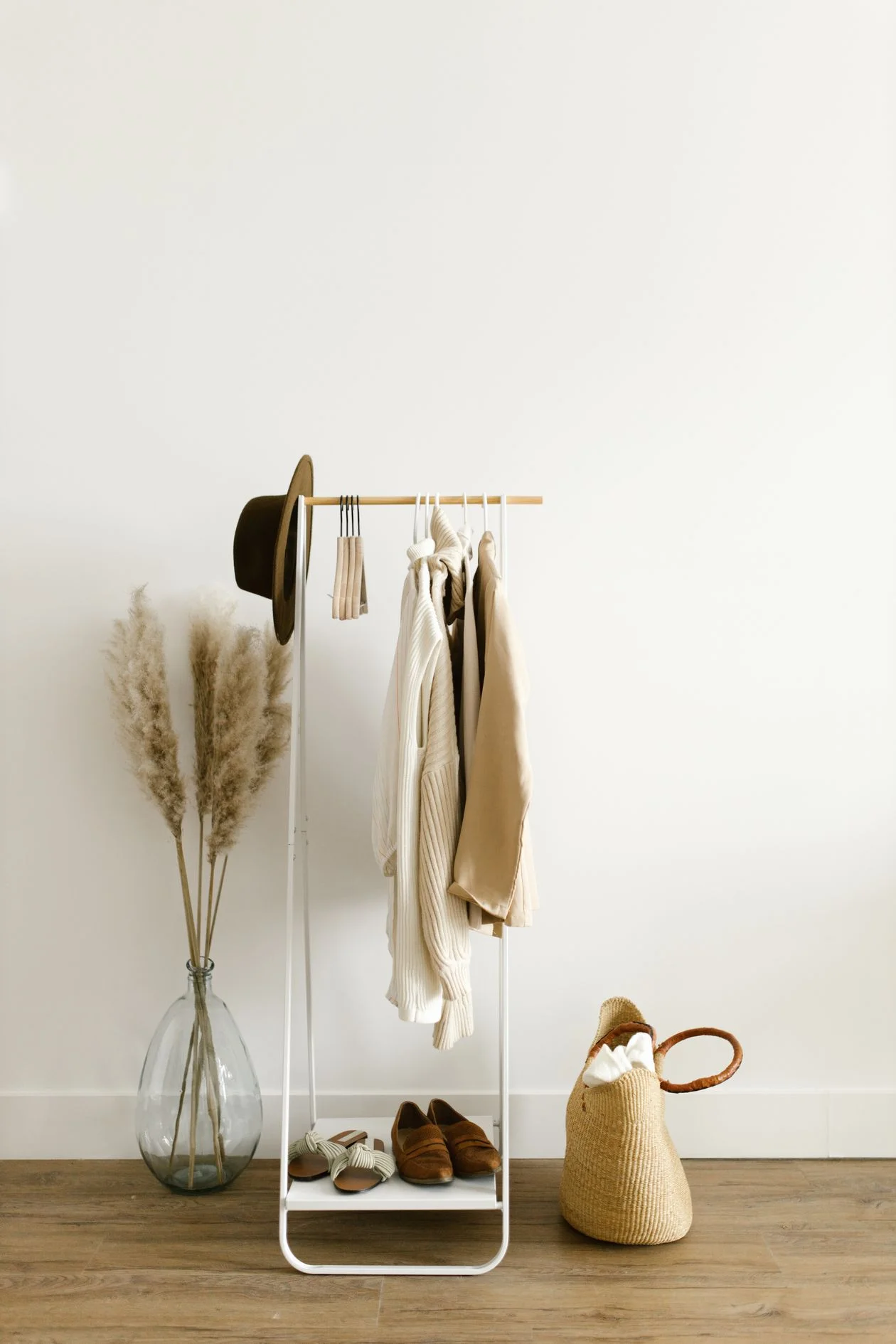
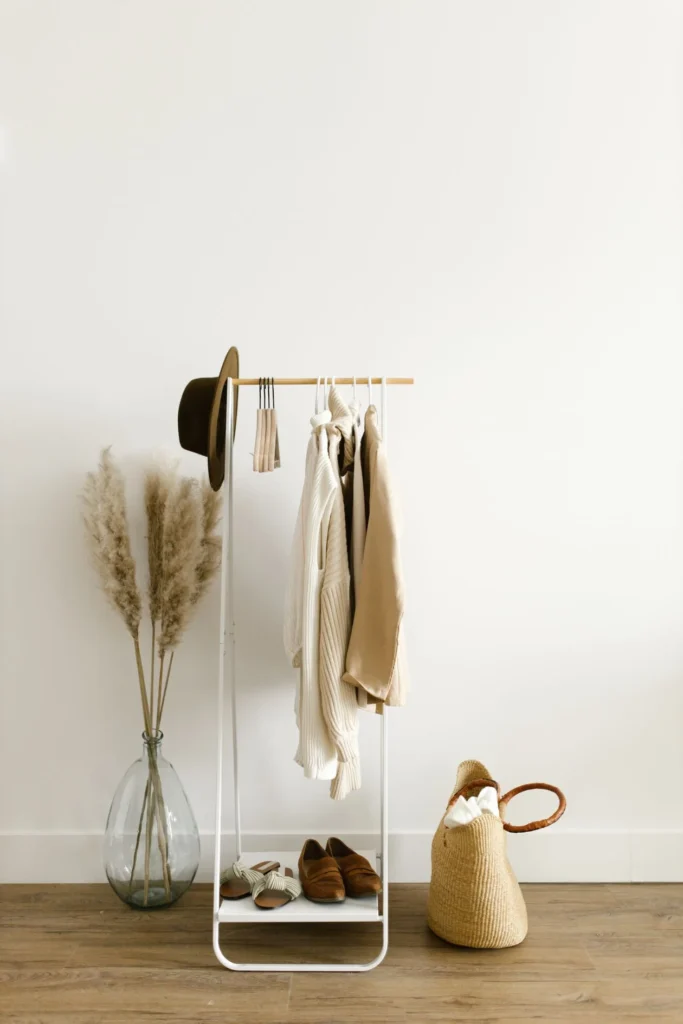
A spring capsule starts with a short rail, not a shopping trip: neutrals that all work together, hung where you can see them.
What a spring capsule wardrobe is — and what it is not
A capsule wardrobe is a small, intentional collection of pieces that mix and match easily. The phrase is usually credited to Susie Faux, who ran a boutique called Wardrobe in London’s West End in the 1970s and told busy professional women to buy a handful of good, interchangeable pieces instead of starting from scratch every season. A decade later, Donna Karan built her 1985 label around “seven easy pieces” — a bodysuit as the base, with layers swapped on top. The idea has not changed since: fewer pieces, more combinations.
What a spring capsule is not: it is not a uniform, and it is not a punishment. You are not throwing clothes away, and you are not dressing the same every day. The pieces you do not choose go into a box, out of sight, for three months — and if you genuinely miss something, you swap it in, one for one. It is also not a shopping challenge: the most common mistake is treating a capsule as a reason to buy 30 new things. When the waste charity WRAP surveyed more than 6,000 UK adults in October 2022, it found the average person owned around 118 items and had not worn roughly a quarter of them — about 31 pieces — for at least a year. Your wardrobe probably holds a full spring capsule already.
Start with your life, not a shopping list
Before you choose a single piece, write down what spring actually looks like for you. How many days a week do you go to an office? Do you walk to work or drive? Do you have weddings, interviews or holidays between March and May? A capsule built for someone else’s life will not fit yours — and that is the point.
Then empty the wardrobe. Take everything out — the rail, the drawers, the chair in the corner — and put it on the bed. Seeing the whole pile at once is uncomfortable, and that discomfort is useful: it is the only moment you see what you actually own. Sort it into four piles: love and wear, fits but rarely worn, does not fit, and out of season. Be honest about the second pile — those are the pieces you like but never prioritise, and they are the reason the rail feels full while mornings feel empty. Then ask which of the “love and wear” pieces you actually reached for in the last month. The ones with an honest yes are your capsule’s foundation. Our guide to building a capsule wardrobe on a budget covers the same audit in detail.
The 30-piece spring capsule: the full list
Here is the list, category by category. Treat it as a template, then swap pieces to match your climate, your work and your palette. The count is 30 — close enough to Project 333‘s 33-items-for-3-months challenge that the same counting rules apply: clothing, outerwear, shoes, accessories and jewellery count; underwear, sleepwear, loungewear and genuine workout clothes do not, and neither does a wedding ring.
| Category | Pieces | What usually works in spring |
|---|---|---|
| Tops | 9 | White tee, black tee, striped top, white shirt, blue shirt, silk blouse, linen top, smart blouse, camisole |
| Knitwear | 3 | Fine cream crew-neck, light cardigan, one slightly warmer jumper for cold mornings |
| Bottoms | 5 | Dark straight-leg jeans, light-wash jeans, black tailored trousers, cream wide-leg trousers, one skirt |
| Dresses | 2 | One casual day dress, one midi dress that works for events |
| Outer layers | 3 | Classic trench coat, denim jacket, one blazer |
| Shoes | 4 | White sneakers, loafers, ankle boots, one dressy pair (heels or smart flats) |
| Bags and accessories | 4 | Everyday bag, structured tote, neutral scarf, leather belt |
That is 30 pieces. Notice what is not on the list: no heavy coat, no chunky knit, no thermal layers. Spring is a season of light layers — the trench and the denim jacket replace the winter coat, and the cardigan replaces the heavy jumper. The list bends; the rule does not: every top should go with at least two bottoms. If a piece only works with one other thing, it is a costume, not a capsule item. There is no correct count — Project 333 uses 33, and many people settle between 25 and 40.
The palette system: 3 neutrals + 2 accents
A capsule works because of its palette, not its piece count. When every piece shares two or three neutrals, a smaller number of clothes produces far more outfits — that is the entire secret. The system is simple: three neutrals plus two accents.
The three neutrals are your base. Pick the neutrals you already own most of. For most people that is some version of white or cream, black or charcoal, and one warm neutral — camel, beige or chocolate brown.
The two accents are your personality. Choose one soft accent and one stronger one. Spring’s easy pairs are sage green with tomato red, powder blue with burgundy, or lilac with chocolate brown. An accent in three or four pieces is enough; in ten, it becomes a second wardrobe.
The test is the rail test. Hang the thirty pieces together and step back. If the rail looks calm — mostly neutrals, with the accents dotted through like punctuation — the palette is working. Our old money colour palette guide covers the classic combinations in full.
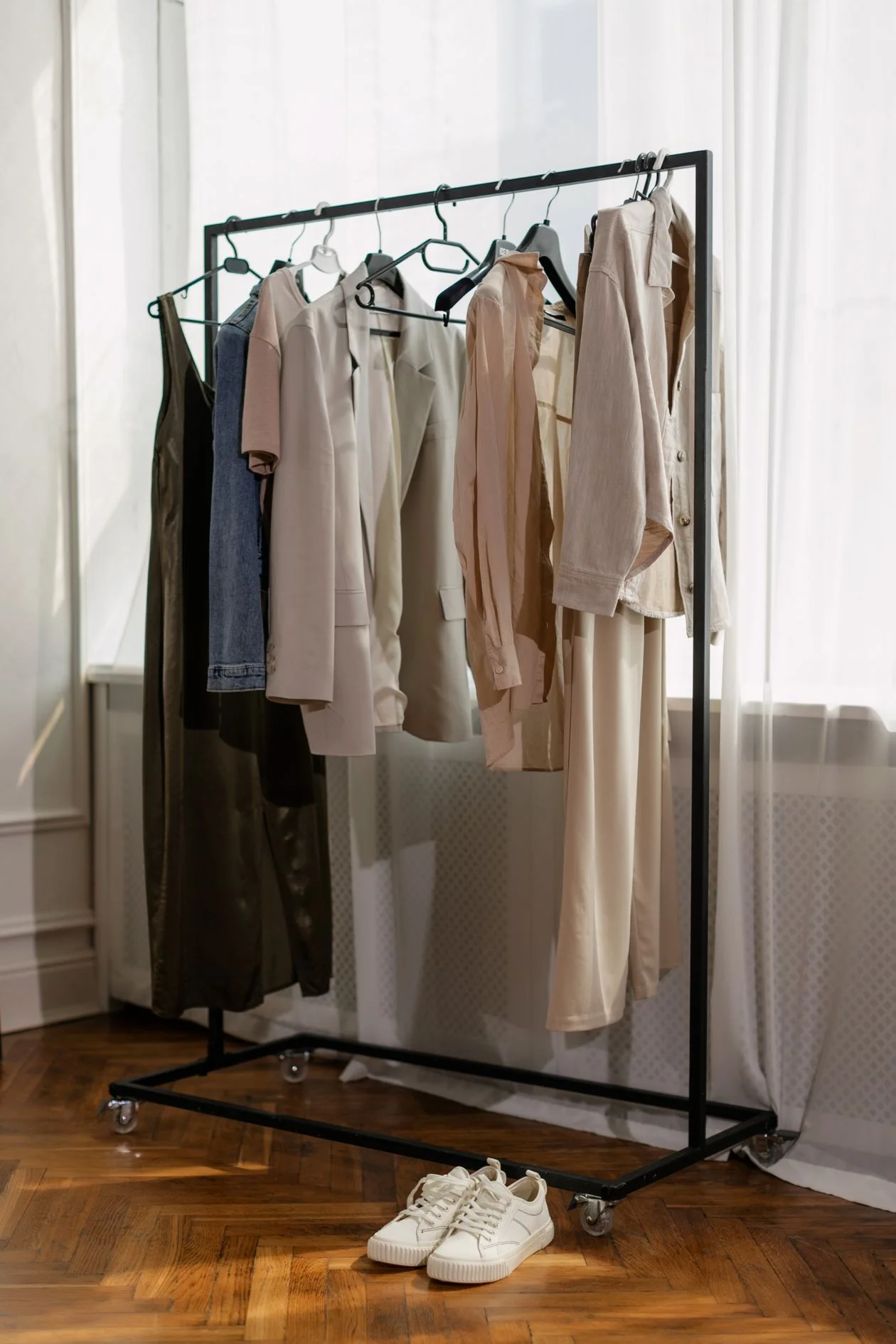
Three neutrals, two accents: when the rail looks like this — calm, with one or two colours doing the talking — the palette is working.
One more rule: the palette applies to shoes and bags too. A quiet luxury capsule wardrobe works because the accessories are quiet — the everyday bag in black or tan, the belt in brown or black, the scarf in cream. If the bag, the shoes and the scarf are all shouting, the outfit has no quiet place for the eye to rest.
Spring capsule wardrobe outfits: 5 formulas that work
Formulas are what make a capsule feel bigger than its count. Here are five, built only from the thirty pieces above.
Work: white shirt, black tailored trousers, blazer, loafers. Add the leather belt and the structured tote.
Weekend: striped long-sleeve top, light-wash jeans, white sneakers, denim jacket over the shoulders. The trench replaces the denim jacket on cooler days.
Smart-casual: silk or satin blouse, dark straight-leg jeans, ankle boots, trench coat worn open. This is the evening version of the weekend formula — the only thing that changed is the top and the shoes.
Tonal: cream crew-neck, cream wide-leg trousers, camel trench, loafers. One colour family, three textures. Our guide on how to style a blazer the old money way shows how tonal dressing stays polished — the trick is mixing textures, not matching shades exactly.
Rainy day: fine knit, black trousers, trench belted, ankle boots. The trench is the spring capsule’s most important piece: a coat, a layer and a finishing touch at once.

The spring capsule’s outer layer does the most work: a trench over a striped top and dark jeans is one formula, not one outfit.
If you want a looser version of the same method, the Y2K capsule wardrobe on this site builds a capsule around playful pieces rather than neutrals — the counting and the palette rules are identical, only the direction is different.
Shoes and accessories: the finishing five
Shoes eat the count fastest, so choose them first, not last. Four pairs cover spring: white sneakers for everyday, loafers for work and smart days, ankle boots for cold mornings and rain, and one dressy pair for evenings. White sneakers are the most-worn pair in most spring capsules — they go with jeans, dresses and tailored trousers.
Accessories are where the capsule gets its personality without spending a piece slot on clothes. Your four accessory slots — everyday bag, structured tote, neutral scarf, leather belt — should all be in your neutrals. The scarf is the hardest-working of the four: it adds colour near your face, warms a cool morning, and turns the same white shirt and black trousers into a different outfit.

White sneakers are the spring capsule’s most-worn shoe: they go with jeans, dresses and tailored trousers, and they keep every outfit feeling like spring.
The one-in, one-out rule and the 30-day test
A capsule only stays a capsule if nothing sneaks in. Decide your shopping rule before you need it: if you want a new item, wait 30 days, and it must replace something in the capsule. One in, one out. Then run the 30-day test: keep a note of everything boxed that you reach for, try three combinations you have never worn together in week two, and at day 30 count which pieces you never wore at all. At the end of spring, open the boxes and note what you missed.
Common mistakes and how to fix them
- Buying 30 new things to start. The capsule is already in your wardrobe. Fix: build from the “love and wear” pile first.
- Choosing a palette you do not own. Fix: build the palette from the neutrals you already own most of.
- Counting the wrong things. Underwear, sleepwear, loungewear and genuine workout clothes sit outside the count. Fix: use the Project 333 counting rules.
- One-outfit pieces. A top that only goes with one skirt is a costume. Fix: every top must pair with at least two bottoms.
- Too many accents. Five accent colours is five wardrobes. Fix: two accents, in small doses.
- Skipping the box. Fix: box the unchosen clothes up and put them out of sight.
Shopping guidance: what to buy first
Buy nothing for the first week. Build the capsule from what you own, wear it for seven days, and write down what is genuinely missing. Most people find the gap is one layer or one pair of shoes — not a new wardrobe. When you do buy, buy the piece that unlocks the most outfits: usually the trench, the white sneakers or the blazer, in the best quality you can afford. Before you pay, check three things: it fits over the thickest knit in your capsule, it works with at least two bottoms you already own, and it is in one of your three neutrals. No prices are promised here, because they change by store and season. And remember the environmental arithmetic: the Ellen MacArthur Foundation’s 2017 report found that clothing utilisation had fallen by 36% over fifteen years, and less than 1% of clothing material was recycled into new clothing.
Frequently asked questions
How many items should a spring capsule wardrobe have?
There is no correct number. Project 333 uses 33 items including shoes and accessories, and most people settle between 25 and 40. This guide uses 30 as a target.
Can I build a spring capsule wardrobe without buying anything?
Yes, and you should try. Most wardrobes already hold a full capsule buried under pieces that are rarely worn. Empty the wardrobe, sort it into piles, and build from the pieces you love and actually wear.
What colours work best for a spring capsule wardrobe?
Three neutrals plus two accents. The neutrals are usually white or cream, black or charcoal, and one warm neutral such as camel, beige or chocolate brown. The accents are one soft colour and one stronger one.
What is the difference between a capsule wardrobe and Project 333?
A capsule wardrobe is the broad idea: a small, intentional set of clothes that all work together, with no fixed number and no time limit. Project 333 is a specific, rule-based version — 33 items for three months, with everything else boxed out of sight.
How do I keep a spring capsule from getting boring?
Boredom usually means the capsule is too uniform: too many neutrals and nothing that feels like you. Try three combinations you have never worn together, change the accent piece, or swap one boxed favourite back in.
Conclusion
A spring capsule wardrobe 2027 is thirty pieces, three neutrals, two accents and one honest audit of what you already own. Start with the wardrobe, not the shops. Hang the thirty together, box the rest out of sight, and let the formulas do the work for three months.