

A wrap dress is the easiest dress to wear — and the easiest to put away for winter. It fits without tailoring, it suits almost every frame, and it goes from a desk to a dinner without a change of outfit. The only problem is the cold: a light jersey wrap dress, bare legs and an open neckline are not a winter outfit. Learning how to wear a wrap dress in winter is about adding warmth without losing the shape that makes the dress work — layers underneath, tights and boots below, and a coat that works with the waist instead of hiding it.
This guide covers the whole system: choosing a winter-weight wrap dress, layering under and over it, tights and boots, coats, and outfit formulas for work, parties and weekends.
How to wear a wrap dress in winter: the quick answer — layer under, cover the legs, coat over
Wear a fine thermal or roll-neck under the wrap dress, fleece-lined or opaque tights on your legs, knee-high boots, and a long coat over the top. Choose a winter-weight dress — jersey, wool, velvet or a heavy crepe — rather than a thin summer one. Keep the dress’s own tie visible at the waist, and let the coat be open or belted so the waist is not lost.
That is the system in one paragraph. The rest of this guide is about getting each layer right.
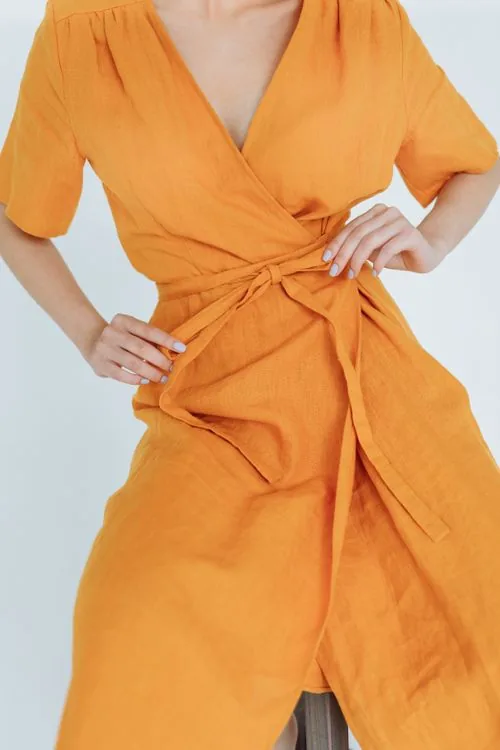
What a wrap dress actually is
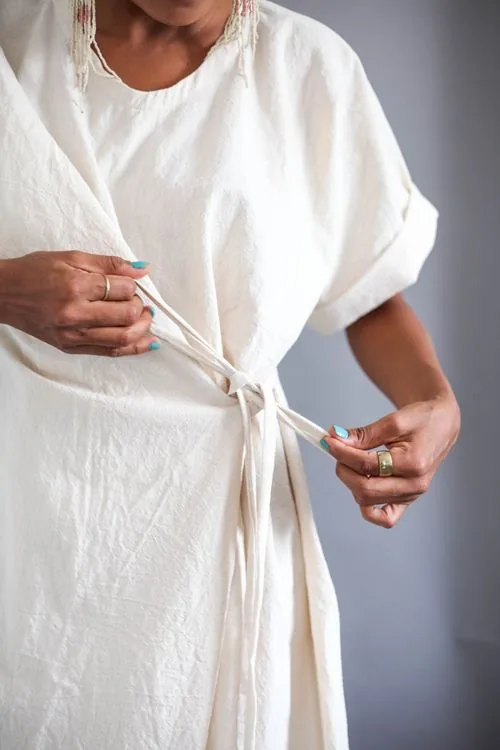
A wrap dress is a dress with a front closure formed by wrapping one side across the other, fastened at the side or tied at the back, which forms a V-shaped neckline. A faux wrap dress looks the same but is already fastened together and slips on over the head — worth knowing when you shop, because a true wrap can be adjusted at the waist and a faux wrap cannot.
The modern wrap dress is most associated with Diane von Fürstenberg, who is best known for her wrap dress — her knitted jersey version, introduced in 1974, became one of the most recognisable dresses in fashion. That history matters for winter styling, because the classic wrap dress is jersey: stretchy, comfortable, and warm enough to layer, but not warm on its own. The winter versions — wool, velvet, heavy crepe — are the ones to look for when the temperature drops.
Choosing a winter-weight wrap dress
Not every wrap dress is a winter dress. A thin, light jersey wrap in a pale colour is a summer dress, and no amount of layering will quite make it a winter one. Look for these instead:
Fabric. Wool, wool blends, velvet, heavy jersey and heavy crepe are the winter fabrics. They hold their shape, they keep you warm, and they look right with boots and a coat. A velvet wrap dress is the most obviously winter version — it reads as evening and occasion wear the moment you put it on.
Sleeves. Long sleeves are the obvious winter choice, and they make layering underneath much easier. A three-quarter sleeve works with a fine roll-neck underneath. A sleeveless wrap dress can still work in winter, but only with a layer under it — a roll-neck or a fine knit — and it will always be a layered outfit rather than a dress on its own.
Length. A midi length — falling below the knee and above the ankle — is the most useful winter length. It covers the knee, it works with knee-high boots, and it leaves enough leg visible to keep the outfit from looking heavy. A knee-length wrap dress works too, with opaque tights and knee-high boots. A maxi wrap dress is warm, but it needs a long coat to match, or the proportions can look unbalanced.
Layering underneath: the warmth layer
The layer under the dress is the difference between wearing a wrap dress in winter and freezing in one. A fine thermal top, in a colour that matches the dress or in black, adds warmth without bulk. A fine roll-neck is the more visible option: the collar shows at the V-neckline, which looks intentional and adds a second layer of warmth at the neck.
Two rules for the under-layer. First, keep it fine — a chunky knit under a wrap dress will bunch at the waist and spoil the wrap’s clean line. Second, keep it smooth at the waist: tuck it in, or choose one that ends at the waist and sits flat under the dress’s tie. If the under-layer bunches, the dress will not wrap cleanly, and the waist — the whole point of a wrap dress — will disappear.
For very cold days, add fleece-lined tights as well as the top layer. The dress covers the top of the tights, the boots cover the bottom, and the only tights on show are the shin — which reads as a deliberate part of the outfit.
Tights and boots: the leg formula
Tights are not optional with a winter wrap dress — they are half the outfit. Opaque tights in black are the simplest choice: they go with every dress colour, they read as a continuation of the boots, and they are warm. Fleece-lined tights are the warmest option, and they look identical to ordinary opaque tights once they are on. On the coldest days, they are the difference between wearing the dress and leaving it in the wardrobe.
Sheer tights are the version to avoid in deep winter — they are not warm enough, and they make the outfit look like a summer dress with a coat thrown over it. Patterned tights can work with a plain dress, but keep the pattern small and the colour dark, so the tights do not compete with the dress.
Boots are the other half of the leg formula. Knee-high boots are the best choice with a midi wrap dress: the boot meets the hem, or sits just below it, and the whole leg reads as one line. Ankle boots work with a knee-length dress, especially with opaque tights. Heeled boots lift the outfit for work or evenings; flat knee-high boots are the comfortable choice for a long day.
Avoid trainers and very casual shoes with a wrap dress — they push the outfit toward daytime casual and away from the polished look a wrap dress does best.
Coats: long, belted, and open or closed
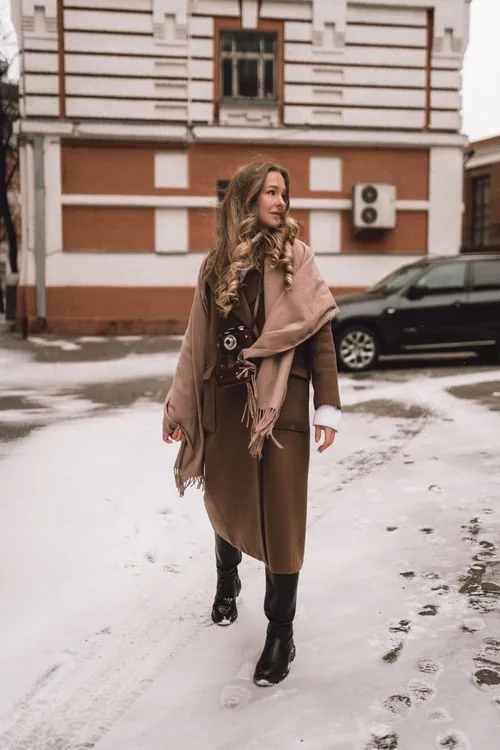
A wrap dress needs a coat that respects its waist. A long wool coat, worn open, shows the dress’s tie and V-neckline while keeping you warm. A belted coat, worn closed and belted at the same place as the dress’s waist, gives you a second waist definition and looks deliberate rather than bulky. A short, boxy jacket is the hardest choice: it ends at the hip, hides the wrap’s shape, and leaves the legs exposed.
Length matters. A coat that falls to the knee or below works with a midi dress; a coat that ends above the knee can work with a knee-length dress, but it needs to be well cut to avoid looking boxy. Colour is simple: a coat in a neutral — black, navy, camel, grey or chocolate — goes with every wrap dress you own. A coloured coat in burgundy or forest green is a beautiful match for a dark dress, but it needs the rest of the outfit to be quiet. For more cold-weather outfit ideas built on the same layering system, see these winter outfit ideas for women.
Blazers and cardigans: the indoor layer
Indoors, the coat comes off, and you need a second layer that works with the dress. A tailored blazer over a wrap dress is one of the best work outfits there is: the blazer adds structure at the shoulder, the dress gives the waist, and the combination looks polished without effort. Choose a blazer that ends at the hip, and wear it open so the dress’s tie stays visible. For the details, see how to style a blazer.
A long cardigan is the softer option — a fine knit cardigan, worn open over the dress, adds warmth without hiding the shape. A chunky cardigan can work too, but only if it is open and long; a short, bulky cardigan over a wrap dress tends to hide the waist entirely.
A fine roll-neck under the dress, plus a blazer or a cardigan over it, is the full winter system: three layers, all thin, all working together, and none of them hiding the dress.
Outfit formulas: work, party, weekend and evening
Work: a wool or heavy jersey wrap dress in navy or burgundy, a fine roll-neck underneath, opaque tights, knee-high boots, a tailored blazer, and a long wool coat over the top. For more classic work looks, these old money work outfits are a useful starting point.
Party: a velvet wrap dress, sheer-to-opaque tights or fleece-lined tights depending on the cold, heeled knee-high boots or heeled ankle boots, a long coat, and a small bag. Keep the jewellery simple — the dress is the statement. For more party ideas, see these Christmas party outfit ideas.
Weekend: a jersey wrap dress, a thermal top underneath, fleece-lined tights, flat knee-high boots, a long cardigan and a long coat. Comfortable, warm, and far more polished than jeans and a jumper.
Evening: a velvet or heavy crepe wrap dress in a dark colour, opaque tights, heeled boots, a long coat, and one piece of jewellery — a pendant or earrings, not both. The V-neckline is the frame for the jewellery, so keep it simple.
Accessories: less is more
A wrap dress already has a lot going on: a V-neckline, a defined waist, a tie. Accessories should be quiet. A pendant necklace that sits in the V of the neckline is the classic choice; a long necklace can work too, but it should not compete with the tie. Earrings are a good alternative if you prefer to leave the neckline bare.
A bag should be structured and simple: a tote for work, a small cross-body or clutch for evenings. A scarf is useful outdoors — a fine wool scarf in a neutral colour, worn loosely so it does not hide the neckline entirely.
Fabrics and care: keeping a winter wrap dress looking good
Winter wrap dresses are usually made from fabrics that need a little care. Jersey can be machine-washed on a cool, gentle cycle, but velvet and wool usually need dry cleaning or a careful hand wash — always check the label before the first wash. For the detail, read how to care for silk, cashmere, velvet and wool — a velvet dress washed wrongly is a much more expensive loss than a jersey one.
Common mistakes and how to fix them
- Wearing a thin summer wrap dress in deep winter. Fix: choose a winter-weight fabric — wool, velvet or heavy jersey — and layer under it.
- No tights, or sheer tights in the cold. Fix: opaque or fleece-lined tights, in black, with knee-high boots.
- A chunky knit under the dress. Fix: keep the under-layer fine — a thermal top or a fine roll-neck — so the wrap still wraps cleanly.
- A short, boxy coat that hides the waist. Fix: wear a long coat, open or belted, that shows or matches the dress’s waist.
- Too many accessories competing with the tie. Fix: one quiet piece of jewellery, a simple bag, and no extra belt.
- Forgetting the dress’s tie. Fix: tie it neatly at the side or the back, and check it in a mirror before you leave — a loose, trailing tie looks unfinished, and a tie that has come undone is the one wardrobe malfunction this dress is known for.
Frequently asked questions
Can you wear a wrap dress in winter?
Yes — with a fine thermal or roll-neck underneath, opaque or fleece-lined tights, knee-high boots and a long coat. Choose a winter-weight fabric like wool, velvet or heavy jersey rather than a thin summer one.
What do you wear under a wrap dress in winter?
A fine thermal top or a fine roll-neck, in a colour that matches the dress or in black. Keep it smooth at the waist so the dress wraps cleanly.
What tights go with a wrap dress in winter?
Opaque black tights are the simplest choice, and fleece-lined tights are the warmest. Sheer tights are not warm enough for deep winter.
What coat do you wear over a wrap dress?
A long wool coat, worn open or belted. A belted coat works especially well, because it defines the waist in the same place as the dress’s tie.
What boots go with a wrap dress in winter?
Knee-high boots are the best choice with a midi wrap dress; heeled ankle boots work with a knee-length dress. Avoid trainers — they push the outfit toward casual.
Can I wear a wrap dress to work in winter?
Yes — a wool or heavy jersey wrap dress with a roll-neck underneath, opaque tights, knee-high boots and a blazer is a classic work outfit.
Conclusion
A wrap dress does not have to wait for spring. Choose a winter-weight fabric, add a fine layer underneath, put opaque or fleece-lined tights and knee-high boots on your legs, and finish with a long coat that shows the waist instead of hiding it. That is the whole system — and once you have it, the wrap dress becomes what it always was: the easiest dress you own, now wearable in the coldest months too.