

Two colours own winter 2026-27: burgundy and chocolate brown. Burgundy is the season’s lead shade — the most frequent non-neutral on the autumn/winter 2026 runways — and chocolate brown has replaced beige as the working neutral, doing black’s old job in coats, boots and tailoring. Learning how to wear burgundy and chocolate brown is mostly about learning how to pair them.
This guide covers both colours separately, then together — the pairings, the formulas, and the mistakes to avoid.
The quick answer: treat both colours as neutrals
Treat burgundy as a dark neutral, not a bright red: it sits next to cream, camel, grey, navy and black, and works as a coat, a knit, a skirt or a bag. Treat chocolate brown as the new black — the base colour for coats, boots, trousers and bags — which pairs with everything burgundy pairs with, plus burgundy itself.
The simplest formula is one rich colour plus one light neutral: a burgundy coat over a cream knit and dark jeans, or a chocolate coat over a cream roll-neck and grey trousers. If you want both colours in one outfit, keep the rest quiet — cream, camel or grey — so the two dark tones have room to breathe.

What is the A/W 2026-27 rich-neutral palette?
The palette is a shift away from the pale neutrals of recent winters: where beige, pale grey and off-white used to carry a winter wardrobe, this season’s base is dark and warm — burgundy and oxblood in place of red, chocolate and spiced browns in place of beige, and near-blacks for depth. The autumn/winter 2026 colour trends coverage describes burgundy as the season’s lead colour and brown as its working neutral — the two ideas this article is built on.
Why does it matter for an ordinary wardrobe? Because both colours behave like neutrals: they anchor an outfit, pair with almost anything, and repeat across pieces without clashing. They also suit winter fabrics — wool, cashmere, velvet, suede and leather — where both colours look their richest.
Two definitions help when shopping. Burgundy is a dark, purplish red named after the wine from France’s Burgundy region; the family includes wine, oxblood, merlot and Bordeaux. Chocolate brown is the deep, warm end of brown — darker than camel and cognac, cooler than rust, and close enough to black to replace it.
The pairing table: what goes with burgundy and chocolate brown
Every pairing below works for both colours, which is what makes the palette so easy to shop. Pick one row and the outfit almost builds itself.
| Pairing | Effect | Best for |
|---|---|---|
| Burgundy or chocolate + cream / ivory | Soft, light, expensive-looking | Knits, shirts, scarves under a dark coat |
| Burgundy or chocolate + camel | Warm, tonal, classic | Coats, boots, bags, tailored trousers |
| Burgundy or chocolate + grey | Cool balance, modern | Work outfits, grey wool trousers, charcoal coats |
| Burgundy or chocolate + navy | Deep, polished, evening-ready | Tailoring, dresses, coats for formal days |
| Burgundy + chocolate together | Rich, tonal, the season’s signature | One piece in each colour, rest of the outfit quiet |
Cream is the most useful partner: it lifts both dark colours and stops a winter outfit looking heavy.
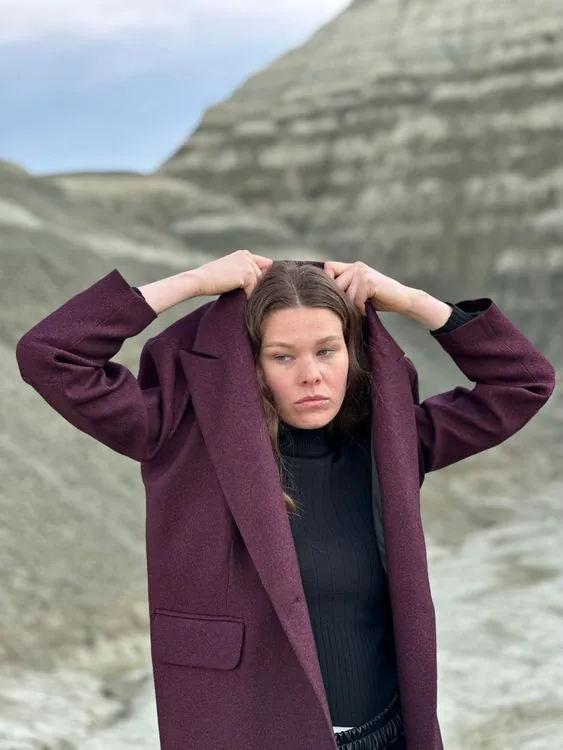
How to wear burgundy: the dark neutral
Start with the coat: a burgundy wool coat is the single easiest way to wear the colour, and everything underneath can be simple. Cream, grey or navy all work under it; black works too, but add a cream scarf or a lighter bag if the whole look feels heavy. Over dark jeans and boots it is a weekend outfit; over tailored trousers and a cream roll-neck, a work outfit.
A burgundy knit is the next easiest entry point: a crew-neck or roll-neck works with dark jeans, grey wool trousers, navy skirts and chocolate trousers. Keep the knit simple — the colour is the statement, so it does not need a pattern as well.
Burgundy also works in smaller pieces: boots add colour to a neutral outfit, and a burgundy bag is the cheapest way to try the colour — a leather tote or cross-body works with a chocolate, camel, grey or navy coat.
For evenings, burgundy comes into its own in velvet and silk: a velvet blazer over black trousers, or a silk blouse under a chocolate tailored jacket, reads dressy without sequins.
How to wear chocolate brown: the new black
Chocolate brown works exactly where black used to work — and in winter, that is almost everywhere. A chocolate wool coat over a cream knit and dark jeans is the everyday version; over grey tailored trousers and a white shirt, a work version. The difference from black is warmth: chocolate softens the edge of an outfit and is gentler next to the face in flat winter light.
Chocolate tailoring is the season’s quietest power move: a chocolate suit, or wide-leg trousers with a matching blazer, works for the office with a cream shirt and dark shoes. Chocolate trousers alone, with a cream knit and a camel or grey coat, give you most of the effect.
Chocolate looks best in leather and suede: boots, a suede jacket or a leather bag all gain depth from texture that flat fabric cannot give. A chocolate leather bag is the most useful accessory in this palette — it goes with burgundy, camel, grey, navy and black coats alike.
Chocolate knits are the softest way in: a cashmere or merino jumper with dark jeans and boots is a complete outfit, and a cardigan over a cream shirt works for days when a coat is too much indoors. Dark wool and cashmere show wear quickly, so read how to care for silk, cashmere, velvet and wool before the season’s first wash — a faded chocolate knit loses the depth that makes the colour work.

How to wear burgundy and chocolate brown together
Yes, burgundy and brown go together — this winter, they are the pairing the runways keep returning to. The two colours are close in depth and warmth, so they sit side by side without clashing. The rule is simple: one piece in each colour, and everything else quiet.
The easiest combinations:
- Burgundy coat + chocolate boots and bag. The coat is the statement; the brown accessories ground it.
- Chocolate coat + burgundy knit. The knit shows at the neck and cuffs, which is enough colour to change the whole outfit.
- Burgundy knit + chocolate trousers. The season’s simplest tonal outfit — add cream or grey shoes and a camel scarf.
What keeps the pairing from looking muddy is contrast: a cream shirt, a camel scarf or light-coloured shoes gives the two dark colours something to sit against. An all-dark outfit can work for an evening, but in daylight it often reads as one dark block — a cream scarf is usually enough.
Outfit formulas: work, casual, evening and weekend
Work: chocolate tailored trousers, a cream shirt, a burgundy blazer, dark leather shoes and a chocolate bag. Or a burgundy knit dress with chocolate knee-high boots and a camel coat.
Casual day: burgundy coat, cream roll-neck, dark straight-leg jeans, chocolate ankle boots. Or a chocolate coat, grey knit, dark jeans and burgundy scarf. Keep the palette to two dark colours plus one light one.
Evening: burgundy velvet blazer, black tailored trousers, a cream silk camisole, dark heels or loafers, and a small chocolate or burgundy bag.
Weekend: chocolate suede jacket, cream T-shirt or knit, dark jeans, burgundy or chocolate boots.
If you are still building the base wardrobe these formulas sit on, the quiet luxury capsule wardrobe is a useful starting point — burgundy and chocolate slot into it as the dark neutrals, replacing black in most outfits. For more cold-weather ideas beyond this palette, see these winter outfit ideas for women.
Accessories: the low-commitment way in
Accessories are the best place to start if you are unsure about either colour. A burgundy or chocolate bag, scarf, belt or pair of boots changes an outfit you already own, costs less than a coat, and tells you quickly whether you like wearing the colour.
- Bags: chocolate leather is the most versatile — it works with every coat colour in this guide. Burgundy leather is the more striking choice, and the better one if your coats are mostly camel, grey or navy.
- Boots: chocolate knee-high boots with a burgundy coat, or burgundy ankle boots with a chocolate coat, are the two pairings to remember.
- Scarves: a cream scarf lightens a dark coat, a burgundy scarf warms a camel coat, and a chocolate scarf deepens a grey coat.
- Belts and gloves: a chocolate belt with dark jeans and a burgundy knit, or burgundy gloves with a chocolate coat, are small touches that make an outfit look considered.

Fabrics and texture: where the colours look richest
Burgundy and chocolate repay good fabric: in wool, cashmere, velvet, suede and leather, both colours have a depth that flat cotton or thin jersey cannot match. That is why the season’s best versions are coats, knits, velvet blazers and suede boots rather than T-shirts.
Texture also solves the “muddy” problem: two dark fabrics with different textures — a burgundy velvet blazer over chocolate wool trousers, or a chocolate suede boot under a burgundy wool coat — read as clearly separate pieces. If an outfit looks flat, change one texture before you change a colour.
Velvet and suede show marks, and dark colours show fading first, so check the care label before you buy — faded burgundy or chocolate looks tired rather than soft.
Common mistakes and how to fix them
- Wearing both colours with nothing light. Burgundy plus chocolate plus black can turn into one dark block. Fix: add cream, camel or grey — a scarf, a shirt or a coat is enough.
- Matching burgundy and chocolate exactly. They are partners, not twins. Fix: let them be different depths; a burgundy coat and a chocolate bag do not need to be the same tone.
- Adding a third strong colour. Burgundy and chocolate plus bright red, green or royal purple is usually too much. Fix: keep the rest neutral and let the two lead colours do the work.
- Wearing the colours in thin, flat fabrics. A thin burgundy top can look washed out, and a flat chocolate fabric can look dull. Fix: choose wool, cashmere, velvet, suede or leather for these colours, and save thin fabrics for the cream and grey layers.
Shopping guidance: what to buy first
You do not need a new wardrobe: most people already own the light neutrals — cream knits, grey trousers, dark jeans, a camel or navy coat — that make burgundy and chocolate work. Start with what you own, then add in this order:
- One lead piece in the colour you like most — a burgundy coat or a chocolate coat. This is the piece that changes the most outfits.
- One knit in the other colour — a burgundy roll-neck with a chocolate coat, or a chocolate jumper with a burgundy coat. This gives you the pairing for the price of a knit.
- Chocolate boots or a chocolate leather bag. Both work with every coat you own, not just the new one.
- A cream knit or a cream scarf if you do not already own one — the light layer that stops dark outfits looking heavy.
Buy the coat in the best quality you can afford — it is the piece everyone sees and the one that has to survive the winter. The knit and accessories can be simpler. If you are working to a budget, build a capsule wardrobe on a budget first and add the burgundy or chocolate piece as the single seasonal update. And how to style a blazer covers the tailored layer in detail.
No prices or availability are promised here, because both change by store and season. Check the colour in daylight before buying — burgundy can look brown and chocolate can look black under shop lighting.
Frequently asked questions
Does burgundy go with brown?
Yes. Burgundy and brown — especially chocolate brown — are one of the easiest pairings of the season, because both are deep, warm and muted. Keep the rest quiet (cream, camel or grey).
What colour goes with a burgundy coat?
Cream, camel, grey, navy and black all work, and chocolate brown is the season’s best partner. A cream knit under a burgundy coat is the simplest combination.
What colour goes with chocolate brown?
Almost everything a black coat goes with: cream, grey, navy, camel and burgundy. Chocolate is softer than black, so it also pairs well with other warm tones like camel and olive.
Can you wear burgundy and chocolate brown together?
Yes — one piece in each colour, with the rest of the outfit neutral. A burgundy coat with chocolate boots, or a burgundy knit with chocolate trousers, are the two easiest versions.
Conclusion
Burgundy and chocolate brown are not difficult colours — they are two dark neutrals that happen to be more interesting than black. Treat burgundy as the statement and chocolate as the base, pair either one with cream, camel, grey or navy, and wear them together with one light layer for contrast. Start with a coat, add a knit in the other colour, and let a chocolate bag or a pair of boots do the rest.