
The Problem Isn’t Your Body — It’s Where Things End
If you are 5’4″ or under, you know this feeling: an outfit that looked lovely on the hanger looks off in the mirror. The top hangs past your hips, the trousers pool over your shoes, the sleeves cover your hands. Nothing is wrong with your body — the clothes were cut for a longer frame.
Tailoring adds up: Pretty Designs, the only guide inspected that priced tailoring, puts hemming at upwards of $25, shortening sleeves at upwards of $40, and taking in a jacket at around $50 on average.
This guide answers a different question: how to dress petite without tailoring, using clothes you already own. Instead of changing the garment, change where it ends — with a tuck, a roll, a belt, a shoe swap, or a different cut next time you shop.

The Quick Answer: Four Moves That Fix Most Outfits
- Shorten the top line. Tuck, half-tuck or French-tuck your top so it ends at your waist or hip bone, not halfway down your thigh.
- Mark the waist. Add a narrow belt — around 1.5 inches wide, per SewGuide — at your natural waist.
- Fix the hem with shoes or a roll. Roll pooling trousers once, cleanly, to the ankle bone, or wear a shoe that lifts the hem off the floor.
- Push the sleeves up. Push sleeves to three-quarter length or roll them once to the wrist bone, so they stop swallowing your hands.
The Rule of Thirds: Your 1/3–2/3 Proportion Guide
The strongest proportion framework in the guides inspected comes from Thirstyle: the rule of thirds. For petite styling, your outfit should read as roughly one-third top and two-thirds bottom — or the other way round — but not half and half.
A top ending at your natural waist with full-length trousers gives that split: a short top section, a long leg line.
Where Tops and Hems Should End
Tops: at your waist or hip bone. A top ending mid-thigh usually needs a tuck or belt.
Jackets and blazers: at the hip bone, or cropped above it. A blazer ending at the hip bone is the safest starting length. For more, see our guide on how to style a blazer.
Sleeves: at the wrist bone. Thirstyle’s shoulder-seam test is a useful check too: the seam should sit within about 2 cm of your shoulder line.
Trouser hems: skimming the shoe, or grazing the ankle. Avoid the “ankle gap trap” — a hem hovering just above the shoe.
Skirt and dress hems: above the knee, or full-length. A midi hitting mid-calf is the riskiest length.

Lengths Cheat-Sheet
| Piece | Length | Works when | Fails when |
|---|---|---|---|
| Trousers | Cropped | Ends at/above the ankle; shoe continues the leg line | Ends mid-calf, leaving bare-leg gap |
| Trousers | 7/8 | Shows a sliver of ankle with a pointed flat | Hovers just above the shoe |
| Trousers | Ankle-length | Hem grazes the ankle; shoe is slim | Bulky shoe or thick strap breaks the line |
| Trousers | Full-length | Hem skims the shoe; trouser is high-rise | Fabric pools, or the rise is low |
| Skirts & dresses | Mini | High waist lengthens the leg | Low waist; one short block |
| Skirts & dresses | Knee-length | Hem at or just above the knee | Hem just below the knee |
| Skirts & dresses | Midi | Column shape, or hem on the thin leg | Hem hits the widest calf |
| Skirts & dresses | Maxi | Full-length column, one colour or soft drape | Heavy fabric or large print overwhelms |
| Coats | Cropped | Ends at the waist; long line underneath | Ends at your widest point |
| Coats | Hip-length | Ends at the hip bone; worn open | Boxy and closed, hiding the waist |
| Coats | Knee-length | Single-breasted; hem at or above the knee | Double-breasted and bulky |

The No-Tailor Fit-Fix Toolkit
French tuck: tuck in just the front centre of your top, leaving the sides loose.
Half-tuck: tuck one side in, leave the other out.
Full tuck: tuck the whole top in. Best for crisp shirts with high-rise trousers or skirts.
One clean roll: roll a too-long trouser hem up once, evenly, to the ankle bone. The Elle Diaries recommends a single clean roll: one neat roll looks deliberate, several small folds look like you gave up.
Sleeve push: push sleeves to three-quarter length, or roll once to the wrist bone.
Narrow belt: add a belt around 1.5 inches wide at your natural waist.
Shoe-colour continuity: wear shoes close in colour to your trousers, tights or skin tone
Swap the cut, not the tailor: some garments cannot be styled into fitting. If the shoulder seam sits more than about 2 cm past your shoulder, or a dress waist sits at your hips, the piece is the wrong cut. Apparel Search notes honestly that hemming is cheap, but raising a waist, shortening a torso or moving pockets often costs more than the garment itself.
Shoes and the Hemline
Pointed-toe flats are the most useful petite shoe. SewGuide’s advice of “anything but flats” is contradicted by Thirstyle, The Elle Diaries and Updoria, all of which recommend pointed flats.
Heels are a choice, not a rule. One source suggests 2–3 inches as “ideal” — a suggestion, not a rule.
Boots work best under the hem, not against it. A hem skimming the boot top is clean; one ending just above it leaves a gap.
Trainers and chunky shoes need a hem that clears them. An ankle-grazing trouser with a slim trainer looks deliberate.
Different Petite Proportions: Resolving the Contradictions
Short torso, longer legs. Your waist sits high and tops always seem too long. Thirstyle notes that for short-waisted women, especially with a larger bust, a mid-rise under 9 inches can work better than a very high rise, and rises over 10.5 inches can shorten the torso further.
Short legs, longer torso. Your legs need the lengthening. High-rise trousers and full-length hems skimming the shoe give the longest line.
Large bust, petite frame. Choose tops with a defined waist, not boxy cuts, and try a mid-rise under 9 inches.
Under 5 ft. The same fixes apply, but the margins are tighter — a shoulder seam more than 2 cm past your shoulder shows more, and a full-length trouser must skim the shoe exactly.
Petite and curvy. Petite does not mean skinny, and guides that assume it are wrong.
Fabric and Layering
Soft, drapey fabrics — chiffon, rayon, silk and fine knits — fall close to the body and follow your line.
Bulky textures and oversized prints do the opposite. A heavy tweed, thick cable knit or very large print can wear you rather than the other way round.
Layering needs the same discipline. Keep one layer short and one long — two layers ending mid-thigh create a block.
Column dressing is the simplest layering trick: wear one colour, or close tones, from top to bottom. For ideas, our quiet luxury outfits post shows the same principle in action.
Five Outfit Formulas (Each With a No-Tailor Fit Check)
Five formulas built on the 1/3–2/3 rule. The examples are hypothetical illustrations, not reports of real outfits worn or tested.
Formula 1: Cropped top + high-rise full-length trouser. A short top ending at the waist, with high-rise trousers skimming the shoe. Fit check: the top ends at your waist, and the hem just touches the shoe.
Formula 2: Tucked blouse + 7/8 trouser + pointed flat. A blouse French-tucked at the front, 7/8 trousers showing a sliver of ankle, pointed-toe flats extending the leg line. Fit check: the ankle gap is a sliver, not a wide band.
Formula 3: Column dress + belted layer. A full-length column dress in one colour, a narrow belt at the waist, and a hip-length jacket or cardigan left open over it. Fit check: the belt sits at your natural waist, and the jacket ends at the hip bone so the dress shows below it.
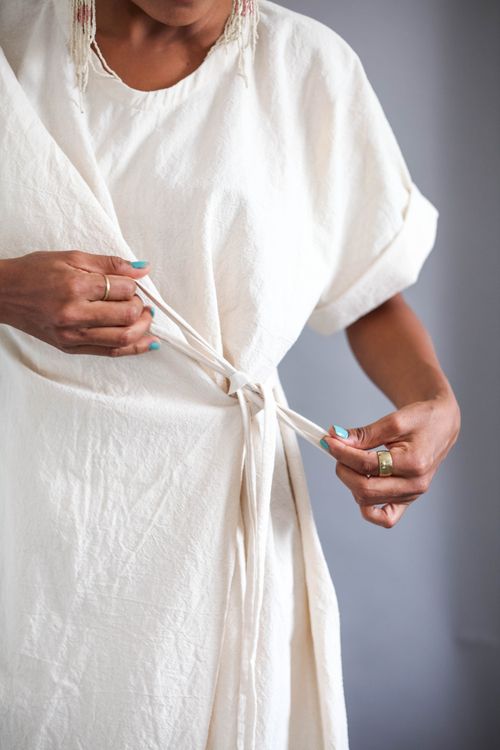
Formula 4: Fitted top + wide-leg trousers + pointed shoe. A fitted top tucked into high-rise wide-leg trousers, with a pointed flat or small heel. Pretty Designs and SewGuide warn against this — but Thirstyle and The Elle Diaries recommend wide-leg trousers with conditions, and the conditions are the point. Fit check: high-rise, fitted tucked top, hem skimming the shoe without pooling.
Formula 5: Mini dress + high waist + tonal shoe. A mini dress with a defined high waist, with shoes close in colour to your skin tone or tights. Fit check: the waist sits at your natural waist, and the shoe continues the leg line.
Common Mistakes and Fixes
Half-tucked and half-hanging. Commit to one line: tuck the top properly, or leave it fully out with a belt.
Hem at the widest part of the calf. Roll the hem to the ankle, or pick a shoe that covers the gap.
All one length. A top, jacket and skirt all ending at the same point create a horizontal block.
The belt doing the wrong job. A wide belt on a short torso, or a belt at the hips when the waist needs marking, makes things worse. Use a narrow belt, around 1.5 inches, at your natural waist.
Buying petite everything. Petite sizes help, but they are not the only answer, and they are not always available or affordable. For a small, versatile set of pieces, see our guide to a capsule wardrobe on a budget.
Hem Is Wrong — What Now?
- Can a shoe fix it? Try a small heel or platform to lift the hem off the floor, or a boot that meets the hem.
- Can a roll fix it? Roll the hem once, cleanly, to the ankle bone. If one roll looks neat, you are done.
- Can a tuck or belt fix it? If the outfit looks bottom-heavy because the top is too long, tuck it or add a belt.
- Can you change the length by changing the piece? Swap the trousers for a 7/8 pair, or the midi skirt for a knee-length one.
- Is it a swap-the-cut piece? If the shoulder seam is more than 2 cm past your shoulder, or the rise is so wrong no tuck or belt rescues it, the piece is the wrong cut.
Shopping Without Tailoring: What to Look For
Check the rise before you buy. Short torso or large bust? Try a mid-rise under 9 inches as well as a high-rise, and notice which leaves your torso room. For work trousers, Apparel Search gives a concrete figure: a work-trouser inseam of 27–29 inches is a useful starting point for petite frames.
Check the shoulder seam in the shop. Within about 2 cm of your shoulder line is fine.
Buy co-ords and sets. A matching set gives you column dressing without effort.
Choose the cut, not the size. If a regular-size piece needs more than a tuck or a roll, try the same style in a different cut — a shorter jacket, a higher rise, a straight leg instead of wide — before trying a different size.
On brands: the research inspected did not verify specific affordable petite clothing brands or their current ranges, so no brand recommendations are made here. See our work outfits, winter outfits and look expensive on a budget posts for next steps.
Frequently Asked Questions
How can I dress petite without tailoring?
Change where clothes end instead of changing the clothes: tuck tops to your waist, roll hems once to the ankle bone, push sleeves to the wrist, add a narrow belt to mark your waist, and choose shoes that continue your leg line.
What is the petite fashion rule of thirds?
An outfit looks most balanced dividing roughly one-third to two-thirds, not half and half. A top ending at your waist with full-length trousers gives a short top section and a long leg line
What is the best hem length for petite women for trousers and skirts?
For trousers, a hem skimming the shoe or grazing the ankle bone. For skirts, above the knee or full-length; avoid hems at the widest part of the calf.
Are cropped or full-length trousers better for petite women?
Full-length trousers skimming the shoe give the longest leg line, suiting short legs. Cropped trousers ending at the ankle bone with a pointed flat suit longer legs.
High-waisted or mid-rise for a petite woman with a short torso and large bust?
Try both. Thirstyle’s numbers for this shape: a mid-rise under 9 inches can work better than a very high rise, and rises over 10.5 inches can shorten the torso further.
Can petite women wear wide-leg trousers without looking swamped?
Yes, with three conditions: high-rise trousers, a fitted top tucked in, and a hem skimming the shoe without pooling.
Do petite outfits need heels?
No. Pointed-toe flats extend the leg line without any heel, and several inspected guides recommend them. One source suggests a 2–3 inch heel as an “ideal” height, but that is a suggestion, not a rule.
Conclusion
Petite styling without tailoring is not about buying a new wardrobe or paying someone to rebuild the one you have. It is about knowing where things should end — top at the waist, sleeve at the wrist, hem skimming the shoe or grazing the ankle — and having a few free fixes ready when they do not: a tuck, a roll, a belt, a shoe swap, or a different cut.



Pingback: How to Style Knee-High Boots in Winter (2026-27 Guide)