
If you have a slim frame, you know the frustration: a shirt that fits your shoulders billows at the waist, trousers that fit your waist are too short, and a jacket slides off your shoulders. Nothing is wrong with your body — most off-the-rack clothes are cut for a wider midsection, so a slim build falls between sizes.
This guide is about fit that follows your frame, layers that add shape without bulk, and textures that give an outfit interest — for women and men alike, and not about looking bigger or thinner.

The quick answer: fit first, then texture, then layers
Buy for your shoulders and your narrowest point, then tailor the rest — a good tailor costs less than a wardrobe of almost-right clothes. Choose fabrics with weight and texture, such as knitwear, tweed and denim, because thin, clingy fabrics show every line underneath. Build outfits in layers — base, mid-layer, outer layer — so you can add shape where you want it.
Fit first: the part no trend can fix
Shoulders are the one fit point you cannot fake. On jackets, blazers and coats, the shoulder seam should sit at the edge of your own shoulder — not drooping down your arm, not pulling inward. This is the hardest thing to alter, so if a jacket fits in the shoulders, a tailor can usually fix the waist and sleeves. If it does not fit in the shoulders, put it back. A natural, lightly padded shoulder usually looks better than heavy padding, which can overwhelm a slim frame.
The waist: take it in, don’t size down. The most common slim-frame problem is a garment that fits the shoulders but billows at the waist. The fix is not a smaller size — that usually makes the shoulders too tight — but having the waist taken in. A shirt should follow your torso without pulling or ballooning, and a blazer should close without gaping. A belt, a wrap top, a cropped jacket or a half-tuck can define the waist just as well.
Length matters too. Sleeves should end at the wrist bone. Trousers should break once at the shoe, or sit just above it — a pooling hem swallows a slim leg.
What pants look best on slim builds
Straight-leg and tapered trousers are the safest choices for women and men: they follow the leg without clinging. Slim-straight jeans, chinos and wool trousers all work, as long as the waist fits and the leg is not skin-tight.
Are skinny jeans bad for skinny men? Not automatically — but very tight jeans on a very slim leg can look uncomfortable and leave the rest of the outfit nothing to balance against. A slim-straight cut usually looks better, is more comfortable, and pairs more easily with bulkier shoes and layered tops. The same applies to women: a skinny jean can work with an oversized knit, but a straight leg is the more reliable everyday choice.
How to buy a suit as a short or skinny man — and as a slim woman
Start with the jacket shoulders, then check that the jacket covers your seat and ends around mid-hip. A single-breasted, two-button jacket is the most versatile choice; double-breasted styles add width across the chest, so try them on.
For a short or slim man, look for a “short” length if you are under about 5’8″ (173 cm), and choose a slim or tailored cut rather than a regular one. For a slim woman, the same rules apply: shoulders first, waist second. A cropped blazer over high-waisted trousers often fits better than a long, boxy jacket. If a suit does not exist in your size, buy separates — a blazer and trousers in the same fabric, fitted individually.
Layering: the 3-layer build
Layering adds visual weight exactly where you want it — and you can take a layer off when you get warm.
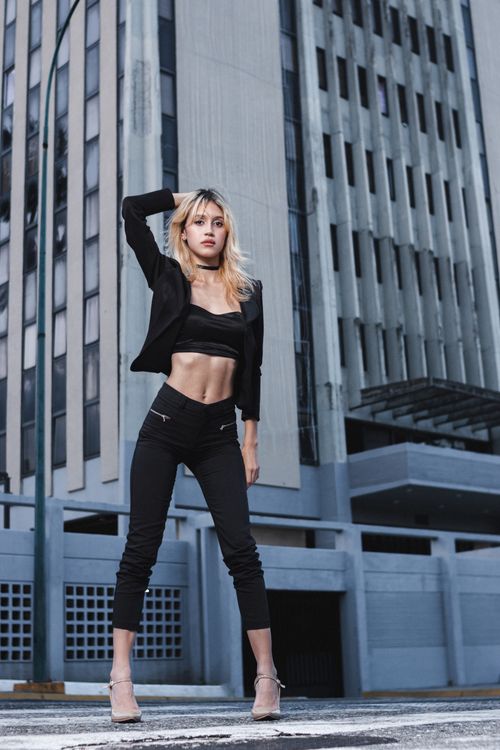
Layer 1, the base: a fitted T-shirt, camisole, fine-knit top or slim shirt, sitting close without clinging. Neutral bases are easiest.
Layer 2, the mid-layer: this is where the shape comes from — a chunky knit jumper, a cardigan, a flannel shirt or a waistcoat. A cable knit or waffle texture adds more interest than a flat, thin layer; a cropped cardigan adds shape at the waist, and a crew-neck jumper over a collared shirt does the same at the neck and shoulders.
Layer 3, the outer layer: a blazer, denim jacket, leather jacket, trench or wool coat. It should hold its shape — a floppy coat collapses onto a slim frame, while a defined shoulder and a belt or buttoned waist give the outfit a frame.
Warm-weather layering: three layers are too many in heat — use texture in a single layer instead, such as a linen shirt, a poplin shirt with rolled sleeves or a knitted polo. A lightweight overshirt worn open over a T-shirt still breathes, and a linen blazer gives structure without the weight of wool.
Fabric: what adds shape and what disappears
Thin, flimsy fabrics cling to a slim frame and show every line; fabrics with weight and texture hold their own shape and give an outfit substance.
| Fabric | Weight | Effect on a slim frame | Best for |
|---|---|---|---|
| Chunky knit / wool | Heavy, textured | Adds visual weight and warmth | Jumpers, cardigans, scarves |
| Tweed / boucle | Heavy, nubby | Adds texture and body | Blazers, coats, skirts |
| Corduroy | Medium-heavy, ribbed | Adds depth without bulk | Trousers, jackets, shirts |
| Denim | Medium-heavy, stiff | Holds its shape | Jeans, jackets, shirts |
| Heavy cotton / poplin | Medium, crisp | Clean lines; holds a collar | Shirts, summer blazers |
| Fine jersey / viscose | Light, clingy | Shows every line; shapeless alone | Base layers only |
Build outfits around the top half of this table, and use the bottom half for base layers and accents.
Relaxed vs structured tailoring
Should skinny guys wear oversized clothes? The same question applies to women. Oversized can work — but only deliberately, and only in one piece at a time.
Structured tailoring — a fitted blazer, a tailored coat, a sharp shirt — gives a slim frame a clear outline, and is the safest route for work and evenings. If you are learning how to style a blazer, start here: a blazer that fits in the shoulders and is shaped at the waist is the most useful piece in a slim wardrobe.
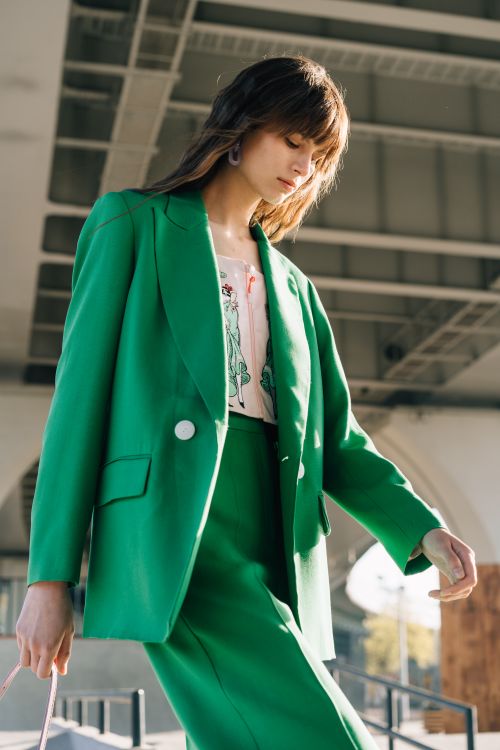
Relaxed tailoring — a slightly oversized blazer, a boxy shirt, wide-leg trousers — can look modern and confident, but only when the rest of the outfit is fitted: an oversized blazer over slim trousers works, but over wide trousers and a baggy T-shirt it looks like the clothes are wearing you. One relaxed piece, the rest fitted.
Stripes: the contradiction, resolved
Other guides disagree about stripes: some say horizontal stripes add width and are ideal; others say avoid them altogether. Both are partly right — the answer is about scale and contrast, not stripes yes or no.
Horizontal stripes can add visual width, but only when they are bold enough to read: wide, high-contrast stripes on a Breton top or a rugby shirt do this well, while very thin pinstripes barely register. Vertical stripes lengthen the frame, which can help shorter wearers. The rule: choose stripes you can see from a few steps away — medium to wide for most people — and wear them as one piece, not head to toe.
Proportions: tall and skinny, and short and skinny
How to dress if you are tall and skinny: the risk is looking like one long line. Break it up with a belt, a colour change between top and bottom, a hip-length jacket and horizontal details such as a striped top. Avoid very long coats. Cuffed trousers and a shoe with some presence — a boot or a chunky trainer — ground the outfit.
How to dress if you are short and skinny: the risk is the opposite — clothes can swallow you. Keep proportions neat: a cropped jacket, a tucked-in top, trousers hemmed to the right length, and shoes in a similar tone to your trousers to lengthen the leg. A tonal outfit and a V-neck can add length. Avoid oversized pieces, and be wary of wide-leg trousers unless the waist is defined and the hem is right.
Shoes: grounding the outfit
A very slim, delicate shoe can make the whole outfit look fragile, while a shoe with some weight balances the leg. Boots, loafers, chunky trainers, block heels and structured flats all work well. For men, a boot or a thicker-soled leather shoe usually looks better than a very narrow, pointed one; for women, a block heel or a pointed flat gives more presence than a thin stiletto. Match the shoe’s visual weight to the outfit: a chunky knit and a denim jacket want a boot; a silk blouse and tailored trousers want a sleeker shoe.
Outfit formulas: work, casual, evening and warm weather
Formulas are starting points, not rules.
Work, women: high-waisted straight-leg trousers, a fitted blouse tucked in, a structured blazer, block heels or loafers, a belt and a structured bag. See these old money work outfits.
Work, men: tapered wool trousers, a poplin shirt, a single-breasted blazer, leather shoes. A tie is optional; in winter, add a fine-knit jumper under the blazer instead.

Casual, women: slim-straight jeans, a fitted T-shirt or camisole, a chunky cardigan or denim jacket, trainers or ankle boots.
Casual, men: straight-leg jeans or chinos, a crew-neck T-shirt, an open flannel or overshirt, boots or chunky trainers — the classic answer to what should skinny men wear day to day. Keep the palette to two or three colours: outfit ideas that look polished without a big budget.
Evening, women: a slip dress or tailored jumpsuit with a defined waist, a cropped blazer, heeled shoes, plus one bolder accessory.
Evening, men: dark tapered trousers or dark straight jeans, a fitted shirt with the top button undone, a blazer, leather shoes or smart boots. A textured blazer adds interest.
Warm weather, women: a linen shirt or knitted polo, high-waisted shorts or a midi skirt, sandals or espadrilles.
Warm weather, men: a short-sleeve poplin or linen shirt, straight-leg chinos or shorts, loafers or clean trainers. Roll the sleeves once.
See these quiet luxury outfits for clean, well-fitted neutrals.
Common mistakes and how to fix them
- Buying a size up for comfort. It adds bulk where you do not want it. Fix: buy for the shoulders, tailor the waist.
- Wearing everything oversized at once. One relaxed piece is a style choice; three is a tent. Fix: pair one oversized piece with fitted pieces.
- Hiding in all black. An all-black, all-thin outfit can look flat. Fix: add one texture or one contrasting colour.
- Ignoring the tailor. Most slim-frame fit problems are a short alteration, not a new wardrobe. Fix: take in waists, shorten sleeves, hem trousers.
Shopping guidance
You do not need a new wardrobe. Start with what you own and check each piece against the fit points above: shoulders, waist, length. Keep what fits or can be tailored, and let go of what cannot be fixed. When you do buy, prioritise a few well-fitting staples over many almost-right ones — the investment pieces worth buying are a good place to start. Look for slim or tailored cuts, short lengths and a range of inseams, and compare the shoulder fit, not just the waist. Check the fabric before you buy: hold it up and ask whether it will hold its shape or collapse. In winter, layering is cheaper than a new coat — see these winter outfit ideas for women. No prices or availability are promised here, because both change by store and season.
Frequently asked questions
What should skinny men wear?
Straight or tapered trousers, a fitted T-shirt or shirt, and one textured layer — a knit jumper, an overshirt or a blazer. Fit at the shoulders and waist matters most.
Should skinny guys wear oversized clothes?
Yes, but only one oversized piece at a time, with the rest fitted. An oversized blazer over slim trousers works; oversized everything looks like the clothes are wearing you.
How to dress if you are tall and skinny?
Break up the long line with a belt, a colour change between top and bottom, a hip-length jacket and horizontal details such as stripes. Avoid very long coats.
How to dress if you are short and skinny?
Keep proportions neat: a cropped jacket, a tucked-in top, trousers hemmed to the right length, and shoes in a similar tone to your trousers. Tonal outfits and a V-neck can add length.
How to dress a slim frame women?
The same principles apply: fit at the shoulders and waist, fabrics with texture, and layering. Try a structured blazer, high-waisted straight-leg trousers or a chunky knit over a fitted base.
Conclusion
Dressing a slim frame is not about fixing your body or pretending it is something else. It is about fit — shoulders first, waist second — about fabrics that hold their shape, and about layers that add structure where you want it. Start with one outfit formula from this guide, wear it, adjust it, and build from there. A wardrobe that fits is not a luxury; it is the whole point.