

A favourite sweater covered in bobbles looks ten years older than it is. The good news is that pilling is not damage and not permanent: the bobbles can be removed, and with a few changes to how you wash and wear your knits, they come back far more slowly. This guide explains how to remove pilling from sweaters safely — which tool to use, what to avoid, and how to stop pilling coming back.
The short version: use a fabric shaver or a sweater comb on a flat, dry sweater, in short, gentle passes; never pull pills off by hand. Then wash knits inside out on a cold, gentle cycle, and rest each sweater between wears.
How to remove pilling from sweaters: shaver, comb, or razor?
The best tool for most people is an electric fabric shaver: fast, effective on most knits, and hard to damage fabric with if you keep it flat and move slowly. A manual sweater comb is the gentlest option and the best for delicate knits like cashmere, but it is slow on a badly pilled sweater. A disposable razor can work in a pinch, but it is the riskiest method — it is easy to nick the fabric — so it is the last resort. Whichever tool you use, the rules are the same: lay the sweater flat, keep the fabric taut, work in short passes, and stop to empty the tool often.
What is pilling, and why do sweaters pill?
Pilling is the formation of small balls of fibre — bobbles — on the surface of a fabric. Loose fibres work their way out of the yarn, and friction (from wearing, a bag strap, the inside of a coat) rolls them into small bundles, anchored by fibres that have not broken. The textile industry divides pilling into four stages: fuzz formation, entanglement, growth, and wear-off.
Pilling happens where a garment receives the most abrasion: the cuffs, the collar, under the arms, and anywhere a bag strap rubs. It is not a sign of poor quality on its own — almost all knits pill to some extent, and even expensive sweaters pill in their first season. What differs is how long pilling lasts: wool pilling tends to diminish over time, as weaker fibres work free and break away, while pilling on synthetics persists, because the stronger fibres hold on to the pills.
Which fabrics pill most — and which pill least
| Fabric | Pilling tendency | What to expect |
|---|---|---|
| Wool | Moderate, improves with wear | Pills early, then settles as loose fibres shed |
| Cashmere | Moderate | Pills where it rubs; needs the gentlest tools |
| Cotton | Moderate | Pills, especially in blends with polyester |
| Acrylic | High, persistent | Pills heavily and the pills stay put |
| Polyester | High, persistent | Strong fibres hold pills in place |
| Polyester blends | Highest | Weaker fibre breaks, stronger fibre holds the pill |
| Silk and linen | Low | Smooth, long fibres pill far less |
Two things predict pilling: fibre length and knit tightness. Longer fibres pill less than short ones, because there are fewer fibre ends and it is harder for them to work out of the cloth. Knitted fabrics pill more than woven fabrics, because the yarn crossings are further apart — for the same reason, a tightly knitted sweater pills less than a loosely knitted one. When shopping, that is worth knowing: a dense, tightly knitted sweater will usually outlast a loose, fluffy one, even at the same price.
Method 1: the electric fabric shaver (fastest)
An electric fabric shaver is a small device with a rotating blade behind a perforated metal head. It is the best tool for most sweaters: it removes pills quickly and evenly, and the guarded blade cannot easily cut the fabric.
Lay the sweater flat on a hard surface — a table, not a bed. Turn the shaver on and move it across the pilled area in short, straight passes, with light pressure. Do not press hard: pressure pushes the blade into the fabric and can thin it. Work one area at a time, and empty the pill container when it fills up — a full shaver stops cutting cleanly. When you finish, shake the sweater out and check it in good light: pills hide in the folds and under the arms.
A shaver works on wool, cotton, acrylic and blends, and on most knit weights. Use it with extra care on very fine or loosely knitted sweaters: if the knit is open enough to catch in the shaver head, switch to a manual comb instead. Never use a shaver on a wet or damp sweater — the fabric stretches and the blade can catch.
Method 2: the sweater comb (gentlest)
A sweater comb is a small, fine-toothed comb that lifts pills off knitwear. It is the gentlest method, and the best choice for delicate knits — cashmere, fine merino, and loosely knitted sweaters a shaver might catch.
Lay the sweater flat and hold the fabric taut. Draw the comb across the pilled area in short, even strokes, always in the same direction, and clear the comb often. It is slower than a shaver — a badly pilled sweater can take fifteen minutes or more — but it gives you complete control, and it is almost impossible to damage fabric. Without a sweater comb, a fine-toothed hair comb can work on a sturdy knit, but not on delicate fibres — the teeth are usually too sharp and too widely spaced. A dedicated sweater comb costs little and lasts for years, so it is worth having alongside a shaver.
Method 3: a razor (last resort)
A disposable razor can remove pills, and it is the method most people try first because the razor is already in the bathroom. It works, but it is the riskiest of the three: the unguarded blade can nick the yarn, thin the fabric, or cut a hole — especially on fine or loosely knitted sweaters.
If you use a razor, lay the sweater flat, pull the fabric taut, and use a clean, sharp razor with almost no pressure, in short strokes in one direction. Keep the blade flat against the fabric — never angle it into the knit — and stop the moment you feel resistance. Never use a razor on cashmere, fine merino, or any sweater you would be upset to lose; for those, use a comb. And never use a razor on a sweater while you are wearing it.
What not to do when removing pilling
- Do not pull pills off by hand. Pulling a pill tugs the fibres that anchor it — and those fibres are part of the sweater — which can thin the fabric and, over time, create a hole.
- Do not use sticky tape or a lint roller. Tape lifts loose fluff but does not remove anchored pills.
- Do not use a pumice stone or a rough sponge. Both are too abrasive and will rough up the surface, causing more pilling.
- Do not de-pill a wet sweater. Wet fibres stretch and break more easily, and a shaver or razor can catch and tear damp fabric. Always work on a dry sweater, laid flat.
- Do not press hard with any tool. Pressure is what damages fabric. Light, repeated passes remove pills; hard pressure thins the knit.
How to stop pilling coming back
Removing pills is only half the job — the other half is reducing the friction that causes them. Most pilling comes from three things: friction while wearing, friction in the wash, and friction in storage.
Reduce friction while wearing. Bag straps are the biggest culprit: a shoulder bag rubbing the same spot will pill a sweater in a single day. Carry a handbag in your hand or on your elbow on days you wear a favourite knit, or wear a coat over the sweater so the strap rubs the coat instead. The same applies to seatbelts — anything that rubs the same spot repeatedly will pill it.
Wash less, and wash gently. Turn knits inside out, use a cold, gentle cycle, and put the sweater in a mesh laundry bag so it does not rub against zips and buttons. Use a gentle detergent, skip fabric softener (it coats the fibres), and never wash a knit with rough fabrics like denim or towels. Wash knits only when they need it — airing between wears is often enough.
Rest your sweaters. Knits need a day off between wears. Wearing the same sweater three days running pills it far faster than wearing it once a week. Rotating two or three sweaters through the week is one of the simplest ways to keep them looking good. More ideas: winter outfit ideas for women.
Which sweaters are worth saving — and when to let go
Not every pilled sweater deserves twenty minutes with a shaver. The ones worth saving are the ones you actually wear: a good-quality knit in a colour and shape you reach for, a classic style that works with your quiet luxury outfits, or a sweater that was an investment piece worth buying. If it still fits well and the fabric is in good condition apart from the pills, de-pill it — it will look close to new. A well-kept knit is a quiet luxury capsule wardrobe staple.
Let go of a sweater when the fabric itself is worn through: if the pills have been pulled off repeatedly and the knit is thin, if there are holes, or if the shape has stretched beyond recovery. A thinned sweater will pill again within a day or two, because there is not enough fibre left to hold the knit together. In that case, retire it — and remember, when you replace it, that a tightly knitted sweater in a longer fibre will pill less.
Washing and storing knits so they pill less
Check the care label before washing — the symbols on it are standardised by GINETEX, the International Association for Textile Care Labelling, so the same symbols mean the same thing on every garment. Wash knits cold and gently, inside out, in a mesh bag. Dry them flat, not hung: hanging stretches a wet knit and distorts the shape, and a distorted knit pills more.
Store knits folded, not on hangers — hangers stretch the shoulders, and a stretched shoulder pills where it rubs against a coat.
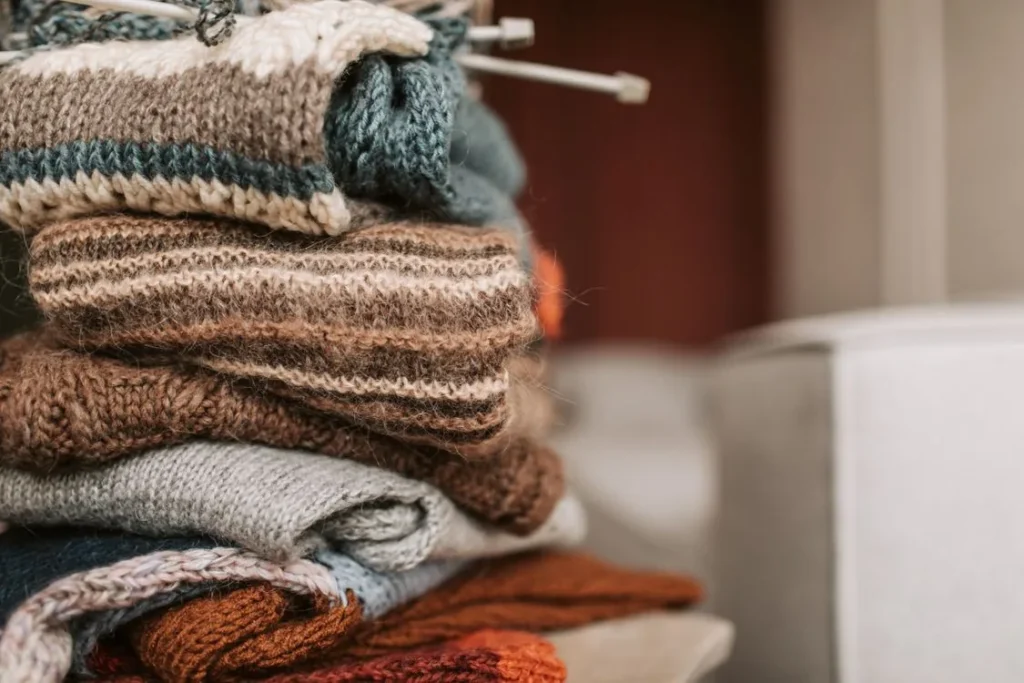
Folded in a drawer or on a shelf, knits keep their shape and pill less. If you store knits for the summer, wash them first — moths are attracted to body oils and food stains — and keep them in a closed container or a sealed bag.
The care advice in how to care for silk, cashmere, velvet and wool covers the same fibres in more detail — worth reading if you own cashmere or fine wool.
Common mistakes and how to fix them
- Pulling pills off by hand. It thins the fabric and can cause holes. Fix: use a shaver or a comb.
- De-pilling a wet sweater. Wet fibres stretch and tear. Fix: always work on a dry sweater, laid flat.
- Pressing too hard with the shaver. Pressure thins the knit. Fix: light, repeated passes — let the tool do the work.
- Washing knits with jeans and towels. Rough fabrics rub knits and cause pilling. Fix: wash knits separately, inside out, in a mesh bag.
- Wearing the same sweater every day. No rest means the fibres never recover. Fix: rotate two or three knits through the week.
Frequently asked questions
Why does my sweater pill so much?
Because of friction and fibre: short fibres, loose knits and synthetic blends pill most, and friction from bag straps and washing makes it worse. Pilling is normal on knits — even good ones pill in their first season — but a tightly knitted sweater in a longer fibre will pill less than a loose, fluffy one.
Can you remove pilling from a cashmere sweater?
Yes, but gently: use a sweater comb, not a shaver or a razor, and work in short, light strokes on a flat, dry sweater. Cashmere pills where it rubs — under the arms, at the cuffs — and a comb removes the pills without risking the fibres. Never pull pills off cashmere by hand.
How often should I de-pill a sweater?
As often as it needs it — for a sweater you wear weekly, that is usually every few weeks in winter. A quick pass with a shaver takes five minutes and keeps the sweater looking new. If it needs de-pilling after every wear, the fabric is probably worn thin, and it may be time to retire it.
Can pilling be prevented completely?
No — all knits pill to some extent, because pilling is a normal result of wearing and washing. But it can be reduced a lot: buy tightly knitted sweaters in longer fibres, wash gently and inside out, rest your knits, and keep bag straps off them.
Conclusion
Pilling is not a sign that a sweater is finished — it is a normal part of wearing knits, and it is fixable. A fabric shaver for everyday knits, a comb for delicate ones, and a few changes to washing and wearing keep your sweaters looking good for years. The best sweater care is simple: wash gently, rest your knits, fold them, and de-pill them early.