

Tights are the reason skirts and dresses survive the winter: without them, a skirt outfit ends in November; with the right pair, it works through January. The trouble is choosing: denier numbers, fleece linings, opaque versus sheer. Learning how to choose tights for winter comes down to three decisions — how thick, how warm, and what colour.
The short version: for everyday winter, buy opaque tights of 40 denier and above in black; for the coldest days, buy fleece-lined tights; keep one sheer pair for evenings and parties.
How to choose tights for winter: match the denier to the day
Denier is the thickness of the yarn, and it decides both how the tights look and how warm they are: low denier (10–20) is sheer and barely-there; mid denier (30–40) is semi-opaque; high denier (50 and above) is opaque and much warmer. For winter days outdoors, 40 denier is the minimum that feels warm, 60–80 is the comfortable everyday range, and 100-plus or fleece-lined is for the coldest.
The other quick rule: match the tights to the outfit’s weight. A heavy wool skirt needs opaque tights; a light dress with sheer tights looks unbalanced in January. And match the tights to the shoes — black tights with black boots reads as one continuous line.

What is denier, and why does it matter?
Denier measures the thickness of the yarn tights are knitted from: the higher the number, the thicker and more opaque the yarn. It is the most useful number on the packet, because it predicts both warmth and appearance. A 10-denier pair is almost transparent; a 100-denier pair is solid black and feels like a second layer of clothing.
Denier is not a warmth rating, exactly — warmth also depends on the fibre and the lining — but thicker yarn traps more air and feels warmer, so denier is a reliable guide. It also predicts durability: very sheer tights snag easily, while opaque tights are far harder to ladder. If you are tired of tights that rip on the first wear, moving up in denier is the simplest fix.
Tights are a close-fitting leg covering that runs from waist to toe, usually knitted from nylon with elastane for stretch. Pantyhose is the sheer version of the same garment — but in winter the difference matters, because sheer pantyhose and opaque tights are built for different weather.
The denier table: what to buy for which day
| Denier | Look | Warmth | Best for |
|---|---|---|---|
| 8–15 | Sheer, barely there | Very little | Evenings, parties, mild days |
| 20–30 | Semi-sheer | Light | Smart days, early winter |
| 40–50 | Semi-opaque to opaque | Good | Everyday winter, work |
| 60–80 | Opaque | Warm | Cold days, outdoor walking |
| 100+ | Fully opaque, thick | Very warm | Deep winter, long days outside |
| Fleece-lined | Opaque, soft inside | Warmest | Coldest days, snow, wind |
For most readers, three pairs cover the winter: one 40-denier black pair for everyday, one 80-denier black pair for cold days, and one fleece-lined pair for the worst weather. Add a sheer pair only if you go to evening events. Three good pairs beat ten cheap ones that ladder, sag or go grey after two washes.
Opaque tights: the winter default
Opaque tights — 50 denier and above — are the pair for most winter days. They are warm, they ladder less easily than sheer tights, and they simplify every outfit, because a solid black leg goes with every skirt, dress and boot you own.
Black is the default for a reason: it reads as a continuous line with black boots, suits every skirt colour, and does not show marks the way lighter colours do. Navy suits navy and grey outfits; brown suits camel, chocolate and burgundy. But if you are buying your first winter pair, buy black — it is the one you will wear most.
Opaque tights also solve the “summer dress in winter” problem: a light dress becomes a winter outfit with opaque tights, a knit and boots. The tights do the warming, and the dress keeps the outfit from feeling heavy — the cheapest way to extend a wardrobe. See these winter outfit ideas for women.

Fleece-lined tights: for the coldest days
Fleece-lined tights have a soft, brushed lining inside — thin fleece or microfibre — that traps warm air against the skin. They look like ordinary opaque tights from the outside, and they are the warmest option in this guide. On a freezing day, they are the difference between wearing a skirt and not wearing one.
There are two kinds. Standard fleece-lined tights have a thin fleece layer and look like normal opaque tights; they suit everyday winter wear. Sheer-look fleece-lined tights have a skin-coloured fleece lining under a sheer black outer layer, so they look sheer but feel thick — useful for evenings when you want the sheer look without the cold.
Fleece-lined tights are bulkier than ordinary tights, so they suit boots and heavier skirts better than delicate shoes. They can feel warm indoors — for a day mostly in a heated office, ordinary opaque tights may be better; for a day mostly outdoors, fleece-lined are. Buy one pair first and test them on your coldest day before buying more.
Sheer and semi-sheer tights in winter
Sheer tights still have a place in winter: evenings, parties, and days when the outfit is dressy. A sheer black tight with a cocktail dress and heels is the classic evening leg, and it works as long as the journey is short and the venue is warm. The trick is the shoes: closed-toe shoes in a similar depth of colour keep the leg line unbroken.
Semi-sheer tights (20–30 denier) are the middle ground: dressier than opaque tights and warmer than sheer ones. They suit smart work outfits and daytime events, especially with a knee-length skirt and heeled boots. They ladder more easily than opaque tights, so carry a spare pair if the day matters.
One rule for sheer tights in winter: keep them for outfits that are already dressy. Sheer tights with a heavy wool skirt and chunky boots looks unbalanced — match the weight of the tights to the weight of the outfit, and the outfit will look deliberate.
Colours and patterns: beyond black
Black is the default, but not the only option. Navy suits navy, grey and burgundy outfits; brown suits camel, chocolate and cream; burgundy adds colour to a neutral outfit and suits black, grey and navy skirts. Coloured tights work best when the rest of the outfit is quiet — one colour on the legs, neutrals everywhere else.
Patterned tights — hearts, dots, herringbone, argyle — are the fun option, and the rule is one pattern per outfit. With a plain skirt, a plain knit and plain boots they look intentional; with a patterned skirt they look busy. Keep the pattern small if unsure: small dots and fine herringbone read as texture, while large patterns dominate the outfit.
Grey tights deserve a mention as the most useful non-black colour: charcoal works with black, navy, grey and burgundy, and softens the leg line in a way black does not. If you want a second colour after black, buy charcoal.

Outfit formulas: work, casual and evening
Work: a wool midi skirt in grey or navy, a cream or white shirt, opaque black tights (40–60 denier), knee-high or ankle boots, and a tailored coat. Match the tights to the boots, not the skirt — black tights with black boots is cleanest. For more work-outfit ideas, see these old money work outfits. See quiet luxury outfits for the clean, neutral version.
Casual day: a pleated midi skirt or a knit dress, opaque tights, ankle boots and a chunky knit. This is where fleece-lined tights earn their keep — a long day outdoors in a skirt needs the warmest pair. A denim skirt with opaque tights and boots is the same formula in a more casual register.
Evening: a cocktail dress or a velvet skirt, sheer or semi-sheer black tights, heeled boots or closed-toe heels, and a coat you can take off indoors. The tights should be the sheerest thing in the outfit — with heavy velvet, semi-sheer balances better than fully sheer. For party outfits, see these Christmas party outfit ideas.
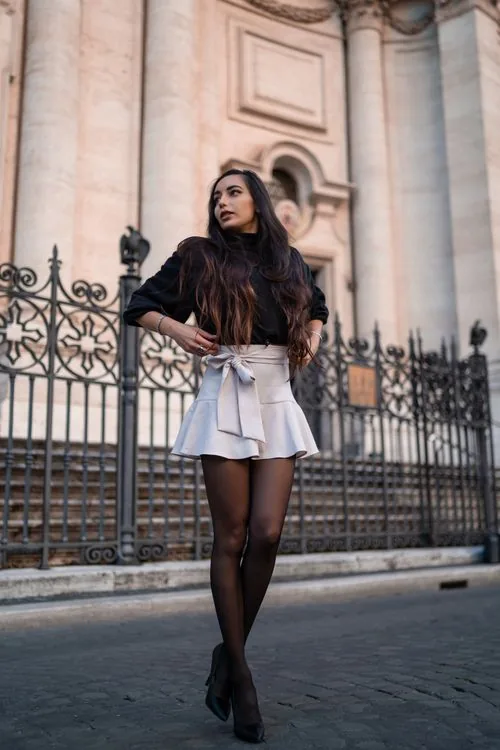
Tights with boots: getting the leg line right
Boots decide how tights look, because the eye reads the leg from hem to shoe as one line. Black tights with black boots is the simplest combination: the leg reads as one long line, and the outfit looks taller and more put-together. It works with ankle, knee-high and over-the-knee boots alike.
With brown or tan boots, black tights still work, but the line breaks at the ankle — fine for a casual outfit, less ideal if it is formal. Brown tights with brown boots give the same continuous line in a warmer palette, and navy with navy does the same. Match the tights to the boots when you want a long, clean line, and mismatch them only when the contrast is deliberate.
With knee-high boots the tights barely show, so denier matters less — a 40-denier pair is enough, since the boot covers most of the leg. With ankle boots the tights are on full display, so choose carefully: opaque black is the safe choice, and patterned tights only work if the pattern is small and the boots are plain.
Fit, sizing and care
Tights that fit badly are uncomfortable all day, so sizing matters more than it seems. Buy by height and weight, not by dress size — the size chart on the packet uses height and weight, and it is usually accurate. If you are between sizes, size up: tights that are too small sag and ladder, while slightly large ones are merely less snug. If you are tall, look for tall sizes rather than stretching a regular pair, which thins the fabric at the knee and toe.
Put tights on carefully: gather each leg, slide the foot in, and unroll up the leg, rather than pulling from the top. Rings, rough nails and rough skin snag sheer tights, so moisturise hands and feet first. Roll tights down rather than yanking them off, which stretches the waistband.
Wash tights gently, in a mesh laundry bag on a cold, gentle cycle, or by hand — they are delicate like the fabrics in how to care for silk, cashmere, velvet and wool, and the same gentle-washing advice applies. Air-dry them: dryer heat weakens the elastane and shortens their life. Keep a spare pair in your bag — even good tights ladder eventually.
Common mistakes and how to fix them
- Wearing sheer tights with a heavy winter outfit. The legs say spring and the coat says deep winter. Fix: match the tights to the outfit’s weight — opaque with wool, sheer with evening dresses.
- Buying the wrong size. Tights that are too small sag and ladder; too large, and they wrinkle at the ankle. Fix: buy by height and weight, and size up if you are between sizes.
- Wearing the same pair every day. Daily wear thins the fabric faster. Fix: rotate three pairs, and wash them gently.
- Matching tights to the skirt instead of the boots. Tights that match the skirt but clash with the boots break the leg line. Fix: match the tights to the boots.
- Ignoring the waistband. A waistband that digs in or rolls down ruins the outfit from the inside. Fix: try a different brand or a higher-waisted style.
Frequently asked questions
What denier tights should I wear in winter?
For everyday winter, 40–60 denier opaque tights: warm enough for outdoors, smart enough for work. For very cold days, move to 80–100 denier or fleece-lined tights. Sheer tights (10–20 denier) are for evenings and parties, not cold days outdoors.
Are fleece-lined tights actually warm?
Yes — the brushed fleece lining traps warm air against the skin, and they are the warmest tights in this guide. They look like ordinary opaque tights from the outside, but can feel warm indoors, so they suit days mostly outdoors better than days in heated rooms.
Can you wear sheer tights in winter?
Yes, for evenings and dressy occasions, when the journey is short and the venue is warm. Pair them with closed-toe shoes in a similar colour, and keep the outfit dressy.
How do I stop tights from laddering?
Buy the right size (size up if between sizes), put them on by gathering and unrolling rather than pulling, and wash them in a mesh bag on a cold, gentle cycle.
What colour tights go with a black skirt?
Black opaque tights are the default and the easiest choice. Charcoal grey works too and softens the leg line, and burgundy adds colour to a black skirt with a neutral top. Avoid white or very light tights with a black skirt in winter — the contrast is harsh.
Conclusion
Choosing tights for winter is simpler than the packets make it look: denier for thickness, opaque for everyday, fleece-lined for the coldest days, sheer for evenings. Buy three good pairs — 40 denier, 80 denier and fleece-lined, all in black — and most outfits are covered. Match the tights to the boots and their weight to the outfit, and the skirts you own will carry you through the winter.