
A scarf coat with built-in scarf is the cleverest winter coat of the last few years: a wool coat with the scarf already attached, so you never lose it or re-tie it, and never add a bulky layer at the neck. It looks effortless because it is — the scarf is part of the coat.
This guide is about that built-in scarf: how to wear it three ways, which shapes and colours work best, and the mistakes that make a scarf coat look bulky. For a separate scarf with an ordinary coat, see how to style a scarf with a winter coat.
Scarf coat with built-in scarf: the quick answer
A scarf coat is a coat with a scarf attached at the neck — usually a wide panel of the same fabric, often with fringed ends — that you drape, wrap or knot instead of reaching for a separate scarf. Wear it like any other wool coat, with the built-in scarf as the only neck layer: a fine knit underneath, slim trousers or jeans, and boots. Draped is the most elegant, wrapped is the warmest, knotted is the most practical when it is windy.
The rule that matters most: nothing else at the neck. The coat already has it covered.

What is a scarf coat?
A scarf coat is a coat — usually wool or a wool blend, sometimes quilted or bouclé — with a scarf built into the neckline. The scarf is typically a wide panel of the same cloth as the coat, attached at the back or sides of the neck, with fringed or blanket-stitched ends. Some versions are detachable (buttoned or zipped on); most are fixed. The coat itself is usually simple: a straight or slightly oversized body and a length from hip to mid-calf.
The style went mainstream in 2021, when Swedish label Totême’s embroidered scarf jacket — a draped, wool-blend coat with a blanket-stitch border — sold out in its first season. HELLO! traces the scarf coat’s mainstream moment to that Totême jacket and notes that scarf coats are still huge news for 2026, with new A/W 2026 versions on the high street. Stylist agrees that the built-in scarf detail adds a soft, sculptural touch.
That history explains the shape. The original was oversized, boxy and cropped — a jacket, not a long coat — and the high-street versions kept the boxy cut and the blanket stitching. The long scarf coats that came later are the same idea stretched out. You will see both when you shop, and the styling rules in this guide work for both.

How to wear the built-in scarf: draped, wrapped, knotted
The built-in scarf has three settings, and each one changes the outfit.
Draped. Let both ends hang loose down the front, or throw one end over one shoulder. This is the most elegant way to wear it — the scarf falls in a soft line and shows the fringe — and the best choice for smart days and evenings. The trade-off is warmth: a draped scarf does not seal the neck, so it suits mild days and short walks. Keep the ends roughly even; never let one hang to your waist and the other stop at your chest.
Wrapped. Loop the scarf once around your neck, so the ends hang shorter in front. This is the warmest way to wear it, and the best choice for cold days and commutes. Wrap loosely — a tight loop bunches the coat’s neckline. The wrap should sit on the coat, not squeeze it.
Knotted. Tie a loose knot at the front, or knot the two ends together once. This is the most practical way to wear it: the scarf stays put in wind and does not slip off your shoulder when you carry a bag. It is the least formal — save it for casual days, and keep the knot low and loose. A tight knot looks fussy, because the wide scarf becomes a lump.
| Way to wear it | Best for | Watch out for |
|---|---|---|
| Draped | Smart days, evenings, mild weather | Ends hanging unevenly; no warmth at the neck |
| Wrapped | Cold days, commutes | Wrapping too tight; collar bunching |
| Knotted | Windy days, carrying a bag | A tight knot becoming a lump |
Proportions: length, volume and your frame
The scarf coat’s proportions need more thought than an ordinary coat, because the scarf adds volume at the neck and chest. The rule is simple: volume at the neck means slimness everywhere else.
Short scarf jackets (hip length, boxy, oversized) are the original shape. They work best with slim bottoms — straight-leg jeans, slim trousers, or an A-line skirt — because the boxy top needs a narrower line below it. If you are petite, the short scarf jacket is your friend: it does not swallow your frame the way a long coat can.
Long scarf coats (knee length or below) are the winter version. They suit almost everyone, because the long line balances the volume at the neck. Wear them over slim trousers, straight jeans or a midi dress, and keep the coat closed or belted — an open long scarf coat with the scarf hanging loose can look unfinished. For the length rules, see how to wear a trench coat in winter. If you already own a funnel-neck coat, the rules here will feel familiar — both give you a built-in neckline — but the scarf coat’s scarf is far more flexible than a funnel’s fixed collar. See how to style funnel neck coats.
Sleeves and shoulders. Most scarf coats have dropped shoulders and wide sleeves. That means the knit underneath must be slim — a fine roll-neck or a fitted crew-neck, not a chunky sweater, which fills the wide sleeve. A shoulder bag slips off a dropped shoulder, and the scarf gets in the way — a cross-body bag or a tote carried in the hand works better.
Colours: which scarf coat to choose
Black, grey and chocolate brown are the most worn scarf coats, and for good reason: they go with everything, and they are the colours the original Totême jacket made famous. A black scarf coat over black trousers and boots is the most polished version of the look — tonal, simple, and hard to get wrong.
Cream and beige are the second choice if your wardrobe is mostly light neutrals. A cream scarf coat over dark jeans and brown boots is a complete outfit, and the fringe shows up beautifully against a pale coat. The trade-off is marks: a pale scarf at the neck picks up makeup faster, so check whether the scarf is detachable for washing before you buy.
Burgundy is the colour to choose if you want the scarf coat to be a statement. It works over black, grey and navy, and a burgundy scarf coat with black trousers and boots needs nothing else. Checked and bouclé versions are the heritage option: a checked scarf coat reads as classic rather than trendy.
Outfit formulas: work, casual and evening
Work: a long black or charcoal scarf coat, scarf draped, over a fine knit and tailored trousers, with loafers or heeled boots and a structured tote. Draped looks deliberate, not bundled. If your office is cold, wrap the scarf for the commute and re-drape it when you arrive.
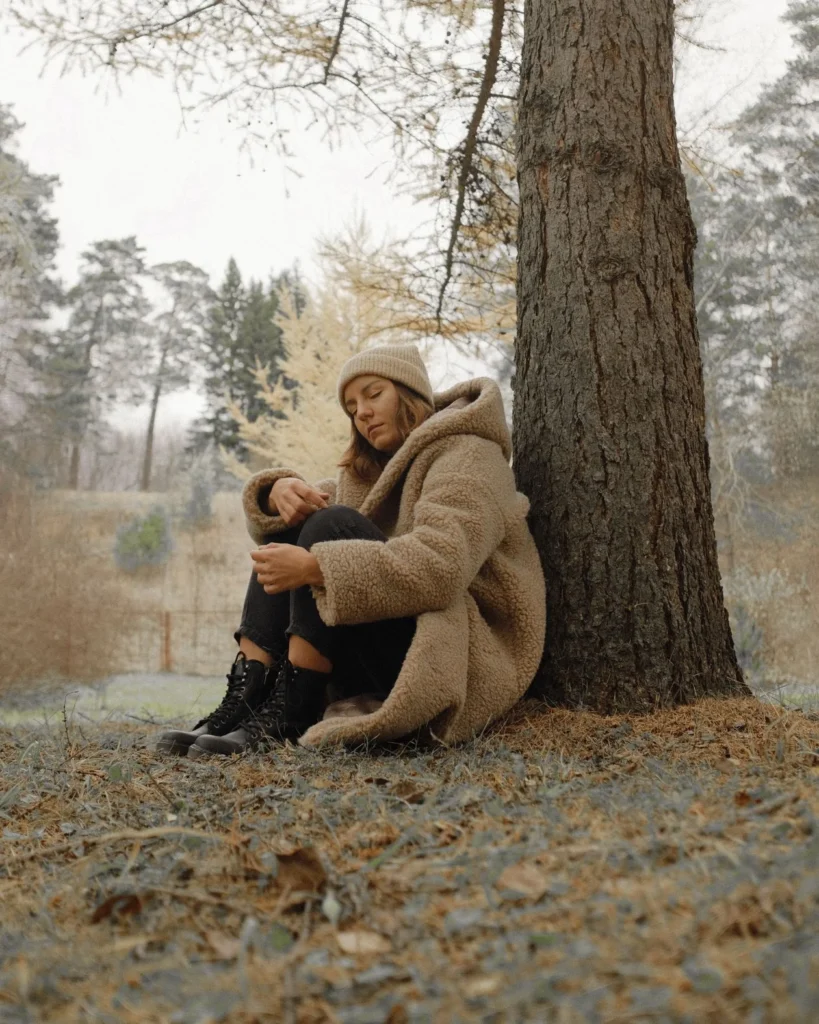
Casual day: a short boxy scarf coat, scarf knotted or wrapped, over a fine roll-neck, straight-leg jeans and ankle boots or trainers. A baseball cap instead of a woolly hat keeps the outfit current, and a cross-body bag stays put under the scarf. Keep the layers underneath slim — see how to layer clothes in winter without looking bulky before you add a third layer.
Evening: a long scarf coat, scarf draped, over a slip dress or a silk blouse and tailored trousers, with heeled boots. The dress underneath can be simple. Burgundy or black is the best evening choice; cream works too, over a dark dress.
Coldest days: a long scarf coat, scarf wrapped, over a thermal base layer, a fine knit, wool trousers and knee-high boots. The wrapped scarf seals the neck, and the boots close the gap at the hem — see how to style knee-high boots in winter.
What to wear underneath — and what not to
Underneath, the rule is slim and simple. A fine knit or a fitted long-sleeve top sits flat under the coat and does not fight the scarf. A shirt can work, but only with a small, flat collar — a big shirt collar plus a built-in scarf is two necklines competing for the same space.
What not to wear: a second scarf — the coat already has one, and two scarves look like a mistake. A chunky roll-neck is the second thing to avoid: it pushes the coat’s neckline open. A hoodie underneath is the third: the hood bunches behind the scarf and ruins the line of the coat. A statement necklace is wasted — nobody sees it under the scarf, and it catches on the fringe.

Buying guide: attached vs detachable, and fabric
Before you buy, check whether the scarf is attached or detachable. Detachable scarves — usually buttoned or zipped on — are the practical choice: you can wash the scarf separately and wear the coat without it on milder days. Fixed scarves look better, because they fall more naturally, but they are harder to clean.
Fabric matters as much as the scarf. Wool and wool-blend coats are the warmest and the closest to the original; they hold their shape and the scarf drapes well. Bouclé gives a softer look, but it can pill where the scarf rubs. Quilted scarf coats are the most practical in wet weather, but the scarf is usually thinner. Cotton versions are transitional — fine for autumn, not enough for deep winter.
Accessories: less is more
The built-in scarf is already the accessory, so everything else should be quiet. A structured bag in smooth leather — a tote or a cross-body — is the best partner; a slouchy bag plus a draped scarf is too much soft fabric in one outfit. Gloves in black or dark brown leather are the practical choice. Jewellery should be minimal, because the scarf covers the neckline where a necklace would sit.
Common mistakes and how to fix them
- Wearing a second scarf. The coat already has one. Fix: leave separate scarves for your other coats.
- A chunky roll-neck underneath. Two thick layers at the throat push the coat open. Fix: a fine knit under the coat.
- Wrapping the scarf too tight. It bunches the collar. Fix: one loose loop, ends hanging in front.
- Wide-leg trousers with a boxy short jacket. The outfit becomes one wide block. Fix: slim bottoms, or a cropped jacket that shows the waistband.
- A shoulder bag that slips off. Dropped shoulders plus a scarf leave the strap nowhere to sit. Fix: a cross-body bag or a tote in the hand.
- Scarf ends hanging unevenly. One end at your waist and one at your chest looks accidental. Fix: even the ends before you leave, or knot them once.
Frequently asked questions
What is a scarf coat?
A coat with a scarf built into the neckline — usually a wide panel of the same fabric, often with fringed ends — that you drape, wrap or knot instead of wearing a separate scarf. Totême’s scarf jacket made the style mainstream in 2021.
Can you wear a scarf coat with another scarf?
No — a second scarf adds bulk at the neck and looks like a mistake. If you want a separate scarf, wear an ordinary coat — see how to style a scarf with a winter coat.
How do you wear a scarf coat so it does not look bulky?
Keep everything underneath slim — a fine knit, slim trousers — and wear the built-in scarf draped or loosely wrapped, never with a chunky roll-neck underneath.
Is a scarf coat warm enough for winter?
Yes, in wool or a wool blend, especially with the scarf wrapped — it seals the neck, where cold air gets in. Layer a thermal base and a fine knit underneath on the coldest days.
What is the difference between a scarf coat and a scarf jacket?
Length. A scarf jacket is the short, boxy, hip-length original; a scarf coat is the same idea in a longer coat. Both have the built-in scarf, and the styling rules are the same.
Which colour scarf coat should I buy first?
Black, grey or chocolate brown for the most versatile coat; cream or beige if your wardrobe is mostly light neutrals; burgundy if you want a statement. For more ideas, see these winter outfit ideas for women.
Conclusion
A scarf coat works because it solves a real problem: the scarf is always there, and never something you have to carry, lose or re-tie. Wear it draped to look polished, wrapped to be warm, and knotted when it is windy — and keep everything underneath slim, so the scarf has room to do its job.