

You put on a thermal, then a jumper, then another jumper, then a coat — and suddenly you cannot lower your arms. That is the winter layering trap: more layers feel like more warmth, but past a point they only add bulk. Learning how to layer clothes in winter without looking bulky is not about owning a better coat. It is about choosing three thin layers that each do one job.
This guide is for women and men, for work days, weekends and evenings, and it works with clothes you probably already own.
The quick answer: three thin layers, staggered hems, one fitted area
Start with a thin base layer that sits close to the body. Add one warm mid-layer — a fine knit, a cardigan or a fleece — not two or three. Finish with a roomy outer layer with space for everything underneath. Then stagger the hems so each layer peeks out at a different length, and keep one area fitted — the waist, the wrists or the ankles — so the eye has somewhere neat to land.

Why layers look bulky (it is rarely the coat’s fault)
Bulk usually comes from stacking pieces that are all doing the same job. Two chunky jumpers under a coat do not double the warmth; they double the thickness around your middle and shoulders. A coat that fitted perfectly over a T-shirt in the shop will pull and strain once a thick knit goes under it — and a strained coat always looks bulky, however good the coat is.
The second cause is matching lengths. When your base layer, your jumper and your coat all end at exactly the same place, they pile up into one thick band around your hips, and the eye reads that band as width. The third cause is looseness everywhere at once. The fix is simple: fewer, thinner layers, each a different length, with one part of the outfit kept neat.
The three-layer method, layer by layer
Layered clothing is usually described as three layers: an inner layer that keeps skin dry, a mid layer that insulates, and an outer layer that protects against wind and water. The fashion version keeps the same logic but chooses each layer for how it looks as well as how it warms.
Layer 1, the base: thin and close-fitting. A fine thermal top, a long-sleeve T-shirt, a thin turtleneck or a camisole under a shirt — the layer nobody should see much of. It should sit close without squeezing, with flat seams and no bunching. Merino wool is the classic choice because it is warm for its weight: Merino wool base layers insulate without the thickness of a heavy knit. Avoid cotton as a base in real cold — it holds moisture and feels clammy once you warm up indoors.
Layer 2, the mid-layer: one warm piece, not two. This is where the warmth comes from, and where most people go wrong by adding a second one. Choose one: a fine-gauge cashmere or merino jumper, a cardigan, a fleece, a quilted gilet or a knitted vest. A fine knit traps warm air while staying thin enough for a coat to close over it. A chunky knit can work too, but only if the coat over it is genuinely roomy. If you are still cold, make the mid-layer warmer rather than adding a fourth layer.
Layer 3, the outer: roomy and structured. The coat needs space for the two layers beneath it — roughly a size up from your summer jacket, or a style cut with room built in. A structured coat with a defined shoulder and a belt or buttoned waist holds its shape over layers far better than a soft, unstructured one, which collapses onto the knit. The test is simple: button the coat and raise your arms. If you cannot, the outer layer is too small for the layers under it.

Staggered hems: the trick that makes layers look deliberate
Staggered hems are the single most effective visual trick in winter layering. When each layer ends at a different length, the outfit looks designed. When they all end together, they look like an accident.
Aim for a visible step of a few centimetres between layers: a shirt tail peeking below a jumper, a jumper hem showing below a cropped jacket, a long coat over a shorter knit. Try this order: base layer longest, mid-layer a little shorter, outer layer longest of all (if it is a coat) or shortest (if it is a cropped jacket worn open).
The same idea works at the neck and cuffs: a shirt collar above a crew-neck jumper, a turtleneck above a coat collar, a base-layer cuff showing past a jumper sleeve. Keep it to two or three visible edges at most; more than that looks busy.
One fitted area: give the outfit an anchor
An outfit that is loose everywhere looks shapeless. An outfit with one fitted area looks styled. Pick one place to keep neat, and let the rest of the outfit have its volume.
The waist is the easiest anchor: a half-tuck of the knit into high-waisted trousers, a belt over a coat, or a cropped jacket that ends at the waist. The wrists work well too: push a coat sleeve up slightly to show a fitted base-layer cuff. The ankles anchor a long coat: straight-leg trousers or jeans with boots, so the bottom of the outfit is neat even when the top is voluminous.
A belted coat over straight trousers is the classic winter anchor. If you are layering a dress over trousers — one of the season’s “foundational layer” ideas, with dresses worn over trousers and shirts beneath knitwear — the fitted area is the trouser leg itself, kept slim against the dress’s volume.
Colour and texture: warmth you can see
Bulk is partly a visual effect. A single dark colour from head to toe can make layered outfits look like one heavy mass, while too many contrasting colours chop the outfit into blocks. The middle ground works best: a tonal palette — camel, cream and brown, or navy, grey and charcoal — with one contrasting piece, such as a coloured scarf or a different-toned coat.
Texture does the same work as colour. A smooth base, a textured knit and a smooth coat give the eye three different surfaces to read, so the outfit looks layered on purpose rather than padded. Mix one chunky texture (a cable knit, a boucle coat, a ribbed scarf) with smoother pieces.
Fabrics: what keeps you warm without the weight
Warmth comes from trapped air, not from weight. A thin fabric that traps air — fine wool, fleece, down — warms better than a thick fabric that does not. Each layer traps a little air, and the air between the layers insulates too.
| Fabric | Weight | Best layer | Why it works |
|---|---|---|---|
| Merino wool | Light | Base and mid | Warm for its weight, breathes, sits flat |
| Cashmere | Light | Mid | Very warm and thin, soft under coats |
| Silk | Very light | Base | Warm, smooth, adds no bulk at all |
| Chunky wool knit | Heavy | Mid (only one) | Warm and textured, needs a roomy coat |
| Down / synthetic fill | Light-medium | Outer | Excellent insulation, very light |
Build the outfit from the top of the table where you can, and save the heavy rows for the single mid-layer or the coat. Look after the knits you layer with: our guide to how to care for silk, cashmere, velvet and wool covers washing and storing them.
Outfit formulas: work, weekend, evening
Work, women: thin turtleneck base, fine-gauge crew-neck jumper, straight-leg trousers, belted wool coat, ankle boots. The fitted area is the waist — half-tuck the jumper and belt the coat. See these old money work outfits for tailored versions of the same formula.
Work, men: long-sleeve thermal or fine merino base, shirt, fine knit jumper or cardigan, single-breasted wool coat, tapered trousers, leather shoes. A shirt collar above the jumper is the detail that makes the outfit look finished.
Weekend, women: thermal camisole, striped or plain long-sleeve top, chunky cardigan or oversized knit, straight-leg jeans, boots, long scarf. The fitted area is the ankle — the jeans and boots keep the bottom neat while the knit has its volume. For more combinations, see these winter outfit ideas for women.
Weekend, men: merino base layer, crew-neck jumper, quilted gilet or open overshirt, parka or puffer, straight-leg jeans or chinos, boots. The gilet is the mid-layer here, and the open overshirt adds a visible layer without extra warmth.

Evening, women: silk camisole base, fine knit or fitted long-sleeve top, slip dress or velvet midi dress over the top, long wool coat, heeled boots. The dress-over-layers look is one of winter 2026’s clearest trends, and it works because the base and knit are both thin.
Evening, men: thin turtleneck, dark blazer or fine knit, dark straight-leg trousers, long wool coat, leather shoes or smart boots. The turtleneck is both base and mid-layer here, which keeps the outfit to three pieces.
If layering is trickier for your frame, the principles in our guide to how to dress a slim frame and how to dress petite without tailoring apply directly: thinner layers, shorter hems, and one fitted area matter even more when a coat can swallow the outfit.
Accessories: the layers people forget
A scarf, hat and gloves are layers too, and they follow the same rule: one textured piece, the rest smooth and light. A chunky knit scarf over a smooth coat adds warmth without bulk at the waist, where bulk shows most. A beanie or a wool hat keeps heat in and finishes the outfit.
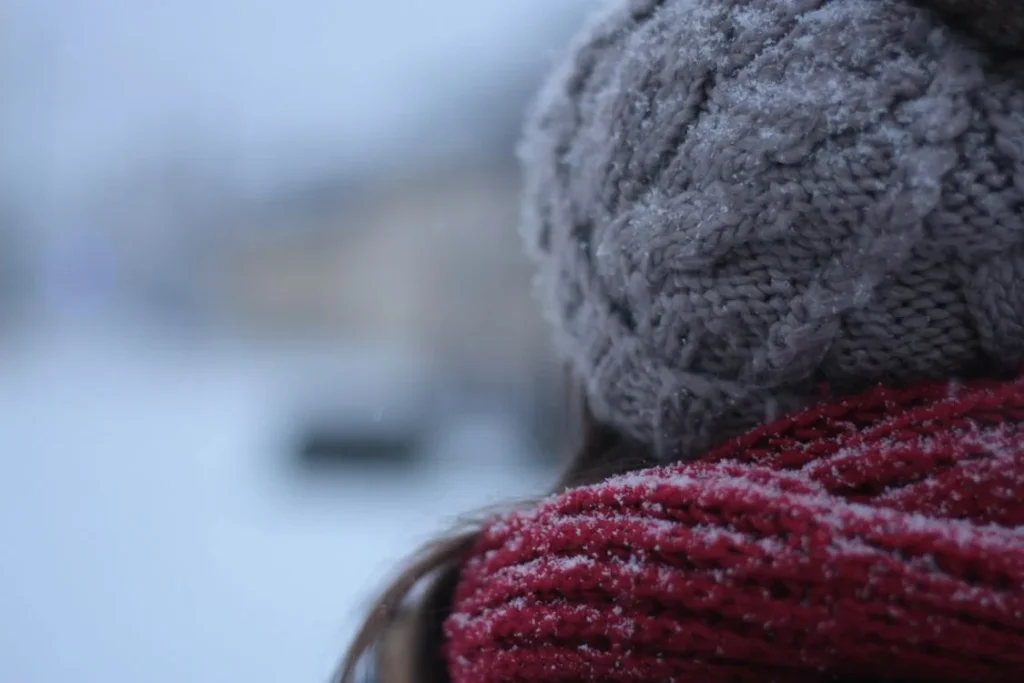
Gloves matter more than they look: cold hands make you hunch into your coat, which makes any outfit look bulky. Leather gloves with a thin lining keep the hands neat. A structured bag worn cross-body over a coat adds a diagonal line that breaks up the outfit’s width, while a huge soft tote adds volume at the hip.
Common mistakes and how to fix them
- Two chunky mid-layers. The most common bulk mistake. Fix: keep one warm mid-layer and make it warmer, rather than adding a second.
- A coat that fitted over a T-shirt. If the coat strains over a knit, it is too small for winter. Fix: size the coat for the layers, or thin the layers for the coat.
- All layers the same length. The thick band at the hem reads as width. Fix: stagger the hems by a few centimetres.
- Loose everywhere. No fitted area means no shape. Fix: pick one anchor — waist, wrists or ankles — and keep it neat.
- Cotton as a base layer. It holds sweat and feels cold once you stop moving. Fix: merino, silk or a fine synthetic thermal as the base.
Shopping guidance
You do not need a new wardrobe to layer well. Start with what you own: lay out your thin base layers, your fine knits and your coats, and try the three-layer combination with the pieces you already have.
When you do buy, buy for the system, not for single outfits. A thin merino base in black and one in cream, one fine-gauge knit in a neutral, and a coat with room for layers will cover most of winter. Buy the coat last, and try it on over the thickest mid-layer you own. Our guide to how to build a capsule wardrobe on a budget shows how to build that set without overspending. No prices or availability are promised here, because both change by store and season.
Frequently asked questions
How many layers should I wear in winter?
Three: a thin base, one warm mid-layer and a roomy outer layer. If you are still cold, make the mid-layer warmer or add thermal leggings under trousers, rather than adding a fourth top layer.
How do I layer without looking bulky?
Use thin layers, not thick ones; keep one fitted area (waist, wrists or ankles); stagger the hems; and make sure the coat has room for everything underneath.
Can I layer a sweater over a shirt?
Yes — it is one of the easiest layered looks. Keep the shirt thin, let the collar and a little of the shirt tail show below the jumper, and make sure the jumper is fine-gauge enough to sit smoothly over the shirt.
How to layer clothes in winter without looking bulky for work?
A thin turtleneck or fine base, a fine knit or shirt, tailored trousers and a belted wool coat. Keep the palette tonal, keep one area fitted, and choose a mid-layer you would happily wear on its own once the coat comes off indoors.
Should my coat be a size bigger for layering?
Not necessarily a full size, but it must have room for your thickest mid-layer. Try coats on over a knit, not over a T-shirt, and check you can button it and raise your arms comfortably.
Conclusion
Staying warm in winter is not about wearing more — it is about wearing the right three layers. A thin base that sits flat, one warm mid-layer, and a roomy outer that holds its shape will keep you warmer than a pile of thick knits, and it will look better too. Stagger the hems, keep one area fitted, and try the system tomorrow with clothes you already own: base, one knit, coat.