A maxi coat is the warmest coat you can own and the most dramatic — and the one most likely to wear you instead of the other way round. The question of how to style a maxi coat in winter comes down to proportion: where the hem falls, what sits underneath it, and which boots meet it at the bottom.
Choose a hem that falls between mid-calf and just above the ankle. Keep everything underneath slim — a fine knit, straight trousers or a column skirt — because the coat already supplies the volume. Finish with boots that have a slim shaft: knee-high boots under a skirt or dress, or ankle boots with slim trousers. One long, unbroken line from shoulder to hem is what makes a maxi coat look deliberate rather than swamping. In short, how to style a maxi coat in winter is a proportion problem first: get the hem, the layers and the boots right and the rest follows.
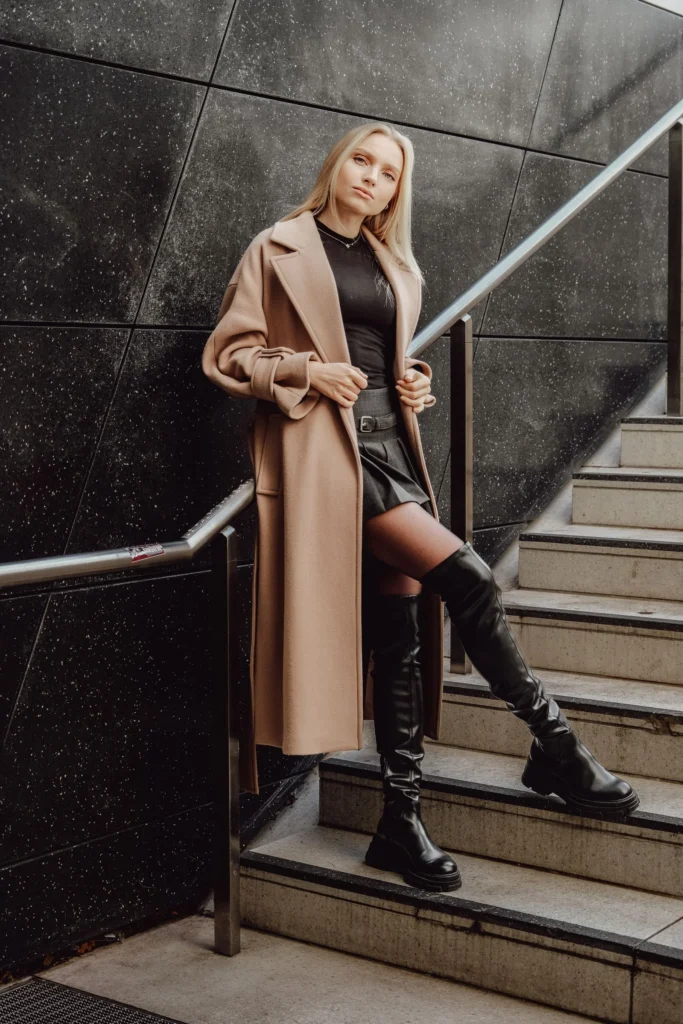
A maxi coat does the work of a whole outfit — the length is the statement, so everything underneath can stay simple.
What is a maxi coat, exactly?
A maxi coat is a coat whose hem reaches the lower calf, the ankle, or — in the longest versions — the floor. It is the longest standard coat length, below the mid-calf coats and well below knee-length styles. In the classic sense, an overcoat is a type of long, thick coat worn as the outermost layer for warmth, usually extending below the knee; a maxi coat is the longest version of that idea, cut for fashion as much as for warmth.
How to style a maxi coat winter: the length guide
Hem length is the decision that matters most, and it depends on weather as much as on height. A hem that drags on wet pavements soaks up rain and snow, and a hem that stops too high loses the maxi effect entirely.
Hem length
Best for
Mid-calf
Wet weather, commuting
Just above the ankle
Dry days, evenings
Ankle-grazing / floor-sweeping
Dry days, tall frames
The safest choice for most people is mid-calf to just above the ankle: warm enough to matter, long enough to read as a maxi, and short enough to stay clean.
When you try one on, walk in it and climb a step. A maxi coat that is fine standing still can catch at the knee when you walk if it is too narrow, and a very wide hem can billow in wind.
The proportion rules that make a maxi coat work
A long coat is, as one long coat styling guide puts it, a long coat is all about proportion — and knowing how to style a maxi coat in winter is easy once you have a few reliable rules. The coat supplies length and volume, so everything else should supply the opposite: slimness, structure, or a clear waist.
Rule one: slim underneath. If the coat is voluminous, keep what is underneath streamlined. A fine-knit roll-neck, a fitted crew-neck or a slim shirt works; a chunky knit under a wide maxi coat adds bulk at the shoulders and waist. If you love chunky knits, wear them with a straighter, more tailored maxi, not an oversized one. For the layering detail, see how to layer clothes in winter without looking bulky.
Rule two: define one point. A maxi coat needs a single focal point or it reads as one long block. That point can be the waist, with a belt or a wrap tie; the neckline, with a scarf or a funnel collar; or the boots, with a flash of colour or a pointed toe at the hem. Pick one, not all three.
Rule three: keep the colour column simple. One colour from shoulder to hem lengthens the line. If you want contrast, put it in one place: a cream scarf, a coloured boot, or a bright bag.
Rule four: mind the shoulders. Structured shoulders keep a long coat hanging cleanly instead of drooping. This matters most on oversized maxis: a strong shoulder line gives the garment shape, while a soft, sloping shoulder lets the whole length hang like a blanket.
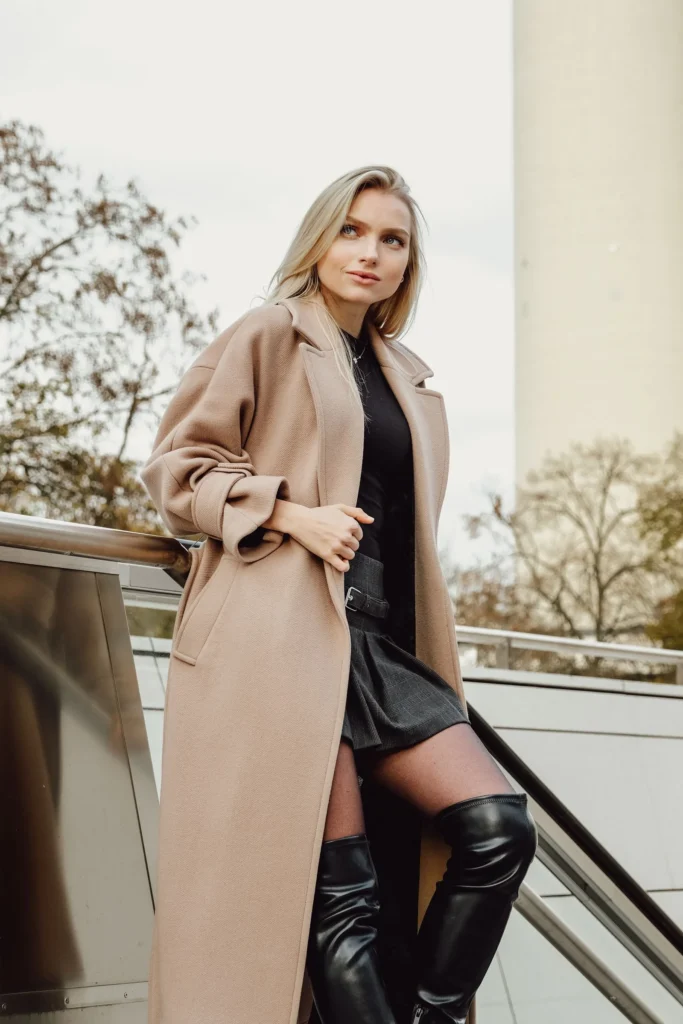
One long line from shoulder to hem: keep what is underneath slim and the coat reads as elegant, not heavy.
What to wear under a maxi coat
Because so little of it shows, what you wear under a maxi coat should be chosen for warmth, slimness and the few inches that do show: the neckline, the cuffs, and the hem below the coat.
Knitwear: a fine merino or cashmere roll-neck is the best partner — warm without bulk, and the high neck fills the coat’s collar nicely. A crew-neck works when the coat is worn open. Avoid heavy cable knits under a fitted maxi.
Trousers: straight-leg or slim trousers in a dark colour keep the line clean under the hem. Wide-leg trousers can work, but the trouser hem must hit right at the shoe — pooling fabric under a long coat looks untidy. Straight-leg dark jeans are the easiest pairing, and the coat dresses them up instantly.
Skirts and dresses: a column skirt or a slip dress under a maxi coat gives the longest, cleanest line of all. A midi skirt works if its hem sits above the coat’s hem, so the layers read in order: coat longest, skirt shorter, boot below. A skirt that is longer than the coat looks like a mistake.
Which boots to wear with a maxi coat
Boots are the second half of how to style a maxi coat in winter. The coat ends, the boot begins, and the join between them is where the outfit succeeds or fails. The rule is simple: the boot shaft should be slim, and a little boot should show rather than being buried.
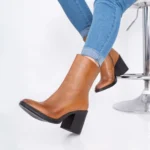
Knee-high boots are the maxi coat’s best partner: a slim knee-high boot under a skirt or dress closes the gap between hem and foot, so no slice of bare leg breaks the line. For the full guide, see how to style knee-high boots in winter. With trousers, choose pointed ankle boots or Chelsea boots with a slim shaft — the pointed toe adds length at the bottom and the slim trouser meets the boot cleanly. Chunky lug-sole boots suit oversized maxis and weekend looks, where their weight anchors the volume; a small block heel helps petite frames and keeps the hem off the ground. Trainers can work with a casual maxi — a clean white or black trainer under a black maxi coat is a modern city look — but keep the rest of the outfit sharp so the trainers read as a choice, not an afterthought.
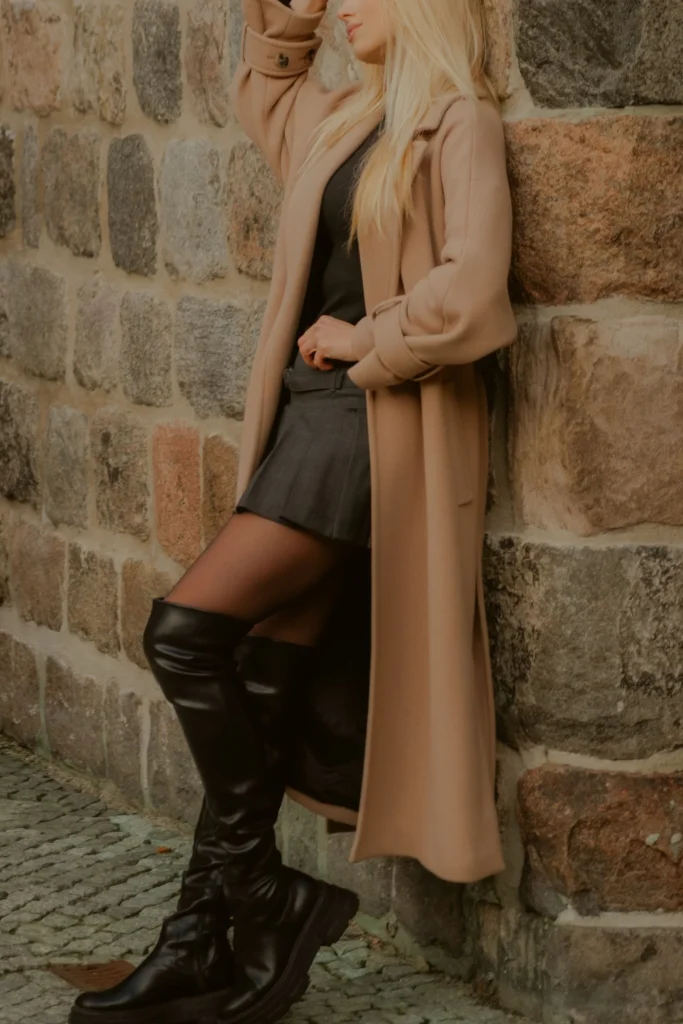
Knee-high boots are the maxi coat’s best partner: the slim shaft disappears under the hem and the line stays clean.
Petite frames: how to wear a maxi coat without being swamped
A maxi coat can work beautifully on a petite frame — the long line can actually make you look taller — but the details matter more. The companion guide to how to wear an oversized coat on a petite frame covers oversized volume in depth; the maxi-specific rules are these.
Choose a hem that lands just below the knee or at mid-calf rather than at the ankle, unless the coat is cut for a petite line. Look for a belted or wrap style to define your waist, which stops the length from reading as one undifferentiated block.
Tall frames: the maxi coat is your advantage
If you are tall, the maxi coat is the easiest coat length you will ever wear — the proportions that worry other people are already yours. A floor-sweeping hem that would drag on most people sits at the ankle on you, and an oversized cut reads as intentional rather than overwhelming.
Use the length: a full ankle-length coat over wide-leg trousers is a striking, elegant line, and a belted maxi over a column dress is evening-ready with almost no effort. The main thing to check is sleeve and shoulder fit — tall ranges exist for a reason, and a maxi coat with sleeves that stop short at the wrist ruins the line. For more on proportions that work at height, see how to dress a tall frame. One caution: a very long coat plus very long layers underneath can tip from elegant into shapeless, so keep one layer fitted — a slim knit or a tucked shirt — so the outfit has a shape inside the length.
Outfit formulas: work, casual, evening and weekend
Casual day: black maxi coat, grey crew-neck knit, dark straight-leg jeans, black Chelsea boots, cream scarf.
Evening: a black or deep green maxi coat worn open over a column dress, with heeled knee-high boots and a small structured bag.
Weekend: an oversized camel maxi, a cream roll-neck, dark jeans and chunky lug-sole boots. The volume of the coat and the weight of the boots balance each other. If you are still choosing the coat itself, how to choose a winter coat compares wool, puffer, trench and faux fur before you commit to the longest length.
The everyday maxi formula: a long wool coat, a fine knit, straight trousers and boots with a slim shaft.
Accessories: the finishing touches
Accessories are how you stop a maxi coat from looking like a uniform. A scarf is the most useful: worn inside the collar it fills the neckline, and worn long it breaks the vertical line in a good way. How to style a scarf with a winter coat covers the knots and placements in detail.
A belt changes the coat entirely. If your maxi did not come with one, a slim leather belt worn over the coat at your natural waist gives shape to a straight cut.
Bags should be structured and medium-sized: a tote or a top-handle bag holds its shape against a long coat, while a slouchy hobo can disappear into the volume. Gloves in a contrasting colour — burgundy, tan or cream against a black coat — are a small, cheap way to add personality.
Fabrics and care: where a maxi coat earns its price
A maxi coat uses more fabric than any other coat, so fabric quality shows — and poor fabric shows more. Brushed wool, wool-cashmere blends and bouclé-style weaves look rich at full length; thin, shiny fabrics can look cheap when there is a metre of them. Check the lining too: a fully lined maxi hangs better and lasts longer.
Because the hem is close to the ground, it takes the most wear: rain splash, salt and pavement dirt. Brush the hem down after wet days, hang the coat on a wide, sturdy hanger so the shoulders keep their shape, and have it cleaned before storing it for spring.
Common mistakes and how to fix them
A hem that drags. The coat picks up water and dirt and you spend the day hitching it up. Fix: choose mid-calf to just above the ankle, or have the hem shortened by a tailor.
Bulky layers underneath. A chunky knit plus a voluminous coat equals a shapeless block. Fix: fine knits under the coat, chunky knits with shorter coats.
The wrong boots. Wide, slouchy boots bunching under the hem break the line. Fix: a slim shaft, knee-high with skirts, pointed ankle boots with trousers.
No focal point. A long coat with nothing to look at reads as a blanket. Fix: one point of interest — a belt, a scarf, a coloured boot or a structured bag.
Too many colours. Three strong colours along a maxi length chop it into bands. Fix: one colour column, with contrast in one place only.
Shopping guidance: what to look for before you buy
Buy the maxi coat in the best quality you can afford — it is the most visible thing you will wear all winter and it uses the most fabric, so quality differences are obvious. Check the shoulder fit first, then the hem length in the shoes you will actually wear with it, then the weight: a good wool maxi feels substantial but not exhausting to wear all day. Try it on with your bulkiest winter knit underneath, so you know the arms and shoulders still move.
Frequently asked questions
How long should a maxi coat be in winter?
When you are working out how to style a maxi coat in winter, length comes first: mid-calf to just above the ankle is the most practical length — warm, elegant, and clear of wet pavements. Ankle-grazing and floor-sweeping lengths look dramatic but are best kept for dry days.
What boots do you wear with a maxi coat?
Slim knee-high boots with skirts and dresses, and pointed ankle boots or Chelsea boots with slim trousers and jeans. The shaft should be slim so it sits neatly under the hem.
Can petite women wear maxi coats?
Yes — choose a hem at mid-calf rather than the ankle, pick a belted or wrap style to define the waist, keep the colour tonal from top to toe, and add a small heel.
What do you wear under a long coat in winter?
Fine, warm layers: a merino or cashmere roll-neck, straight or slim trousers, and a column skirt or dress. Keep the layers slim because the coat supplies the volume.
Is a maxi coat warmer than a knee-length coat?
Yes, in practice — it covers your legs down to the calf or ankle, which keeps the wind off a much larger area. The difference is most noticeable on cold, windy days.
Conclusion
That is how to style a maxi coat in winter without looking swamped: a hem between mid-calf and just above the ankle, slim layers underneath, a single focal point, and slim boots meeting the hem cleanly.