


Peplum tops drop waist dresses winter — two shapes that spent years in the “maybe next season” pile have both arrived at once, and both look like warm-weather ideas. The peplum flares at the waist; the drop waist moves the waistline down to the hip. Both are pure proportion, so every layer you add can bury the line that makes them work. Neither shape needs to be packed away. They need a plan — a thin warm base, a bottom half that stays slim, and a coat that opens without hiding the seam.
Peplum tops drop waist dresses winter: the quick answer
Wear a peplum top with slim, straight bottoms — jeans, tailored trousers or a column skirt — and keep the flare as the only volume. Wear a drop-waist dress with opaque tights and boots, adding warmth underneath it: a thin roll-neck or thermal under the dress, and a long coat left open over it. In both cases one rule holds: the waistline — natural for the peplum, dropped for the dress — must stay visible. If a layer covers it, move it. The simplest formulas are a wool peplum top with black straight-leg trousers and ankle boots, and a long-sleeved drop-waist knit dress with fleece-lined tights and boots.

The 2026 peplum: a clean flare at the waist, not a ruffle — the seam sits at the natural waist and the flare does the talking.
Why peplum and drop-waist, and why now?
Vogue’s Fall 2026 trend report names peplum proportions among the season’s key directions, grouping the wider shift under “Playful Proportions” — waists moving up and down, hips exaggerated. At Dior, Jonathan Anderson opened the Fall/Winter 2026 show with three looks in shrunken peplum-shaped jackets. Style Arcade’s Paris report calls it the new peplum: Givenchy and McQueen offered relief in peplum pleats on tightly nipped blazers, while Alaïa and Chanel took the shape right to the models’ feet — Chanel’s low-waisted, belted skirts and dresses dropping the peplum shape to the ankle. The peplum showed up across spring and fall 2026 at Stella McCartney, Jacquemus, Proenza Schouler, Givenchy, Dior and Tod’s. For winter dressing, that matters: the shapes are being made in wool, crepe and structured knits that hold their line, not floppy jersey.
What is a peplum top?
A peplum top has a short, flared ruffle — the peplum — attached at the waist, so the fabric fans out below the waistline and stops. The seam where bodice meets flare sits at your natural waist, and the flare kicks out from there: the waist reads smaller because the fabric below it moves outward. The 2026 version is quieter than the early-2010s one: the flare is shorter and more controlled — a gentle kick at the hip rather than a full skirt — and it is built into tailoring, appearing on jackets and blazers too. Fabric is the difference: wool, crepe and structured knits hold the flare, while soft jersey lets it collapse. Choose wool or a wool blend for winter: the flare must survive under a coat, and structured fabric springs back when the coat comes off.
What is a drop-waist dress?
A drop-waist dress moves the waist seam to the hips, or lower, and lets the skirt flare or fall straight from there. The bodice is long, the seam sits low, and the skirt starts where a normal dress would already be ending. The effect is a long, low-slung line — the 1920s silhouette, revived with longer hems. Chanel made it most obvious this season, with low-waisted, belted dresses carrying the waistline toward the ankle. A drop-waist dress is not a shift dress — a shift has no waist seam at all — and it is not a sweater dress: for the fitted-knit version see how to style a sweater dress in winter. The seam is the test of whether it suits you: a long torso reads shorter and more balanced, while a short torso can lose its waist. If you want a waist that ties instead of dropping, the alternative is the wrap — see how to wear a wrap dress in winter.
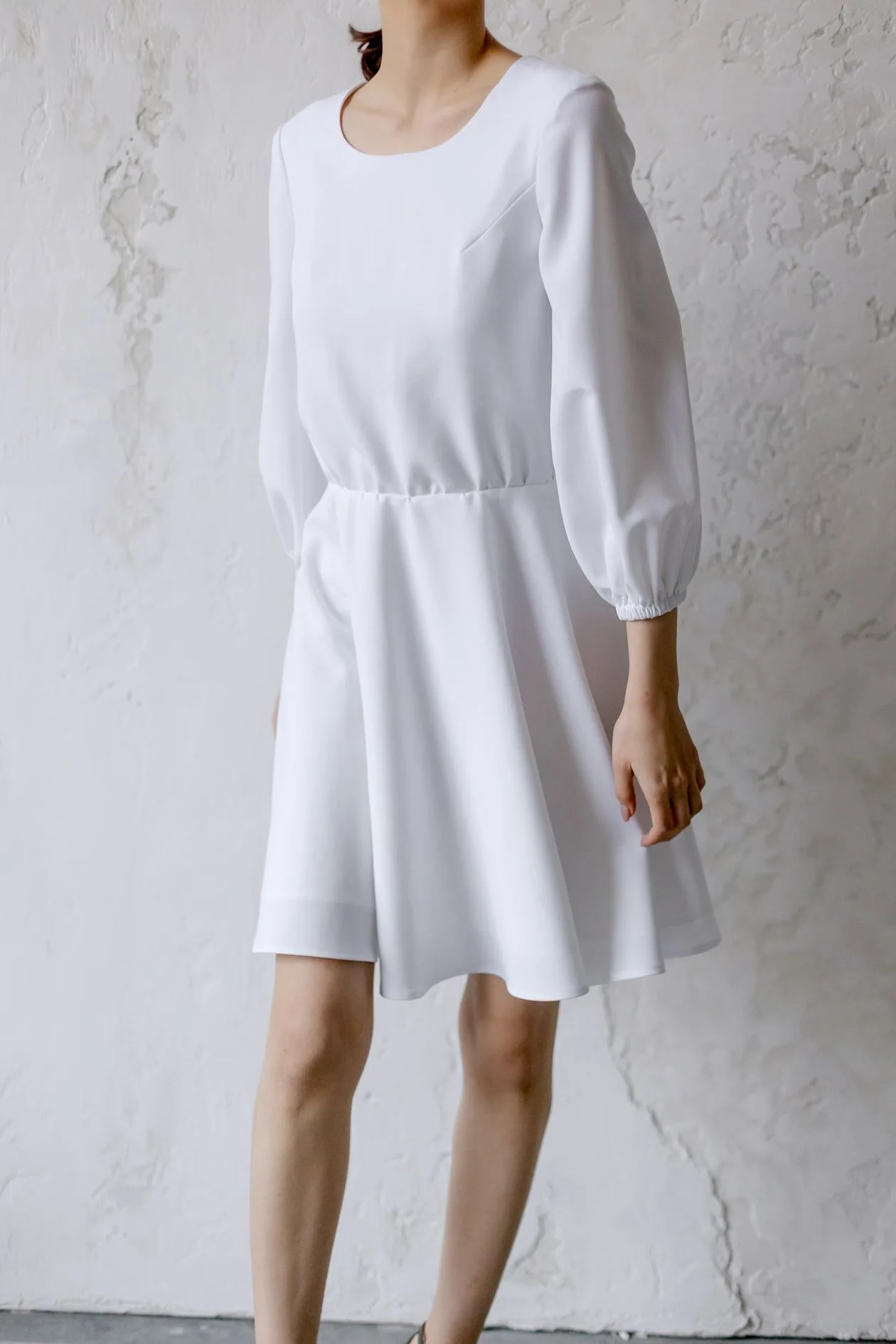
The drop waist in its simplest form: a straight bodice, a seam that sits below the natural waist, and a skirt that flares from there.
Choosing the right one: seam, fabric and fit
Check the seam first. On a peplum top it must sit at your natural waist — a seam an inch high or low ruins the flare. On a drop-waist dress the seam should sit at the hip bone or just below it: a seam at the waist makes it an ordinary fit-and-flare. Second, fabric: the peplum needs structure for winter — wool, crepe, a firm knit — so the flare holds under a coat. The drop-waist skirt needs weight: a jersey or crepe that hangs straight, or a knit that does not cling to tights. Third, length. A peplum top should end at the hip or just below it; longer, and the flare reads as a skirt attached to the wrong top. A drop-waist dress works best at midi length or longer: the long line is the point.
| Shape | Seam sits | Best fabric for winter | Best length |
|---|---|---|---|
| Peplum top | Natural waist | Wool, crepe, firm knit | Hip length |
| Drop-waist dress | Hip bone or below | Knit, crepe, heavier jersey | Midi or maxi |
| Peplum jacket | Natural waist | Wool, structured suiting | Hip length |
| Drop-waist knit dress | Low hip | Ribbed knit, wool blend | Midi |
Peplum outfit formulas for winter
With straight-leg trousers: a wool peplum top in black, chocolate or burgundy, straight-leg dark trousers, and ankle boots. Belt nothing — the peplum is the waist definition — and the straight trousers give the flare room to move.
With wide-leg trousers: the same peplum top in a matching dark tone, wide-leg trousers and a heeled boot. Keep the top fitted and the flare short, so the volume sits at the waist and the hem — and check how to style wide-leg trousers in winter for the proportion rules first.
With a column skirt: a peplum top over a straight midi skirt in the same colour family, with knee-high boots. The skirt’s straight line makes the flare look deliberate.
For evenings: a velvet or satin peplum top over tailored trousers, heeled boots and a long coat worn open. The flare is the party detail, so keep jewellery small.

The everyday peplum formula: a fitted flare on top, a slim, straight line underneath — the trousers stay quiet so the waistline reads.
Drop-waist dresses in winter: outfit formulas
With tights and knee-high boots: a long-sleeved drop-waist knit dress in black, navy or chocolate, opaque or fleece-lined tights, and knee-high boots. The boots warm what the long hem does not cover, and their shaft extends the dress’s line — see how to style knee-high boots in winter.
With a roll-neck underneath: a sleeveless or short-sleeved drop-waist dress over a thin roll-neck in black or cream. The collar and sleeves make a summer dress a winter one, and the fitted knit preserves the long line — see how to style a turtleneck in winter for the weights that sit flat under a dress.
With a coat over it: a long wool coat, worn open over the dress and boots. The coat should be longer than the dress hem or end a touch above it — a coat cutting across the skirt chops the line in half.
For work: a dark, plain knit or crepe drop-waist dress, a tailored coat, opaque tights, heeled ankle boots and a structured bag. Keep the seam subtle: a soft flare, not a full skirt.
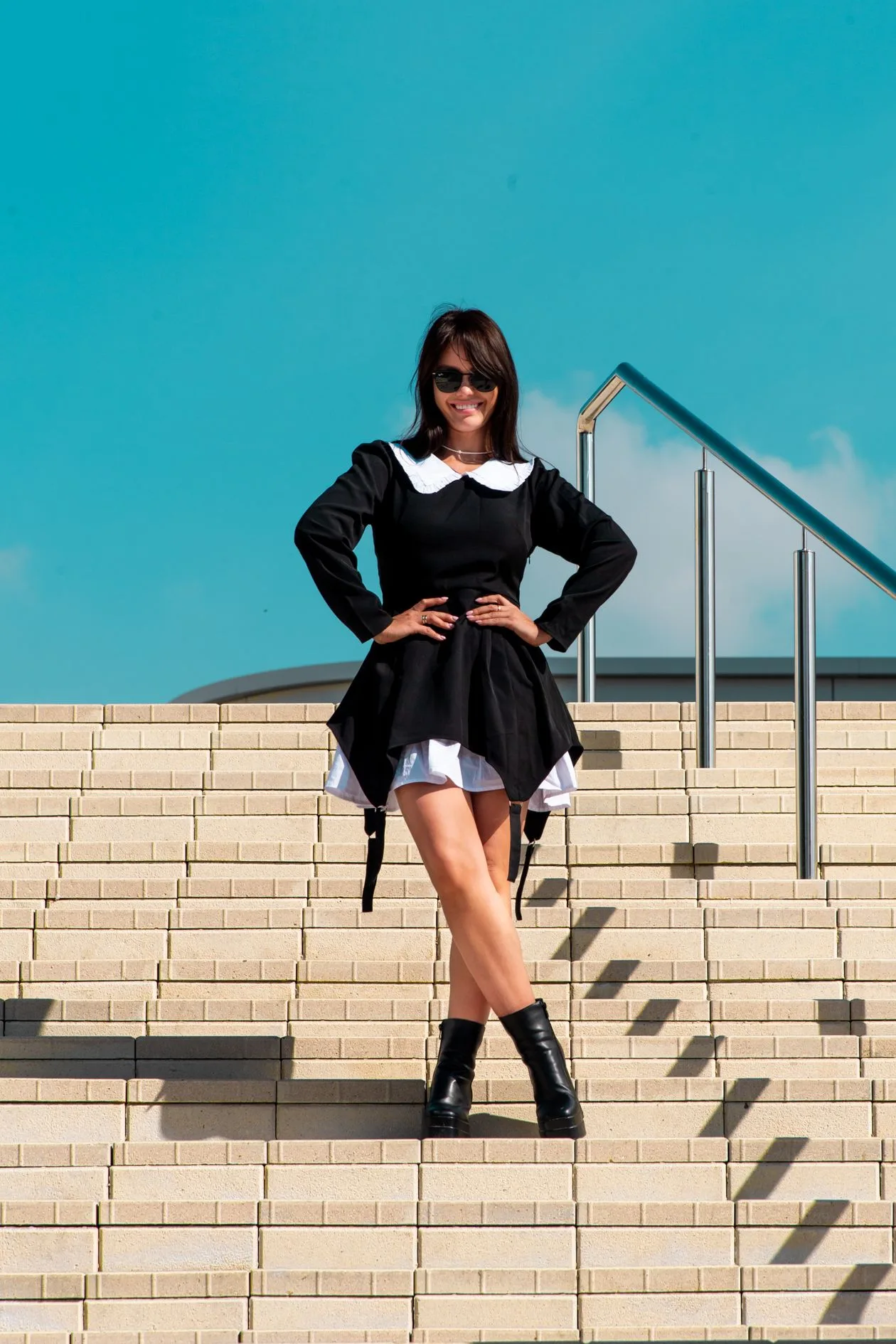
A drop-waist dress in winter: long sleeves, a covered leg and a boot that meets the hem — the shape survives the season when the styling does the warming.
Layering for warmth without hiding the line
Both shapes punish the wrong kind of layering: add warmth underneath and keep the middle slim — see how to layer clothes in winter without looking bulky for the full method. Under a peplum top, wear a thin thermal or fine roll-neck in the top’s colour, tucked in, so the base layer stays invisible and the seam stays clean. A chunky knit under a peplum bunches at the waist and pushes the flare out wrong — save chunky knits for jeans and open coats. Under a drop-waist dress the skirt hides a lot, so you can be warmer than you look: a thermal top and thermal tights or fleece-lined leggings underneath. Avoid a bulky layer at the hip — a thick jumper tucked into the skirt, or a belt over the dropped seam: the seam is the design, and anything on top of it flattens the shape. Over both shapes, wear the coat open: an open long coat frames the waistline instead of covering it.
Coats, boots and the hem gap
The coat decision differs for each shape. Over a peplum top, choose a coat that ends above the flare or well below it — a cropped jacket, or a long coat that opens to show the top. A mid-length coat ending exactly at the flare creates two hems at the same height — both look accidental. Over a drop-waist dress, choose a long coat: the dress hem should peek out below it or sit just above it. Boots follow the hem: with a midi drop-waist dress, knee-high boots are warmest and most flattering, because they continue the dress’s column. With a maxi, ankle boots are enough — the hem covers the leg — but they must be closed and warm, and the hem should clear the ground by a couple of centimetres.
Accessories: what works with these shapes
Accessories should stay quiet: both shapes are strong enough on their own. Belt a peplum top only if the flare has no structure — and only at the natural waist, on the seam. Belt a drop-waist dress only at the dropped seam, and only if it was cut for one; adding one otherwise pulls the fabric into a waist it was designed not to have. Bags should be structured, on the shoulder or in the hand — a slouchy bag at the hip fights the flare and hides the dropped seam. A fine wool scarf warms the neck without touching the waistline — but keep it thin, since a bulky knit scarf swallows the flare. Jewellery stays small: studs, a short chain, small hoops.
Common mistakes and how to fix them
- A chunky knit under a peplum top. It bunches at the waist and pushes the flare out. Fix: a thin thermal or fine roll-neck in the same colour, tucked in.
- A belt at the natural waist on a drop-waist dress. It erases the shape. Fix: leave the waist alone, or belt at the dropped seam.
- A peplum with a full skirt or wide culottes. Two volumes at one height look bottom-heavy. Fix: slim, straight bottoms — the flare is the only volume.
- A coat that ends at the flare or the dropped seam. Two hems at one height shorten the body. Fix: a cropped coat or a long coat, never a mid-length one.
- Sheer tights with a drop-waist dress in the cold. Bare-looking legs undo the outfit. Fix: opaque or fleece-lined tights, matched to the boots.
- A peplum whose seam misses your waist. The flare sits wrong. Fix: measure your waist first, and try the top on over the thinnest layer.
Shopping guidance: what to buy first
Buy the best fabric you can afford — wool or a wool blend for the peplum top, a knit or crepe with weight for the drop-waist dress — because cheap fabric makes a peplum collapse and a drop-waist skirt cling. Before you pay, check three things: the peplum seam sits at your natural waist, with the flare falling evenly; the drop-waist seam sits at the hip bone, with the skirt hanging straight; and the fabric holds its shape when you sit and stand. No prices are promised here — they change by store and season. If the budget stretches to one shape this winter, make it the peplum top in black or chocolate: it pairs with trousers and coats you already own.
Frequently asked questions
Can you wear a peplum top in winter?
Yes — a wool peplum, a thin thermal or fine roll-neck underneath, straight-leg trousers and ankle boots, and a long coat open over the top.
How do you wear a drop-waist dress in winter?
Keep the dropped seam visible and the layers underneath slim: a thermal top under the bodice, opaque or fleece-lined tights, and a long coat worn open.
What should I wear under a peplum top to stay warm?
A thin thermal or a fine roll-neck in the peplum’s colour, tucked in. The base layer must be slim — anything bulky pushes the flare out wrong.
Are drop-waist dresses flattering for a petite frame?
Yes, if the skirt is straight and the dress is midi rather than maxi. Keep the coat long and open, and wear heeled boots.
What coat works best over a peplum top?
A cropped jacket ending above the flare, or a long coat worn open. Avoid a mid-length coat ending exactly at the peplum.
Can I wear a peplum top to work?
Yes — a peplum in plain dark wool or crepe, a short flare, tailored straight-leg trousers and a long coat.
Conclusion
Peplum tops and drop-waist dresses are not warm-weather shapes in the wrong season — they are two of Fall 2026’s defining silhouettes, made to be layered. Keep the seam visible, add warmth underneath, and let a long coat, opaque tights and boots do the warming.