

Learning how to wear a belt over winter layers is the fastest way to get your waist back. Winter is the season of shapelessness: a thermal, a knit, a coat, a scarf — and suddenly the outfit is a rectangle with a person inside it. A belt fixes that in one move — the right width for the layers, at the right height, tied in a way the fabric can handle. Get one wrong and the belt makes it worse: it sinks into a chunky knit, bunches a wool coat, or draws a line across the widest part of your body. Below: the width rule, belting coats, cardigans and dresses, and petite and tall notes.
How to wear a belt over winter layers: the quick answer
Belt at your natural waist — the narrowest point of your torso, usually a few inches above your belly button — never at your hips. Match the belt to the layer: thin for fine knits, medium for cardigans and mid-weight coats, wide for heavy wool coats. Tie fabric belts in a flat knot or a half-bow, never a full bow on thick wool. Belt the outermost layer, never one hidden under the coat — it has to be seen to do its job.
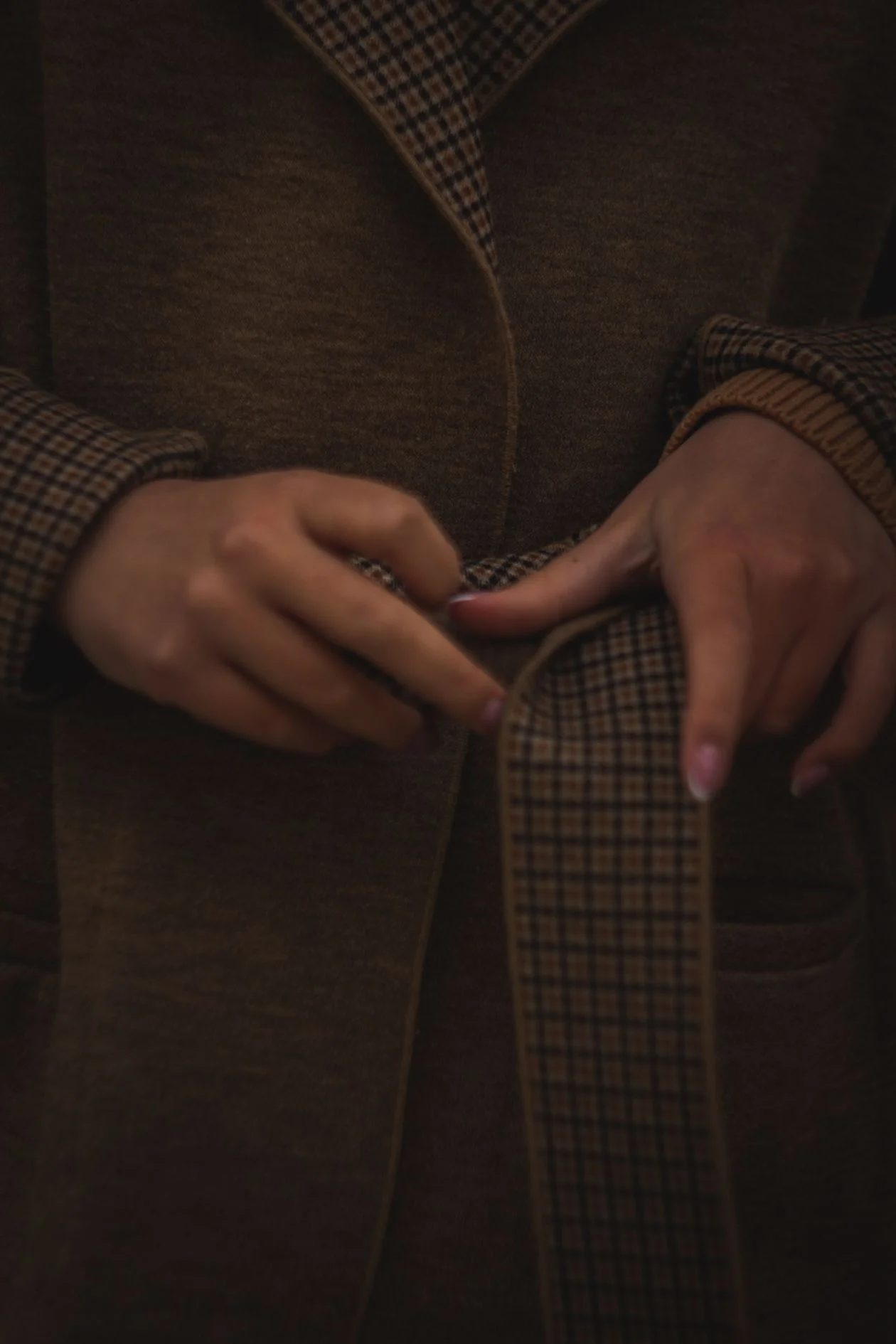
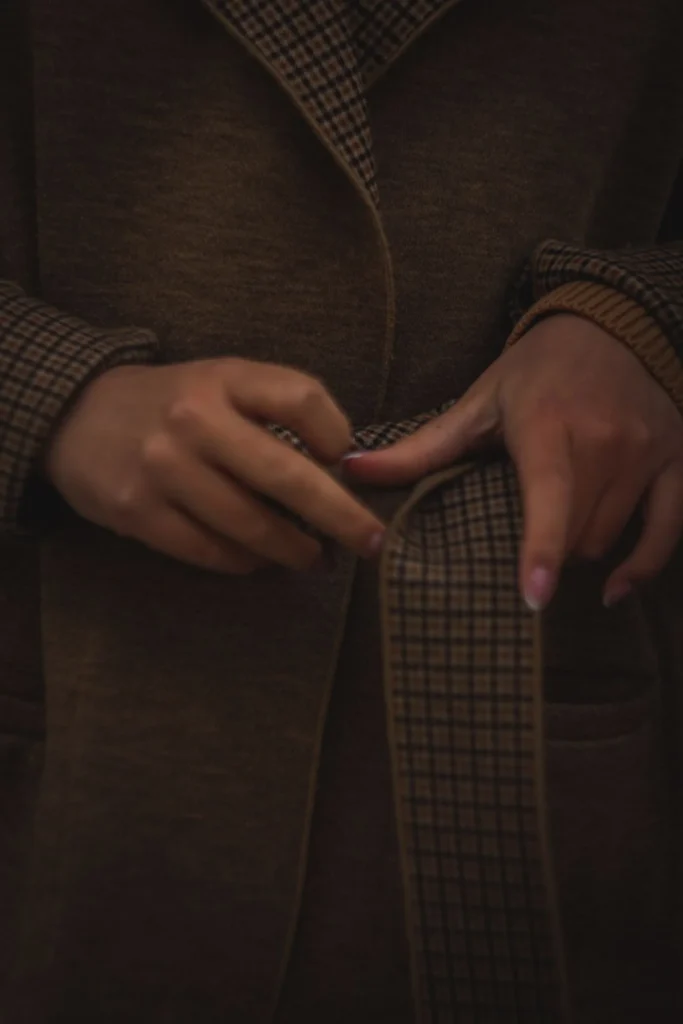
The whole trick in one gesture: the belt sits at the waist, flat and deliberate, over the thickest layer.
First, find your waist under the layers
You cannot belt a waist you cannot find, and winter layers hide it. Before you pick up a belt, put the outfit on and look for the narrowest point of your torso with the coat closed. On most people it sits a few inches above the belly button — higher than you think, especially in a long coat, where the coat’s own waistline can sit inches lower. Belt at the coat’s waistline, or at your hips, and the belt cuts the body at its widest part.
Stand sideways and check the back, too. A belt that looks right from the front and twists or rides up at the back is not sitting at your waist — it is sitting on a fold of fabric. Smooth the layers flat first: pull the knit down, straighten the coat’s back panel, then place the belt.
The other thing to check is how many layers are under the belt. Three thin layers belt well; one chunky layer plus a coat does not always — the belt has to compress all of it at once. If the belt will not lie flat no matter how you tie it, the problem is usually the layer underneath, not the belt. How to layer clothes in winter without looking bulky is the fix — a thermal base, a fine knit and the coat, with nothing chunky in the middle, gives the belt a smooth surface.
Belt width vs knit weight: the rule that matters
This is the rule the whole article hangs on: the belt must be heavy enough to press through the layer, light enough not to fight it. A thin, flimsy belt over a chunky knit sinks into the wool and disappears; a wide, stiff belt over a fine knit folds the fabric into a ridge.
| Layer underneath | Belt width | Belt type |
|---|---|---|
| Fine knit, silk blouse, thin dress | 1–2 cm (slim) | Thin leather, suede or chain |
| Mid-weight knit, cardigan, shirt dress | 2.5–4 cm (medium) | Smooth leather with a small buckle |
| Heavy wool coat | 4–6 cm (wide) | Wide leather, or the coat’s own fabric belt |
| Oversized or puffer coat | 4–6 cm (wide) | Wide leather with a sturdy buckle, or a fabric sash |
A medium belt, around 2.5 to 4 cm, is the most useful width you can own: it shows over a cardigan, holds on a mid-weight coat, and does not overwhelm a dress. If you only buy one belt for winter, buy that — in smooth black or dark brown leather, with a simple buckle. A large statement buckle is the focal point of the outfit, so pair it with a plain coat; a small flat buckle lets the belt work quietly.
Texture is the second half of the rule. Smooth leather is the safest partner for winter knits, because it slides over wool instead of catching on it. A woven or suede belt grips chunky knit nicely — good for holding power, bad if you need to adjust it during the day. Fabric belts, the ones that come with the coat, match best and tie softest, but they stretch over a season, so check the knot before you leave the house.
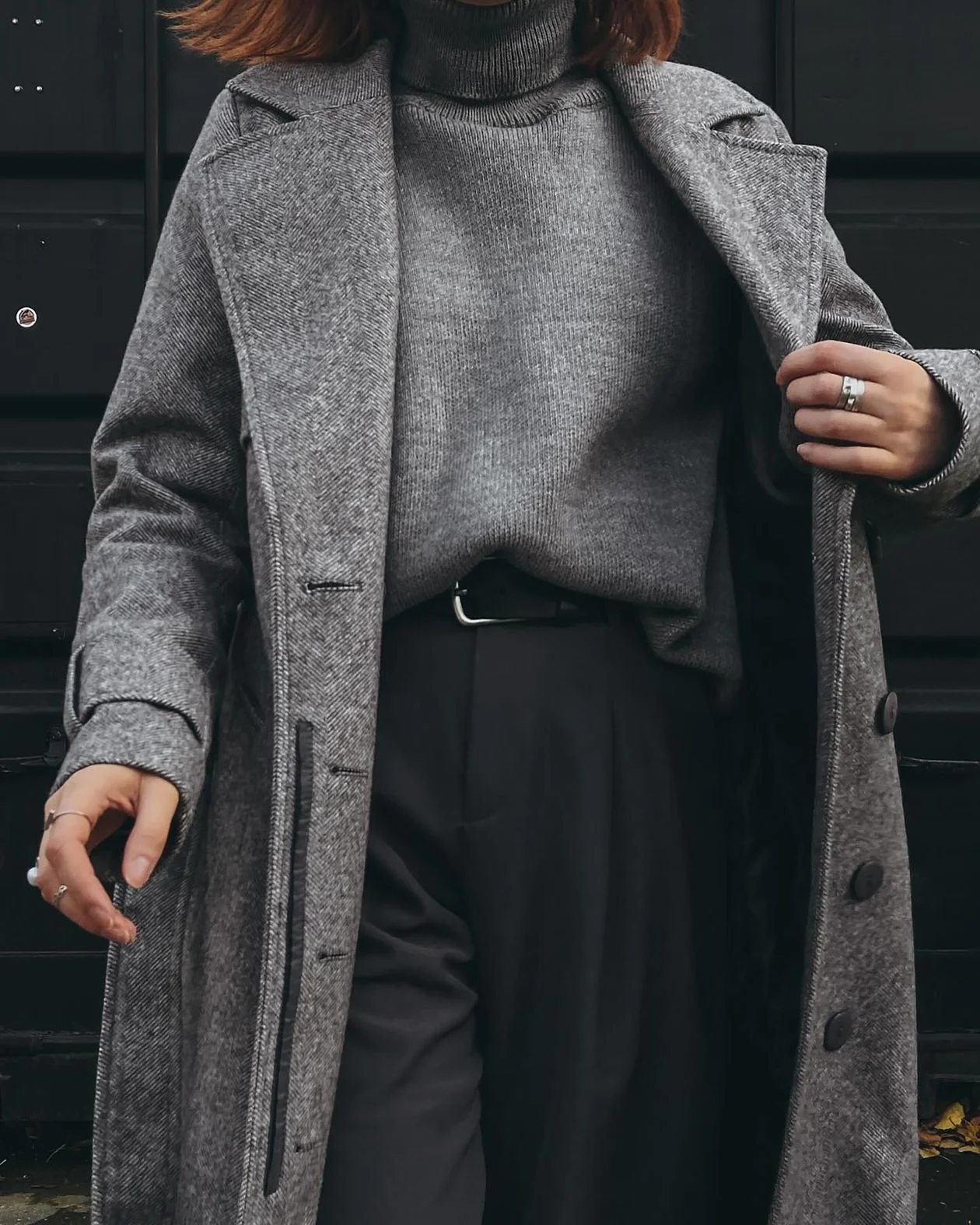
A mid-weight coat over a fine knit is the easiest place to start — the belt has something firm to press against.
Belting a coat
A coat is the hardest layer to belt well and the most rewarding, because it is the layer everyone sees. Start with the coat’s own belt if it has one: it matches the fabric and was designed for the coat’s weight. A funnel-neck coat is the purest case — with no waist seam, the belt is the only thing giving it a shape. The trench coat in winter is the original belted coat, and its buckle and knot habits carry straight over to wool. If the coat came with a fabric belt and you lost it, a wide leather belt in a matching colour is the replacement — not a thin belt, which will cut across the wool instead of shaping it.
The knot is where most coat belts go wrong. Thick wool cannot be gathered the way cotton can, so a full bow on a heavy coat layers the fabric four or five times in one spot and adds visible bulk to the waist. How to tie a belt on a coat explains why, with the fixes: use a flat knot or a half-bow, keep the loose ends at least 15 cm long so they hang vertically, and shift the knot 5 to 7 cm off-centre, toward the hip, which lengthens the silhouette.
How tight is tight enough? The belt should designate the waist, not squeeze it. If the fabric pulls across the back, or deep horizontal folds appear when you sit, the belt is too tight — loosen it and let the coat skim. A structured belted coat works the same way: the belt sits at the narrowest point, the coat flares or falls straight from there, and worn loose it still leaves room for a chunky knit. No belt loops? A sturdy buckle or a tied knot grips well enough, as long as the belt is wide enough to stay put.
Belting a cardigan or a knit
Over a knit, the belt is doing a different job: giving shape to something that has none. A long open cardigan belted at the waist turns into a coat-like silhouette; a chunky knit belted loosely reads as intentional rather than oversized. The knit must be the layer on top — belt over the cardigan, never under it, and never put a coat over a belted knit, or the belt bunches into a ridge.
Width matters even more here than on a coat, because knits are soft. A thin belt over a chunky knit disappears; a wide belt over a fine knit folds the fabric. For an open cardigan, use a medium leather belt and leave the top button undone, so the neckline stays relaxed and the knit blouses gently over the belt. For a closed chunky cardigan worn as a coat, go wide: the belt has to hold the whole weight of the knit, and a medium belt will slide down over the day.
Watch the back. A belt over a knit can ride up when you sit, and a cardigan’s hem can flip out above the belt. Fix it by pulling the knit down and smoothing it under the belt before you leave, and by choosing a belt with a buckle that grips — a smooth belt on a smooth knit slips, while a belt with a little texture holds.

Over a knit, the belt is the structure — choose it the way you would choose the knit itself.
Belting a dress in winter
A dress is the easiest layer to belt, because there is only one layer to deal with. A knit dress with a belt at the waist is the whole outfit — add a coat over the top, belted too, or leave the coat open so the dress belt shows. A sweater dress in winter with a medium leather belt and knee-high boots works for evenings, offices and dinners alike.
The width rule still applies, but the knit weight decides it: a fine ribbed dress takes a slim or medium belt, a chunky knit dress needs a wide one. Over a dress, a belt can also carry colour — tan over black, burgundy over cream — so keep the buckle simple.
The one mistake is belting a dress and then covering the belt completely. A coat worn open shows the belt; a coat worn closed and belted over the top hides it entirely, so take the dress belt off and belt the coat instead. Two belts is the line between styled and overdone.

A long wool coat belted at the waist reads as an outfit, not a blanket — even on a cold platform.
Petite and tall notes
The same belt behaves differently at different heights, because what it draws is a line across the body — and the length of the line matters.
If you are petite: use a narrower belt and a shorter coat. A wide belt on a petite frame takes up a large share of the torso and shortens it visually, while a slim or medium belt defines the waist without cutting the body in half. Keep the hem at or just below the knee, and the outfit one colour from collar to hem. Dress petite without tailoring covers the proportion rules behind this. On a shorter torso, a big bow eats the whole waist, so tie a flat knot or a half-bow. Wearing an oversized coat on a petite frame works the same way — the belt stops the coat swallowing you, but only if it is narrow enough to read as a waist rather than a band.
If you are tall: you can carry the pieces a petite frame cannot. A wide belt, a full-length hem and larger lapels all work, because the torso is long enough to take a strong horizontal line without looking cut in half. The risk at your height is the opposite one: a thin belt disappears against a long coat, so go medium or wide, and check the belt is long enough — a belt that only just fastens pulls the coat tight and rides up.
Common mistakes and how to fix them
- Belting the hips. The belt cuts the body at its widest point. Fix: belt the narrowest point of the torso — a few inches above the belly button.
- Too thin for the knit. It sinks into the wool. Fix: match width to weight — wide for heavy layers, slim for fine ones.
- A full bow on heavy wool. Layers the fabric four or five times in one spot and adds bulk. Fix: a flat knot or a half-bow, ends at least 15 cm long.
- Belting under a coat. The belt bunches and shows as a ridge. Fix: belt the outermost layer only.
- Pulling too tight. Deep folds across the back and a squeezed waist. Fix: the belt designates the waist; it should skim, not compress.
- Two belts. A belted dress under a belted coat is one too many. Fix: belt the coat, or wear it open.
Frequently asked questions
Can you wear a belt over a puffer coat?
Yes, but only a wide, sturdy belt with a strong buckle — a thin belt slides off nylon and a fabric sash will not hold. Belt it loosely at your natural waist. The belt defines the shape; it does not flatten the coat.
What belt width works over a chunky knit?
A wide belt, 4 to 6 cm, in smooth or slightly textured leather. A slim belt disappears into chunky stitches, and a medium belt slides down over the day. Let the knit blouse gently over the belt rather than pulling it flat.
Should the belt match the coat or contrast with it?
Matching is the safe choice — the coat’s own belt, or leather in the same colour family. Contrast works when the outfit is plain: tan over black, or burgundy over cream. Keep the buckle simple if the belt contrasts.
How do I stop a belt sliding down over a knit?
Choose a belt with a little texture or a buckle that grips, and make sure the width matches the knit — a belt that is too narrow for the layer will always slide.
Can a belt work if I carry weight around my middle?
Yes, with a lighter touch: a coat that skims rather than clings, and a belt a little above your natural waist, tied loosely. If the knot adds bulk, remove the belt and wear the coat open, or swap the fabric belt for a stiff, medium-width leather belt fastened flat.
Conclusion
A belt over winter layers works when it respects the layers: the right width for the weight, at the natural waist, tied flat on thick fabric. Get those three right and one belt turns a rectangle of wool into an outfit with a shape — on a coat, a cardigan or a dress.