
The Jeans That Fit Everywhere Except the Waist
The jeans slide over your hips beautifully. The seat sits smoothly, the thighs have room, the length is right. Then you turn around: a gap at the back of the waistband, big enough to slide a hand through. Size down, and now the waist fits but the hips pull and the pockets flare.
It is not your body that is wrong. Most jeans are patterned on a fairly small difference between the waist and the hips, and many real bodies have a much bigger difference than that. The best jeans for different waist-to-hip proportions are the ones whose pattern already expects a bigger difference.

The Quick Answer
- Measure your waist and hips. The difference — not your dress size — tells you how “curvy” a cut you need.
- Buy for your hips, fix the waist. Pick the size that fits your hips and seat smoothly.
- Look for a contoured waistband — higher at the back, lower at the front.
- Choose a high or mid rise that reaches your natural waist, where your body is narrowest.
- Check the fabric label. A little stretch with good recovery — roughly 1–2% elastane.
Measure First: Your Waist-to-Hip Difference
Take two measurements. Natural waist: the narrowest part of your torso, usually an inch or two above your belly button. Stand relaxed, breathe out, and hold the tape level. Fullest hip: the widest point of your hips and seat, tape level, feet together.

Subtract the waist from the hips. Around 8 inches (about 20 cm) or less is close to what many standard “regular fit” jeans are patterned for. Around 9–11 inches (about 23–28 cm) is where the classic waist gap usually starts. 12 inches (about 30 cm) or more is a strong signal to shop curvy fits first and look for a contoured waistband.
For jeans shopping, the simple difference matters more than the “waist-to-hip ratio” (waist divided by hips). Keep both numbers in your phone.
What your numbers suggest: hips much wider than waist (pear or hourglass) — shop curvy fits, contoured waistbands, high or mid rise, and buy for the hips. Waist and hips fairly close — regular fits are usually fine. Waist wider than hips — the reverse problem; look for straight or relaxed fits.
Waistband Shapes Explained
The waistband is where the waist gap lives, so it deserves more attention than the wash or the brand name.
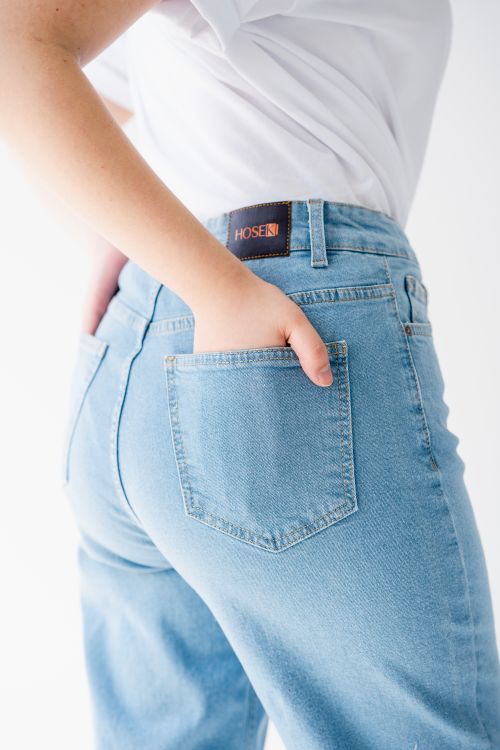
Straight waistband. A band cut in a straight line, the same height all the way around — the cheapest and most common construction, and the main culprit behind the waist gap.
Contoured or curved waistband. Also sold as a “no-gap waistband”, this is cut in a curve — higher at the back, lower at the front — following the shape of a real waist.
Darted waistband. Small darts — short, stitched folds — at the back take in a little extra fabric where the gap usually appears. A halfway solution.
Elasticated waistband. It stretches to fit, which sounds ideal — and sometimes is, for comfort. But elastic can bunch, roll, and look less polished under a tucked-in top.
The takeaway: check the waistband first. Straight means “likely to gap”; contoured means “designed for your shape”.
Rise Explained: What It Is, and Why the Numbers Disagree
Rise is the distance from the crotch seam to the top of the waistband. It decides whether the waistband lands on your narrow natural waist, where it can grip, or lower down, where it has nothing to hold on to.
- High rise sits at or just above the natural waist. For most people with a big waist-to-hip difference, this is the most reliable choice.
- Mid rise sits a little below the natural waist, around the belly button. It works well for many hourglass and pear shapes.
- Low rise sits on the hips, well below the natural waist. It is the hardest rise to fit when your waist is much smaller than your hips, because the waistband sits where your body is widest. If you love the look, our guide to low-rise jeans styled the Y2K way shows how to wear it.
Different guides give different rise numbers, and neither side is necessarily wrong. One guide lists high rise at 10–12 inches and low rise at 6–7 inches; another lists high rise at 9.5–11 inches and low rise at 7–8 inches. Brands measure differently and label inconsistently, and rise grows with size. Treat any rise table as approximate and brand-dependent.
Leg Cuts: Which Shape Works With Your Proportions
The leg cut does not fix the waist gap by itself.
- Straight leg: the safest all-rounder. With a curvy fit and a high rise, it is the classic answer for a pear shape.
- Wide leg: adds volume below the knee, evening out the silhouette. Best with a high rise and a contoured waistband.
- Bootcut and flare: a flare from the knee down balances wider hips. High-rise flares suit hourglass and pear shapes.
- Skinny: the hardest cut for a big waist-to-hip difference. If you love skinnies, look for a curvy fit with good stretch recovery and a contoured waistband.
Rise x leg-cut comparison
| Rise | Leg cut | Likely result for a big waist-to-hip difference | Watch out for |
|---|---|---|---|
| High rise | Straight leg | The most reliable combination | A straight waistband can still gap |
| High rise | Wide leg | Balanced silhouette | Can swamp a petite frame |
| High rise | Bootcut or flare | Classic hourglass and pear pairing | Flare needs the right shoe height |
| Mid rise | Straight leg | A good everyday option | Gap can return |
Remember: the rise numbers behind this table are approximate and brand-dependent.
Fabric and Stretch Recovery: The Part Nobody Checks
Two pairs of jeans can look identical on the hanger and behave completely differently by lunchtime.

- Composition sweet spot: roughly 90–95% cotton, a few percent polyester, and 1–2% elastane (also labelled spandex). That small amount of elastane gives enough give to fit over the hips, while the cotton keeps the shape.
- Stretch recovery matters more than stretch. “Soft stretch” feels comfortable at first but bags out at the knees and seat through the day — and a baggy seat makes a waist gap look worse. “High-retention stretch” snaps back. Sit, stand, and walk in them: if the knees stay baggy, the recovery is poor.
- Too much stretch is a warning sign. Very high elastane content, or a fabric that feels like leggings, will stretch to fit in the shop and keep stretching through the day.
The practical rule: read the label before you buy. If it says 1–2% elastane with mostly cotton, you are in the right territory.
Fit-Problem Checklist: What Is Wrong, and What to Try First
| Problem | Likely cause | Try this first |
|---|---|---|
| Gape at the back waist | Straight waistband; pattern expects a smaller waist-to-hip difference | Switch to a contoured waistband or a curvy fit |
| Pulling across the hips or thighs | Size chosen for the waist, not the hips | Size up to fit the hips, then fix the waist separately |
| Sagging at the seat | Too much stretch or poor recovery | Try a firmer fabric with 1–2% elastane |
| Jeans slide down through the day | Waistband sits below the natural waist | Try a higher rise, a contoured waistband, or a firmer fabric |
| Waistband digs in when you sit | Rise too short, or waistband too tight from sizing down | Go up a size and fix the waist another way |
How to Fix a Waist Gap: Belt vs Button vs Elastic vs Darts vs Tailor
Sometimes the pair is nearly perfect except for the gap.
| Fix | Cost (where verified) | Sewing needed? | Permanence | Best for |
|---|---|---|---|---|
| Belt | Not verified | No | Temporary | A small gap |
| Adjustable jean button / waistband reducer | About $10 | No | Removable | A small to medium gap; the quickest no-sew fix |
| Elastic insert at the back waist | Not verified | Yes, usually | Semi-permanent | A small gap |
| Darts at the back waist | Not verified | Yes | Permanent | A medium gap |
| Tailor takes in the back waistband | About $15–20 in one guide; $20–40 in another | Yes (by the tailor) | Permanent | A medium to large gap |
A belt can pull a small gap closed, but it cannot fix a waistband that is fundamentally the wrong shape. Sizing down also backfires: the waist fits, but the hips pull. Buy for the hips, then fix the waist.
Outfit Examples: Jeans That Fit, Styled Three Ways
These are hypothetical examples.
Everyday — high-rise straight leg, white shirt, trainers. A high-rise straight-leg pair in a mid-blue wash, with a contoured waistband, tucked into a crisp white shirt, plus white trainers and a cross-body bag. This is the pair to build a quiet-luxury capsule wardrobe around.
Work — high-rise wide leg, blouse, loafers. A dark-wash, high-rise wide-leg pair with a blouse tucked in and a blazer over the top, finished with loafers. For the polished, classic side of this look, see our guide to old-money styling on a budget. If you are building a work wardrobe on a budget, our guide to capsule wardrobe on a budget shows how to make a few good pieces do the work of many.
Casual weekend — mid-rise bootcut, knit jumper, ankle boots. A mid-rise bootcut in a light wash, worn with a soft knit jumper half-tucked at the front and ankle boots. For more combinations, see these outfit ideas that look expensive.
Common Mistakes and Fixes
- Buying your usual size without checking the size chart. Fix: buy the size that fits your hips.
- Sizing down to close the waist gap. Fix: buy for the hips and fix the waist with a button, darts, or a tailor.
- Ignoring the waistband shape. Fix: look for “contoured”, “curved” or “no-gap” in the product description.
- Assuming curvy fit means plus size. Fix: curvy fit describes the waist-to-hip difference in the pattern, not a size range.
Shopping Guidance: How to Choose Without Endless Trying-On
- Start with your measurements, not the size label. Keep your waist, hip and difference numbers in your phone, and compare them against the size chart before you order.
- Filter for curvy fit first if your waist-to-hip difference is large, then narrow by rise and waistband shape.
- Read the product description for the waistband. “Contoured”, “curved” or “no-gap waistband” are the words you want to see. If the description says nothing about the waistband, assume it is straight.
- Read the fabric label. Look for mostly cotton with 1–2% elastane, and be cautious about very high stretch.
- Try on with the top you will wear. A tucked-in shirt shows the waistband honestly. Check the fit standing, sitting, and walking.
- Do not buy three almost-right pairs. One pair that fits is better value than three that gap, pull, or slide down. No prices or availability are claimed here, because they were not verified.
- No single brand is the answer. Fit varies by style and season even within one brand.
Frequently Asked Questions
What are the best jeans for a small waist and wide hips?
Look for a curvy fit — patterned with a bigger waist-to-hip difference — with a contoured waistband and a high or mid rise. Buy the size that fits your hips, then fix any remaining gap with a button, darts, or a tailor.
Why do my jeans gap at the waist but fit the hips?
Because the jeans were patterned on a smaller waist-to-hip difference than your body has. When the hips fit, the waistband has extra fabric with nowhere to go.
How can I fix a jeans waist gap without sewing?
An adjustable jean button costs about $10, takes around five minutes to fit, and needs no sewing. A belt can also close a small gap.
What is the difference between curvy fit jeans and regular jeans?
A curvy fit is patterned with a bigger waist-to-hip difference — more room at the hip and seat, less fabric at the waist. A regular fit is patterned on a smaller difference.
Should I get my jeans tailored, or buy a curvy fit?
Try a curvy fit first — it often solves the problem on its own. If a pair you love still gaps, a tailor taking in the back waistband is the neatest fix.
Conclusion
The waist gap is a pattern problem, not a body problem. Once you know your waist-to-hip difference, the fix becomes a method: buy for your hips, look for a contoured waistband, choose a rise that lands on your natural waist. A $10 jean button or a tailor visit can rescue a pair that is otherwise perfect.