


A second skin maxi dress winter layering plan starts with one honest fact: the dress itself is not warm. A second-skin maxi is a long, body-skimming dress — the shape Vogue names among Fall 2026’s key trends — and it is made to be seen, not to insulate. That does not make it a summer-only dress. It makes it a layering project: a warm base nobody sees, a fitted middle that keeps the line, and a coat and boots that close the gaps at the hem and the neck. Get those three parts right and the dress looks as the runway intended — a clean, unbroken column — while you stay warm underneath it.
Second skin maxi dress winter layering: the quick answer
Start with the dress: a fitted, full-length maxi in a fabric with weight — jersey, ribbed knit or a heavier crepe — in black, chocolate, navy or burgundy. Underneath it, wear a close-fitting thermal top and fleece-lined tights or thermal leggings: both disappear under the long skirt. Over it, wear a long wool or maxi coat, worn open or belted, and closed boots — knee-high boots for the warmest days, heeled ankle boots when the dress is floor-length. Keep the top half fitted and the colours in one tight palette: nothing bulky goes under a second-skin dress, because anything bulky breaks the line.

The second-skin maxi in its simplest form: a fitted black column, full-length, with no volume of its own — the line is the whole design.
Why a second-skin maxi, and why this winter?
Vogue names the Second-Skin Maxi among Fall 2026’s key trends: long, body-skimming silhouettes that create a clean, uninterrupted line rather than relying on volume. The runway versions were shown at Alaïa — including a turtleneck maxi — and at Khaite and Valentino, where body-hugging silhouettes and sheer layers celebrated the female form. The wearable version is simpler: long knitted dresses, jersey maxis, turtleneck dresses or plain columns. The point is not the tightness; it is the line. A second-skin maxi gives winter dressing a straight, unbroken vertical, and that vertical is what makes a long coat and tall boots look so put-together over it. The catch is warmth: a fitted dress leaves no room for a chunky knit underneath, so the warmth must come from thin layers, good legwear and the coat.
What is a second-skin maxi dress?
A second-skin maxi is a full-length dress that follows the body from shoulder to hem — fitted, not flared, with no volume of its own. The bodice is close, the waist is defined by the cut, and the skirt skims the hips and legs in one straight column to the ankle or the floor. It is not a sweater dress and it is not a slip dress. A sweater dress is defined by its knit — see how to style a sweater dress in winter — and a slip dress is loose and bias-cut. A second-skin maxi is defined by its line. The fabric makes it wearable in winter: a jersey, ribbed knit or heavy crepe holds the line, while a thin viscose or unlined polyester clings to tights and loses its shape. Choose a fabric with weight and a touch of stretch, so the dress moves with you — and check the neckline and sleeves: a long-sleeved turtleneck version is a winter dress already, while a sleeveless one needs a layer underneath.
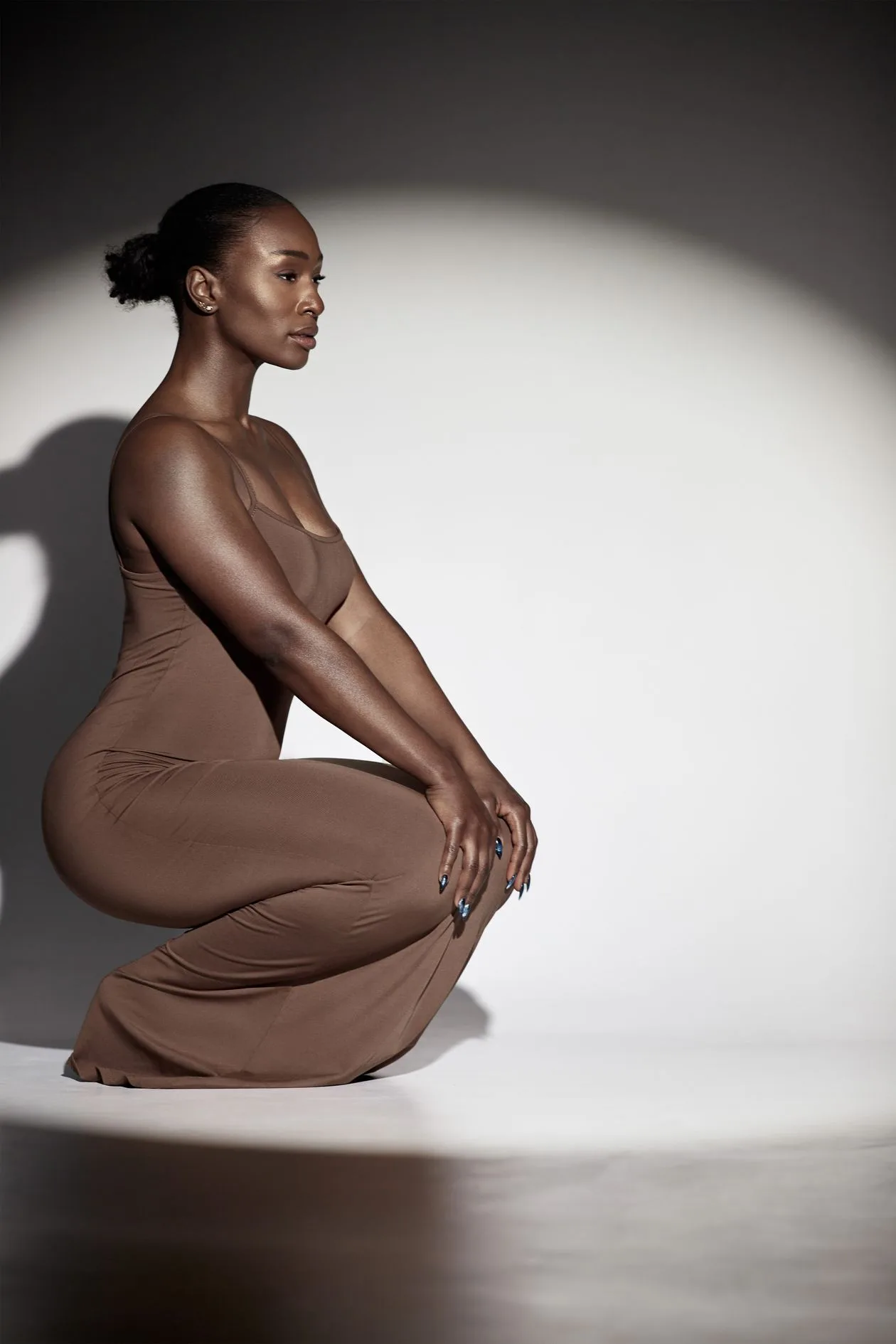
A jersey second-skin maxi in a warm brown: the fabric has enough body to hold the line on its own, which is what a fitted dress needs in winter.
Choosing the right one: fabric, fit, neckline and length
Start with fabric. A second-skin maxi needs weight: a ribbed knit, a jersey with body, a heavy crepe or a velvet. Thin fabric clings to tights, shows every layer underneath and goes cold fast. Next, fit. The dress should skim, not squeeze — if it pulls across the hips or rides up when you walk, it is a size too small, and no layering will fix it. Size up slightly for a thermal underneath; the dress should still skim. Third, neckline and sleeves. A high neck or long sleeves do real warming work, so a turtleneck maxi is the easiest winter buy. A sleeveless or scoop-neck maxi needs a roll-neck underneath, which changes the neckline entirely — decide before you buy. Fourth, length. Ankle length is the most useful in winter: it covers the leg, clears the ground, and works with both boot heights. A floor-length maxi is an evening shape — it drags in slush and needs heeled boots. Colour last: black is the most forgiving under layers, and a pale dress shows every thermal line underneath.
| Dress | Best for | Wear with |
|---|---|---|
| Ribbed knit maxi | Cold days, everyday | Thermal base, knee-high boots |
| Jersey column maxi | Work, evenings | Roll-neck under, long coat |
| Turtleneck maxi | Easiest winter buy | Tights, ankle boots |
| Velvet maxi | Evenings | Thermal base, long coat |

The fit to aim for: the dress skims the body without squeezing, and the fabric springs back rather than clinging. This shot shows the dress only — the boots and coat come from the guide, not the photo.
The layering system: base, middle and outer
The system has three layers, and each one does one job. The base layer sits closest to the skin and traps body heat before it escapes: a close-fitting thermal top and thermal tights or fleece-lined leggings. Keep it slim — anything bulky here breaks the dress’s line — and keep it smooth, with flat seams, so it does not show through the fabric. Seamless thermals are worth the extra cost under a second-skin dress. The middle layer adds warmth and shape: a fine roll-neck under a sleeveless dress, or a fitted cardigan over the dress, cinched with a thin belt to keep the waist defined. A chunky knit over a second-skin maxi works only open and long, worn like a coat; tucked into the dress’s line it makes the outfit heavy. The outer layer handles the weather: a long wool coat or a maxi coat that covers the dress. For the full base-layer explainer — weights and fabrics — see thermal base layers explained.
Legwear and boots: closing the gap
Cold legs undo a warm outfit, so the gap below the hem deserves a real plan. The thickness of your tights, measured in denier, is the quickest lever you have: finer tights, up to about 40 denier, suit mild days; from around 60 denier, opaque tights suit cold days; and in hard frost, thermal or fleece-lined tights — layered over thin leggings if the wind bites — are the answer. That denier guide comes from C&A’s winter-dress guide, built on a warm base, an insulating middle and a weatherproof outer piece. For the full tights guide — denier, fleece-lined and opaque — see how to choose tights for winter. Boots close the look. With an ankle-length maxi, knee-high boots are the warmest choice: the shaft disappears under the skirt and leaves one unbroken vertical line. With a floor-length maxi, heeled ankle boots are better — the hem covers the leg, and a taller boot would bunch under it. For the boot length rules, see how to style knee-high boots in winter. One warning: textured or fuzzy tights can grab a knit dress and make it ride up — smooth tights help it glide.
Coats that work over a maxi
A coat is the layer everyone sees first, so match it to the dress: a clean line, a coat that skims the dress rather than fighting it. A long wool coat is the dependable choice — longline styles cover a maxi neatly, and a belted open coat echoes the waist underneath. A maxi coat is the dramatic one: it matches the dress’s length and turns the whole outfit into one column. For the length and proportion rules, see how to style a maxi coat in winter. A cropped coat or a puffer is the wrong partner for a fitted maxi: a cropped coat chops the line at the waist, and a puffer adds bulk where the dress has none. If you are choosing between coats, how to choose a winter coat covers wool, puffer, trench and faux fur. Length is the detail most people miss: a coat that ends a touch above or below the dress hem looks intentional, while one landing mid-hem chops the outfit in half.
Outfit formulas: day, work and evening
For a daytime look: a black ribbed-knit maxi, a thermal top and fleece-lined tights underneath, knee-high boots, and a long wool coat left open. Keep the palette in one family — black, charcoal, chocolate — so the layers read as one outfit.
For work: a navy or charcoal jersey column maxi, a fine roll-neck underneath if the dress is sleeveless, opaque tights, heeled knee-high boots and a long tailored coat. Keep jewellery simple and the bag structured.
For evenings: a velvet or satin maxi in burgundy or black, a thermal base underneath that nobody sees, heeled ankle boots, and a long coat. The heat comes from the layers.

The evening version: a high-neck fitted maxi in a saturated colour, with the warmth hidden underneath it — a thermal base, tights and heeled boots.
For the coldest days: a turtleneck maxi, thermal top and leggings, fleece-lined tights, knee-high boots, a scarf and a long wool coat. If it still feels cold, swap the middle layer for a long open cardigan worn like a coat, belted at the waist.
Accessories: what works with a fitted maxi
Accessories should protect the line, not compete with it. A thin belt over the dress — or over a cardigan worn over the dress — keeps the waist defined; a wide belt breaks the column. A long scarf warms the neck and, worn open, frames the torso; a bulky knit scarf hides the dress’s shoulders, so keep it fine. Bags stay structured and on the shoulder or in the hand: a slouchy bag at the hip fights the fitted line. Jewellery stays small and close to the face — studs, a short chain, small hoops — because the dress is the statement, and anything long or heavy pulls the eye away from its line. Leather gloves in black or dark brown keep the hands warm under a long coat without adding anything to the silhouette.
Common mistakes and how to fix them
- Wearing a chunky knit under a fitted maxi. It breaks the line and adds bulk where the dress has none. Fix: a thin thermal or fine roll-neck, and keep the knit on top, open, like a coat.
- Going bare-legged under a maxi in the cold. The long hem hides the legs, so it feels like you can skip tights — you can’t. Fix: opaque or fleece-lined tights.
- Choosing a thin, clingy fabric. It shows every thermal line and grabs at tights. Fix: a jersey, ribbed knit or heavy crepe.
- Wearing a cropped coat over a maxi. It chops the column at the waist. Fix: a long coat that skims the dress.
- Sizing down for a tighter fit. A dress that pulls across the hips rides up when you walk. Fix: size up slightly, and let it skim.
- Forgetting static. A fitted dress over nylon tights builds static and clings. Fix: cotton-rich tights, which charge far less than nylon.
Shopping guidance: what to buy first
Buy the best fabric you can afford — a ribbed knit or a jersey with real weight — because the fabric holds the line, and cheap, thin fabric makes a second-skin maxi cling, crease and go cold. Before you pay, check three things: the dress should skim, not squeeze, and spring back when you sit and stand; the hem should clear the ground by a couple of centimetres in the boots you will wear; and the neckline and sleeves should match the layers you already own — a turtleneck maxi needs no roll-neck, a sleeveless one does. No prices are promised here, because they change by store and season. If the budget stretches to one maxi this winter, make it a black ribbed-knit turtleneck maxi: the warmest shape, it takes thermals invisibly and works with the boots and coat you already own.
Frequently asked questions
Can you wear a second-skin maxi dress in winter?
Yes — a thermal base underneath, fleece-lined tights, closed boots and a long coat over the top. The dress itself is not warm; the layers do the warming.
What do you wear under a fitted maxi dress to stay warm?
A close-fitting thermal top and fleece-lined tights or thermal leggings, both smooth and seamless so they do not show through the fabric.
What coat goes over a maxi dress?
A long wool coat or a maxi coat, ending a touch above or below the dress hem. Avoid a cropped coat — it chops the line at the waist.
Which boots work with a maxi dress in winter?
Knee-high boots with an ankle-length maxi, heeled ankle boots with a floor-length one. Both must be closed and warm.
Can you wear tights under a maxi dress?
Yes — and you should. Opaque tights from around 60 denier on cold days, fleece-lined tights in hard frost.
Is a second-skin maxi dress flattering for every body type?
The line suits most frames when the dress skims rather than squeezes. Size up slightly if it pulls.
Conclusion
A second-skin maxi is not a summer dress that wandered into winter — it is one of Fall 2026’s defining silhouettes, and it was made to be layered. Keep the line clean, put the warmth where nobody sees it, and let a long coat and the right boots finish the column.