

Modest winter fashion is not harder than other winter dressing — it is the same problem with higher stakes. Every winter outfit has to balance warmth, movement and style. A modest winter outfit has to do that while keeping the coverage you want. Modesty is personal, and this guide makes no claims about what any faith requires — it is practical advice for the coverage you have chosen. The answer is not more clothes. It is a system — a quiet base layer, a middle layer that stands on its own, and an outer layer chosen for the actual day.
Modest winter fashion: the quick answer
Build the outfit in three layers. Start with a smooth, close-fitting base: a long-sleeved thermal top and leggings or opaque tights that stop cold gaps without adding bulk. Add a middle layer complete on its own indoors — a long dress, an abaya, a tunic with wide-leg trousers, or a long skirt with a knit. Finish with a long coat that closes securely, has room in the sleeves and shoulders for everything underneath, and leaves the hem protected. Choose winter hijab fabrics — wool, jersey or a thick cotton blend — with an underscarf that keeps the hijab in place under the coat.
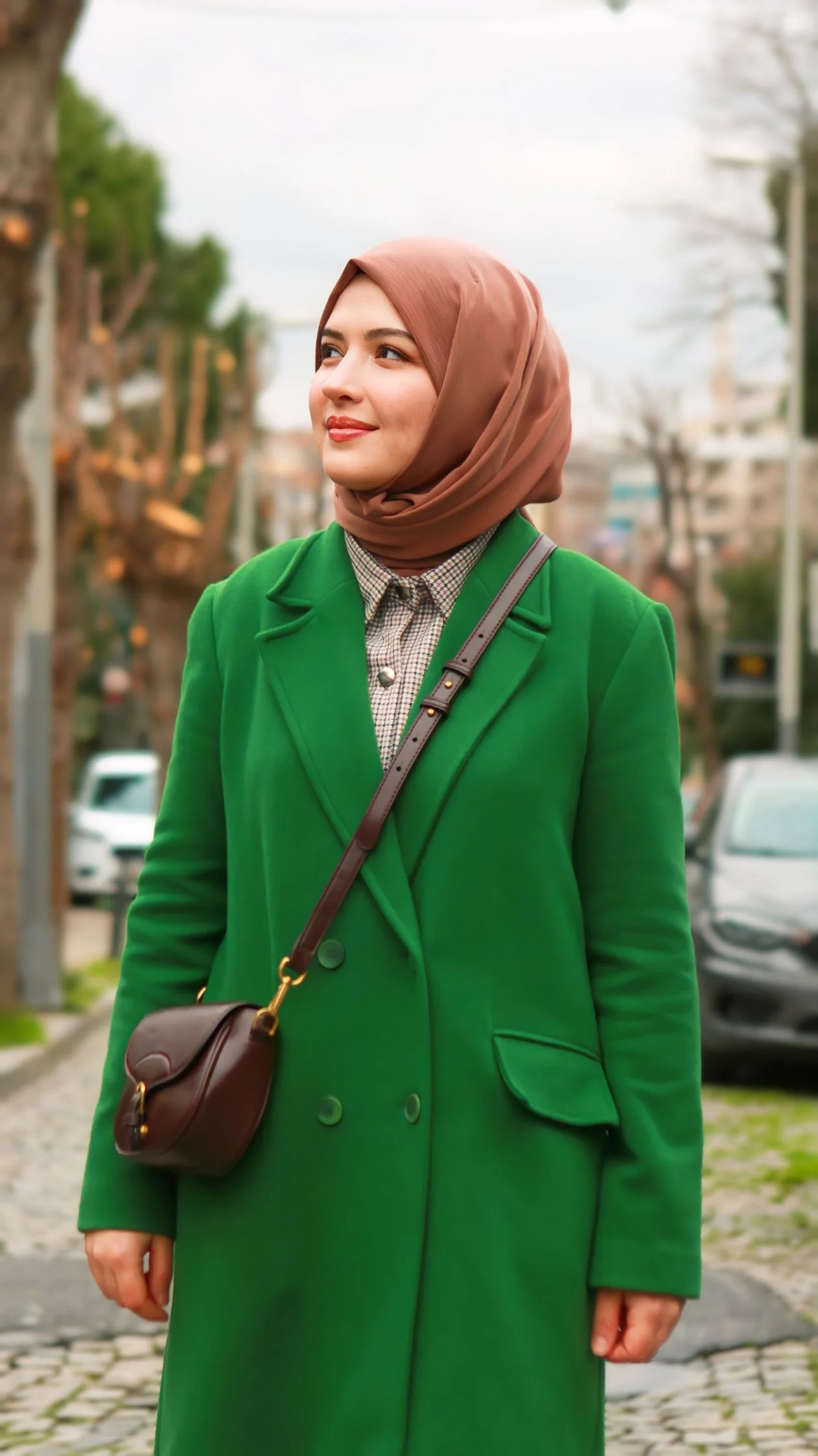
Modest winter fashion in one look: a long wool coat, a warm headscarf, and layers underneath that do the warming.
The layering system: base, middle and outer
Good modest winter wear is not a pile of thick garments. It is a system, and each layer has one job. Good modest winter wear is not a pile of thick garments — the layer closest to the body should make the rest of the outfit easier, not bulkier; the middle layer should remain complete when the coat comes off; and the outer layer should suit the rain, wind, damp or cold you actually have. Think of it as the layering pyramid: a base that touches the skin, an insulating middle, and an outer layer that protects against wind and moisture.
The base layer is the quiet one: a long-sleeved thermal top in a smooth fabric, and leggings or tights underneath a dress or skirt, closing the gaps where cold air gets in — at the waist, the wrists and the ankles — without changing the look of the outfit. If the base layer rolls at the waist or shows through pale fabric, every layer above it starts from a problem. For the details, read our guide to thermal base layers.
The middle layer is the visible outfit: the long dress, the abaya, the tunic and trousers, or the skirt and knit. It has to work indoors, because shops, homes, offices and prayer spaces are warm enough that the coat comes off quickly. Check it without the coat: the neckline, the sleeve length, and the hem after sitting. The outer layer is the weather answer: it should close securely enough for wind, leave the lower garment protected from rain, and have enough sleeve and shoulder room over the middle layer.
Hijab-aware layering: the hijab, the scarf and the collar
For women who wear hijab, winter adds a specific problem: the hijab, the scarf and the coat collar all occupy the same space. A winter hijab can feel secure in the mirror and uncomfortable once a thick scarf and a high collar are added — the neck becomes crowded, the coat will not close properly, and turning the head feels restricted. The fix is to test the head covering with the actual coat, not separately. A less bulky fold often works better than adding another scarf, and a smoother undercap can reduce movement without adding volume.
Fabric choice helps. Winter hijabs in wool, jersey or thick cotton blends hold warmth better than thin, slippery fabrics, and they stay in place under a coat. An underscarf in cotton or bamboo keeps the hijab from slipping and reduces static under heavy coats. The hijab already provides neck coverage, so a chunky scarf on top of it often adds bulk without adding warmth; a higher-necked base layer under the hijab usually solves a cold neck more neatly. When you try a coat on, wear the hijab you will wear with it, do the coat up fully, and turn your head both ways. If you cannot, the coat is the wrong coat for a hijab.
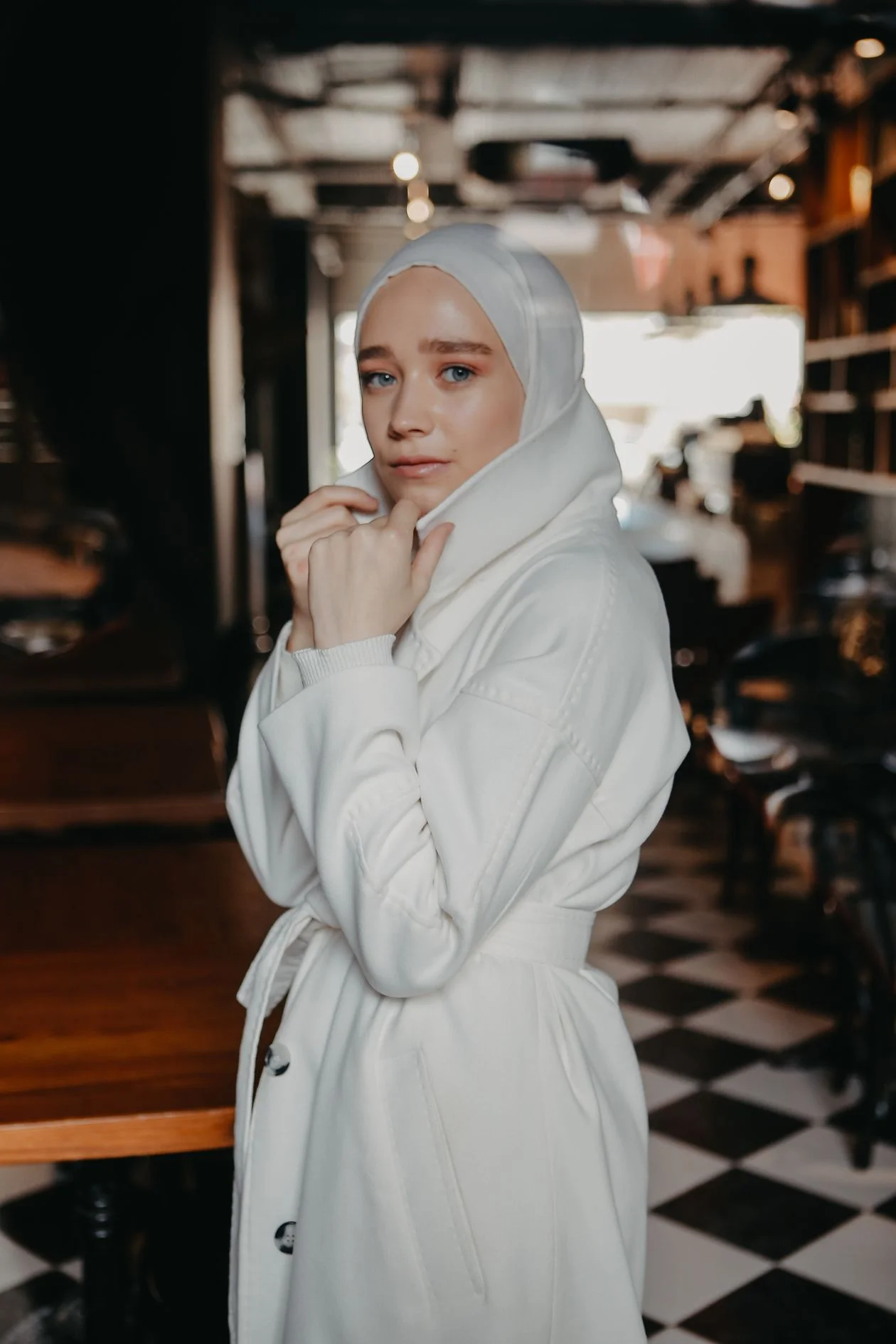
The hijab, the scarf and the coat collar all occupy the same space — the test is wearing them together, not choosing them separately.
Long hemlines: warmth, movement and wet pavements
A long dress or skirt can feel graceful in dry weather and exhausting after one walk through rain. Wet pavement, grit, puddles and slush can make a hem heavy, dirty and uncomfortable, and the folds of a long skirt dry slowly once they are wet. Keeping a hem slightly clear of the ground is not a failure of modesty — it is a practical decision that protects movement, safety and the garment itself. The right length depends on your coverage preference, your footwear, your stride and where you walk. Try the outfit with the boots you will wear, not bare feet in a bedroom: walk in it and use stairs before you decide.
The coat-and-dress relationship needs testing too. A long coat over a long dress can pull the dress backward, trap a full skirt or bunch around the knees. A shorter coat can leave more of the lower garment exposed to wind and rain. Test the coat and dress together while closed: sit down, step up a stair, walk at your normal pace. Our guide to how to wear a trench coat in winter covers the length and belt rules that help here, and the same logic applies to any long coat.
Boots belong in the length decision, not at the end of it. Ankle boots leave more movement at the hem; taller boots can change how a skirt falls; a flat sole can lower the dress toward wet ground, while a slightly higher sole lifts it. Check walking comfort and hem clearance together, and choose boots with grip for wet or icy pavements. Knee-high boots are a natural partner for long hemlines: they keep the lower leg warm and close the gap where cold air enters.
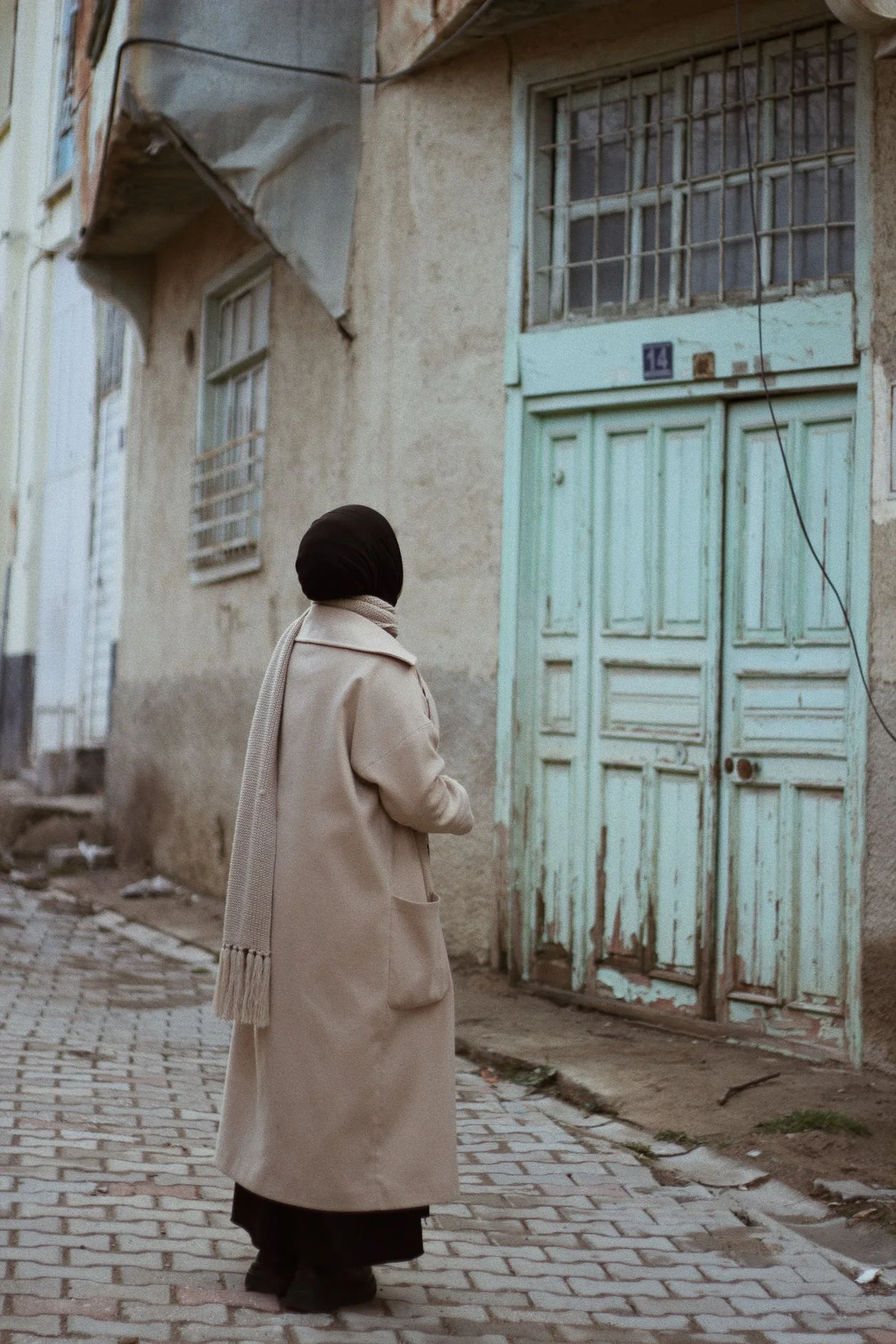
A long coat over a long outfit: the two lengths have to be tested together — walking, sitting and climbing stairs — before the outfit is finished.
The middle layer: dresses, abayas, tunics and skirts
The middle layer is where personal style lives, and there is no single right version of it. A long knit dress is the simplest: one piece, warm, and complete indoors. A closed abaya over a thermal base and a knit works the same way. An open abaya needs a winter plan beneath it, because wind can move the front panels, cold air can enter through the opening, and the outfit underneath becomes visible whenever the abaya opens — that base should meet your own coverage needs without relying on perfect stillness. A tunic with wide-leg trousers is the most practical for walking and stairs, and a long skirt with a fitted knit gives the most outfit options from the fewest pieces.
Two checks apply to any middle layer. First, sleeve bulk: a base sleeve, a dress sleeve, a knit sleeve and a coat sleeve can all sit in the same narrow space, and the elbow tightens, the cuff bunches, and reaching forward pulls the whole outfit upward. Second, the indoor test: take the coat off, sit down, and look at what remains. If the outfit only works with the coat on, it is not finished.
Coats for modest winter: long, closing, and cut for layers
A long wool coat is the classic modest winter choice: it covers the dress, closes securely, and looks intentional over long hemlines. A long puffer or parka is the practical choice for the coldest or wettest days — modern ones come in longer cuts that suit modest layering — but check that it closes over the middle layer without pulling, and that the hood does not fight the hijab. A faux-fur coat is the glamorous option for evenings, warm and dramatic, but it is the bulkiest choice and needs the middle layer to be slim. Our guide to how to choose a winter coat compares wool, puffer, trench and faux fur in detail.
Sizing up the coat is a common mistake. A larger coat gives more room over knitwear, but it can also drop the shoulders, lengthen the sleeves and make the whole coat swing awkwardly. Fit the coat over the thickest realistic outfit, then inspect the shoulder, the armhole, the closure and the hem. If the buttons pull, there is not enough room; if the shoulders collapse and the sleeve covers the hand, the size may be too large.
Warmth without bulk: the thin-layer rule
More coverage plus more warmth sounds like more fabric, and more fabric sounds like a shapeless outfit. The answer is thin layers, not fewer layers. Three thin, insulating layers trap warm air between them and keep the silhouette smooth; one very thick layer is warmer in theory and bulkier in practice, and it often overheats indoors. This is the same principle as how to layer clothes in winter without looking bulky: fitted base, smooth middle, structured outer.
Fabric names are clues, not guarantees. Wool, cotton, fleece and polyester can help you understand a garment, but they do not prove how warm or protective it will be — construction, weight, lining and fit all change how fabric behaves. Judge a garment by what you can verify: how it feels, how it fits, and how it works in the outfit. The knits and scarves deserve proper care too — see how to care for silk, cashmere, velvet and wool before the first wash of the season.
Outfit formulas: work, everyday, evening and cold days
Plan the pieces as a small wardrobe where everything works together — see how to build a winter capsule wardrobe.
Everyday: thermal base, long knit dress in charcoal or navy, opaque tights, knee-high boots, long wool coat, wool hijab in a toning colour.
Work: thermal base, a long tunic over wide-leg trousers in black or dark brown, a fitted blazer, ankle boots and a long coat. The trousers make stairs and commuting easy, and the tunic keeps the coverage.
Evening: a velvet or embellished long dress, a fine-knit layer underneath for warmth, heeled boots, and a long coat or faux-fur coat. Texture does the talking: a matte hijab beside a smoother coat, or a soft knit under structured outerwear.
Coldest days: thermal base plus a second thin layer, a long wool dress or an abaya with a thermal top underneath, fleece-lined tights, knee-high boots and a long insulated parka. On the coldest days, warmth is the style.
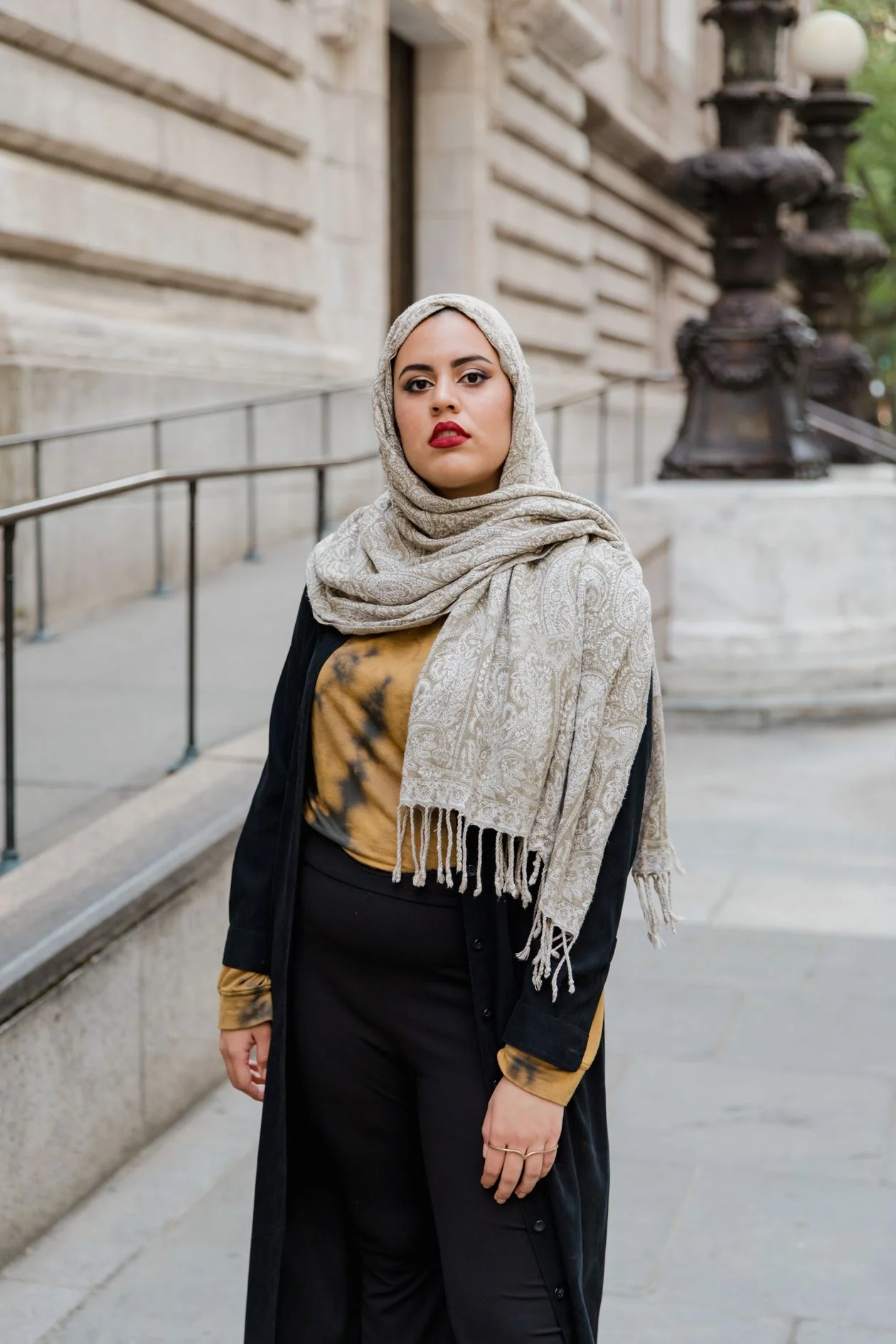
Colour and texture keep a modest outfit visible when the coat covers most of it — here, a long dress with a bold colour does the work.
Common mistakes and how to fix them
- Every layer doing the same job. Fix: give each layer one job — base for comfort, middle for the outfit, outer for the weather.
- A coat that fights the hijab. Fix: try the coat on with the hijab, do it up fully, and turn your head both ways before you buy.
- A middle layer that only works with the coat on. Fix: check the outfit underneath without the coat.
- A long hem dragging on wet pavements. Fix: fit the hem with the boots you will wear.
- Sizing up the coat instead of fixing the layers. Fix: check sleeve order and middle-layer bulk first.
Frequently asked questions
How do I dress modestly and stay warm in winter?
Use three layers: a smooth thermal base, a middle layer complete on its own indoors, and a long coat that closes securely with room for the layers underneath.
What should I wear under a long dress in winter?
A long-sleeved thermal top and leggings or fleece-lined tights underneath. They close the cold gaps at the waist, wrists and ankles without changing how the dress looks, and they keep the outfit warm even when the coat comes off indoors.
How do I wear a hijab with a winter coat?
Test the hijab with the actual coat before you buy it: do the coat up fully and turn your head both ways. Choose winter hijab fabrics like wool, jersey or a thick cotton blend with an underscarf, and avoid adding a chunky scarf over the hijab.
What is the best coat for modest winter outfits?
A long wool coat is the classic choice — it covers the dress, closes securely and looks intentional over long hemlines. A long insulated parka is the practical choice for the coldest or wettest days, and a faux-fur coat suits evenings.
Can I wear a long skirt in winter without getting cold or wet?
Yes, with fleece-lined tights or leggings underneath, boots with grip, and a hem fitted with those boots so it clears wet pavements. On rainy days, a slightly shorter hem or a midi length is the practical choice.
How do I layer modestly without looking bulky?
Layer thin, not thick: a fitted thermal base, a smooth middle layer and a structured outer layer. Give each layer one job, check sleeve order before leaving home, and fit the coat over the thickest outfit you will wear.
Conclusion
Modest winter fashion works as a system: a quiet base layer, a middle layer that stands on its own, and a coat that answers the real weather. When each layer does one job well, the outfit keeps you covered, keeps you warm, and still looks like you.