


Learning how to wear a dress in winter starts with a wardrobe you already own. Most women do not need new dresses for winter — they need a system for wearing the dresses they have. A summer dress, a midi dress, a shirt dress: all of them work in cold weather once the layers underneath, the tights, the boots and the coat are doing their jobs. The dress barely changes. What changes is everything around it.
How to wear a dress in winter: the quick answer
Wear the dress you already own, and winterise it in three layers. Underneath, a close-fitting thermal top holds body heat in. On your legs, opaque tights (from around 60 denier on cold days) or fleece-lined tights when it is properly cold. On your feet, boots matched to the hem: knee-high boots for a shorter hem, ankle or calf boots for a midi. Over the top, a long coat that covers most of the dress. The simplest formula is one dress plus one long coat plus black opaque tights plus knee-high boots. If you can feel the cold on your legs, the tights are too thin.

The winter dress formula in one look: a long coat over a dress, with boots doing the rest of the work.
Why the three-layer rule works
A dress in winter fails for one reason: the warmth is missing where the dress leaves you open — the arms, the legs, and the gap between hem and boot. The three-layer rule gives each one a layer with a single job. The base layer traps body heat: a thermal top under the dress, or thermal tights on the legs. The middle layer adds insulation and shape: a knit over the dress, or a turtleneck under it. The outer layer handles the weather: a long coat that covers the dress and blocks the wind. Build in that order — base, middle, outer — and the outfit stays warm without looking padded. It is the same method in Charles & Keith’s guide to how to layer dresses for winter: a thermal base, thermal tights, a fitted turtleneck under the dress or an oversized sweater over it, finished with a tailored coat. For the bulk problem, see our guide to how to layer clothes in winter without looking bulky.
Start underneath: thermals and base layers
The layer nobody sees is the one that matters most. A thermal top under a dress is invisible and adds more warmth than any scarf. Choose one that fits close to the body — a thermal that bags or bunches under a fitted dress creates lumps at the waist and under the arms. For sleeveless and short-sleeved dresses, a fine merino roll-neck or a thin long-sleeved thermal worn underneath turns a summer dress into a winter one; the thermal’s neckline becomes part of the look, so choose black, cream or a colour that matches the dress. The same logic applies below the waist: thin thermal leggings under opaque tights are the coldest-day trick. See our guide to thermal base layers before buying. One rule for everything underneath: fine and close-fitting beats thick and loose.
Which dresses winterise best
Not every dress winterises equally well, but almost every dress winterises somehow. The easiest are knit, velvet and jersey dresses — fabrics that already hold some heat. The hardest are thin, floaty dresses in viscose or chiffon, and they still work: they just need the full system. Length matters more than fabric: a midi or maxi leaves less leg exposed, so it needs thinner tights and shorter boots, while a mini needs the warmest tights and the tallest boots. A shirt dress and a wrap dress are the most versatile shapes because their waist definition survives layering. If you own a sweater dress, start there — our guide to how to style a sweater dress in winter covers it in full.
| Dress type | Winterise it with | Watch out for |
|---|---|---|
| Knit / sweater | Opaque tights, ankle or knee-high boots | Pilling under a belt |
| Midi | Opaque tights, calf or knee-high boots | Hem and boot shaft at the same point |
| Maxi | Fine tights, ankle boots | Coat shorter than the dress |
| Shirt dress | Thermal underneath, belted waist, boots | A bulky knit hiding the collar |
| Wrap dress | Fine roll-neck underneath, tights, boots | Wrap gaping over a thermal |
| Summer / floaty | Full system: thermal, fleece tights, long coat | Thin fabric showing the thermal |
Summer dresses in winter: the full formula
The summer dress is the one most people give up on, and it is the one this guide is really about. A floaty summer dress — floral, sleeveless, light as air — looks wrong in winter only if you wear it the way you wore it in July. Winterise it and it becomes a different outfit. Start with a fine thermal top underneath, in a colour that works with the dress: black under a dark floral, cream under a light one. Add fleece-lined tights — the step that makes the biggest difference, because bare legs are what make a summer dress feel cold. Add knee-high boots to close the gap between hem and shoe, then a knit over the top and a long coat over everything. The dress provides the colour and the movement; the layers provide the warmth.

Even a light summer dress works in winter once the layers underneath do the warming — the dress is the colour, the layers are the warmth.
Knits over dresses: the sweater trick
Putting a knit over a dress is the fastest way to winterise it, and the easiest to get wrong. The trick is proportion. A fine or medium knit works over most dresses; a very chunky knit works only over a slim dress, and it needs a belt to give the outfit a waist again. The classic move is a jumper over a midi dress, belted at the waist so the skirt still shows below the knit. A cropped knit over a longer dress works too — the dress becomes the skirt. A long cardigan is the relaxed version: leave it open, add a belt over it if you want shape. Keep the knit shorter than the dress, or the dress disappears. Colours should contrast gently: cream over dark, dark over light. If the dress is patterned, the knit should be plain.
Tights: denier, fleece-lined and opaque
Tights are the single biggest lever in a winter dress outfit, and the one most people under-use. Denier measures how thick tights are: the higher the number, the thicker and warmer they are. For mild days, finer tights up to about 40 denier keep a sheer finish under a longer hem. On cold days, reach for opaque tights from around 60 denier — solid, warm, and in a colour that ties to the boots. In hard frost, wear thermal or fleece-lined tights, and layer thin leggings underneath them if the wind bites. That denier guide comes from C&A’s guide to how to wear a dress in winter. Black opaque tights are the default because they go with every dress and boot and visually lengthen the leg. For the full comparison, see our guide to how to choose tights for winter.

Tights are the layer nobody notices and everybody needs — opaque black is the default that goes with everything.
Boots: closing the cold gap
Boots are the other half of the warmth equation, and the rule is simple: match the boot height to where the dress ends. A short hem with a tall boot leaves the smallest cold gap, which is why a mini or short midi with knee-high boots stays warm. A midi pairs with calf or knee-high boots, depending on where the hem falls. A maxi needs only ankle boots, because the hem already covers the leg. Knee-high boots are the most useful boot in a winter dress wardrobe: they add warmth, lengthen the leg, and work with almost every dress length. For the pairings in detail, see our guide to how to style knee-high boots in winter. Two practical points: lined boots are worth the money for the coldest days, and the boot colour should match the tights or the coat.
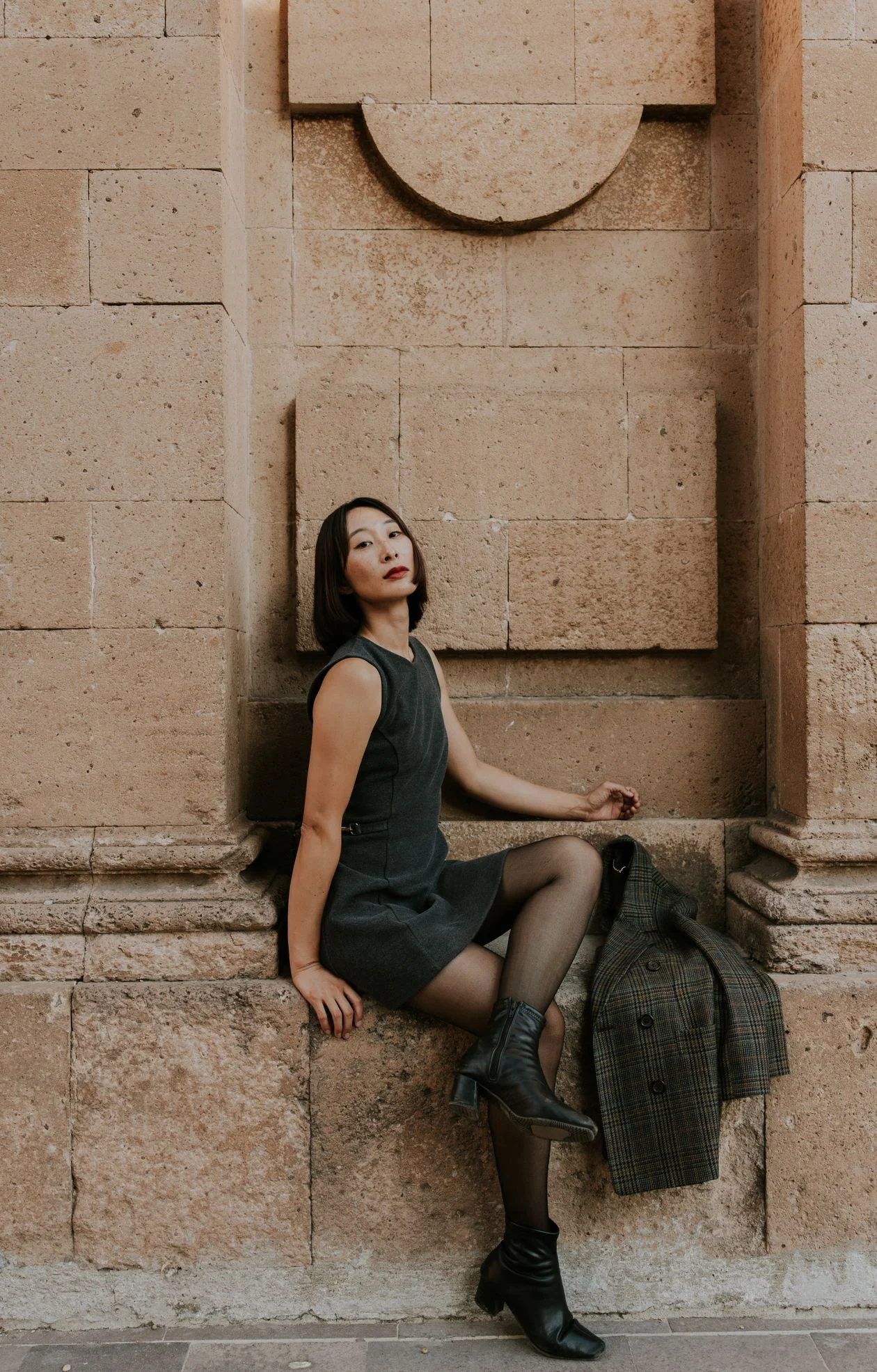
A black dress with boots is the simplest winter dress outfit — the boots close the cold gap and the dress does the talking.
Coats: the finishing layer
The coat is what makes a winter dress outfit look finished, and the rule is length: the coat should be longer than the dress, or at least as long as it. A dress hem peeking out from under a coat looks deliberate when the coat is longer; when the coat is shorter and the dress sticks out below it in a different colour, the outfit looks unfinished. A long wool coat in camel, black or charcoal is the safest choice, and it works over every dress in this guide. A belted coat over a belted dress can be too much belting — leave one of them unbelted. A puffer over a dress works for casual days, but choose a long one; a short puffer cuts the outfit in half. For evenings, a long coat over a velvet or satin dress is the most polished combination. If you own a wrap dress, our guide to how to wear a wrap dress in winter covers the coat pairings in detail.
Outfit formulas for every day
For work: a navy or charcoal midi shirt dress, a fine thermal underneath, opaque black tights, knee-high black boots and a long black or camel wool coat.
For weekends: a floral summer dress, a cream knit over it belted at the waist, fleece-lined tights, ankle boots and a long coat.
For a cold commute: a knit dress with fleece-lined tights, knee-high boots and a long coat.
For evenings: a velvet midi dress, dark opaque tights, heeled knee-high boots and a long coat worn open.
For a smart-casual day: a denim shirt dress over a fine roll-neck, dark tights, calf boots and a long coat.
Each formula follows the same order: thermal underneath, tights, boots matched to the hem, long coat over the top. Change the dress and the colours and the formula still holds — the system is the same, only the dress changes.
Common mistakes and how to fix them
- Wearing a summer dress with bare legs. Fix: fleece-lined tights — they are the step that makes the whole outfit possible.
- A coat shorter than the dress. Fix: wear a longer coat, or choose a shorter dress for that coat.
- A chunky knit over a full dress. It adds bulk at the waist and hides the dress’s shape. Fix: a fine or medium knit, belted at the waist.
- Sheer tights on a freezing day. Fix: 60 denier or above, and fleece-lined when it is properly cold.
- Boots that fight the tights. A pale boot with black tights cuts the leg in two. Fix: match the boot to the tights, or to the coat.
- Skipping the thermal because it feels unnecessary indoors. The cold hits on the walk, not in the office. Fix: a fine thermal that stays on all day.
Shopping guidance: what to buy first
Buy the layers, not the dresses. If your wardrobe already has dresses, the money should go to fleece-lined tights, a good pair of knee-high boots and a long wool coat — the three pieces that winterise every dress you own. A fine thermal top in black and one in cream covers the layer underneath. Only after those should you buy a winter dress, and the first one to buy is a knit dress: the easiest, warmest and most versatile winter dress there is. When you buy tights, buy two pairs of the same fleece-lined ones — one will always be in the wash on the coldest day. No prices are promised here, because they change by store and season.
Frequently asked questions
Can you wear a dress in winter without freezing?
Yes — with the full system: a thermal underneath, opaque or fleece-lined tights, boots matched to the hem and a long coat. The dress does not need to be warm; the layers around it do the warming.
What tights should I wear with a dress in winter?
Opaque tights from around 60 denier on cold days, and fleece-lined tights in hard frost. Black opaque tights are the default because they go with every dress and boot. Finer tights up to about 40 denier are for mild days only.
Can I wear a summer dress in winter?
Yes. A fine thermal or roll-neck underneath, fleece-lined tights and knee-high boots, a knit over the top, and a long coat over everything.
What boots go best with a dress in winter?
Knee-high boots for a shorter hem, calf or knee-high boots for a midi, ankle boots for a maxi. Match the boot height to where the dress ends so the cold gap is as small as possible.
Should my coat be longer than my dress in winter?
Yes, or at least as long. A dress hem peeking out from under a shorter coat looks unfinished. A long wool coat that covers most of the dress is the safest choice.
Conclusion
Learning how to wear a dress in winter is not about buying a winter wardrobe — it is about winterising the wardrobe you already have. A thermal underneath, the right tights, boots matched to the hem and a long coat over the top: that system turns almost any dress, including a light summer dress, into a winter outfit. Start with the tights and the coat, and let the dress be the colour.


