

The winter commute is two outfits in one. Outside, you need warmth, wind protection and shoes that grip wet pavements. Inside, you need to look polished, feel comfortable at a desk, and not spend the morning overheating in a coat you cannot take off. That split is what winter work outfits for cold commutes are about: outfits built in layers, so the outdoor half comes off at the door and the office half is already right underneath.
This guide to winter work outfits for cold commutes gives you that system: the coat, the layers, the boots, the bag, and outfit formulas for walking, trains, driving and the coldest days — plus what to carry so you arrive looking like you meant to.
The quick answer: long coat outside, tailored layers inside
Build the outfit in two halves. The outdoor half is a long, warm coat, a scarf, gloves, a hat and weatherproof boots. The indoor half is what you wear at the desk: tailored trousers or a skirt, a knit or a shirt, and a blazer. The coat comes off at the office door, the scarf and gloves come off with it, and the boots swap for office shoes you keep at your desk or carry in your bag.
The whole system takes two minutes to change, and it means you never have to choose between being warm and looking polished. That is the question behind every search for winter work outfits cold commute: one outfit that survives the journey and still looks right at the desk. The coat does the warming; the layers underneath do the looking polished.
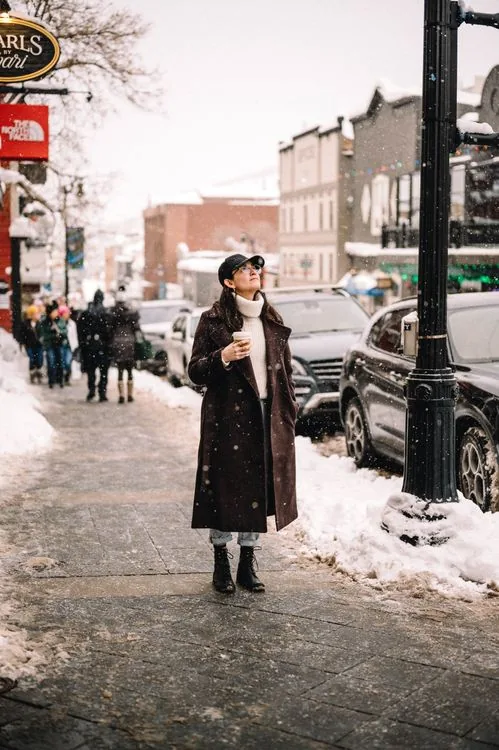
What makes a commute outfit different?
A commute outfit has to survive movement, weather and waiting. You walk to the station, you stand on a cold platform, you sit in a heated train, you walk again in the wind. That means the outfit has to handle temperature changes, not just cold — and it has to do it without wrinkling, without slipping, and without needing an iron at the office.
Three things make a commute outfit different from a regular work outfit. First, it needs a real coat, not a light jacket: the coat is doing serious work, and a coat that is too short or too thin will leave you cold no matter what is underneath. Second, it needs layers you can remove: a heated train and a cold platform are different climates, and the outfit has to adjust. Third, it needs shoes that work on wet ground: office shoes are for the office, and the commute needs something with grip.
Winter work outfits for cold commutes: the three-layer system
The system is three layers, and each one has a job.
Base layer — the office layer. This is what you wear at your desk: a shirt or a fine knit, tailored trousers or a skirt, and office shoes. It should be comfortable for eight hours indoors, and it should look complete on its own. A thin thermal underneath is fine in the coldest weather, as long as it does not show at the neck or the cuffs.
Mid layer — the warmth layer. A blazer, a cardigan or a fine knit, worn over the base layer. This is the layer that makes the outfit look tailored when the coat comes off, and it adds warmth on the platform. A blazer is the most polished mid layer; a fine knit is the warmest; a cardigan is the most comfortable. Choose by your office: a blazer for formal workplaces, a knit for relaxed ones.
Outer layer — the weather layer. A long wool coat or a long puffer, plus a scarf, gloves and a hat. This layer does all the weather work, and it comes off at the door. Wool fibres hold air, which causes the fabric to retain heat, which is why a wool coat is warm without being bulky — and why it still looks like office clothing, not outdoor gear.
The rule is that each layer should look right on its own.
The coat: the most important commuter piece
The coat is the piece that decides whether the commute is comfortable, so it is worth choosing carefully. A long coat — knee-length or longer — is better than a short one for commuting, because it covers your legs and keeps the wind off your thighs while you wait. A wool coat is the classic choice: warm, polished, and appropriate for every office. A long puffer is the warmer choice, and the right one for the coldest days or for walking commutes — it is less formal, but nobody at the office sees it once it is on the hook.

A commuter coat needs pockets you can actually use: deep enough for gloves and a phone, with a closure if possible. Wool coats and fine knits need proper care, so read how to care for silk, cashmere, velvet and wool before the season’s first wash.
Boots for the commute, shoes for the office
This is the part most commuters get wrong: wearing office shoes for the whole journey. Office shoes — leather loafers, heels, smooth-soled shoes — are not made for wet pavements, slush or ice. They slip, they get ruined, and they are cold.
The fix is simple: wear weatherproof boots for the commute and change into office shoes at work. The boots should be waterproof or water-resistant, with a grippy sole, and warm enough to stand in. Knee-high boots work well with skirts and dresses; ankle boots work with trousers and jeans. Keep the office shoes at your desk if you can, or carry them in your bag — a pair of loafers or low heels weighs very little and changes the whole outfit.
If you cannot change shoes, choose one pair that does both jobs: a leather ankle boot with a low heel and a grippy sole, in black or chocolate, works for the commute and the office. Avoid smooth soles, high heels and suede on wet days.
The office layer: what to wear under the coat
The indoor half of the outfit should be built from pieces that look polished on their own and layer well. Business casual is an ambiguously defined Western dress code for white-collar workplaces — typically a dress shirt and trousers, without a matching suit jacket, with ties optional — and most commuter outfits in this guide sit inside that definition, with a coat and layers added for the weather.
Tailored trousers are the most useful commuter bottom: they look polished, they layer over thermals on the coldest days, and they work with boots and with office shoes. Charcoal, navy and black are the most versatile colours. A skirt works too, with opaque tights and knee-high boots for the commute — the tights are the warmth layer, and the boots are the weather layer.
A knit or a shirt is the top half. A fine merino or cashmere knit is warmer and more comfortable than a shirt, and it layers under a blazer without bulk. A shirt is more formal and works better under a blazer for formal offices. Either way, keep it simple: the coat and the scarf are already adding visual interest, and the indoor layer should be calm.
A blazer is the piece that makes the indoor outfit look finished. How to style a blazer covers the details, but the commuter version is simple: a blazer that fits over a knit without pulling, in navy, charcoal or black, worn open over the knit or shirt. It is the layer that turns “I just arrived” into “I am at work”.

Outfit formulas: walking, train, driving and the coldest days
For more cold-weather ideas beyond the commute, see these winter outfit ideas for women.
Walking commute: long wool coat, cream or grey knit, charcoal tailored trousers, knee-high or ankle boots with grip, scarf, gloves, hat. Office shoes in the bag. This is the warmest everyday formula, and the coat covers almost everything.
Train or bus commute: long wool coat or long puffer, blazer, shirt or fine knit, tailored trousers or skirt with opaque tights, ankle boots, scarf and gloves. The coat comes off on the train if it is heated; the blazer is the layer that stays on.
Driving commute: the car does the warming, so the coat can be lighter — a knee-length wool coat, a blazer, a knit, tailored trousers, office shoes or ankle boots. Gloves still matter for a cold steering wheel, and a scarf is useful for the walk from the car park.
Coldest days: long puffer over everything, thermal base layer under the office outfit, thick scarf, lined gloves, hat, knee-high boots.

The office outfit underneath is the same as any other day — the puffer and the thermals are the only changes, and both come off at the door.
For more polished office looks to build on, see these old money work outfits.
Shopping guidance: what to buy first
Build the commuter wardrobe in this order, starting with what you already own:
- One long, warm coat. Wool for most days, or a long puffer if your commute is mostly walking. This is the piece that decides whether you are warm.
- Weatherproof boots with grip. The piece that decides whether you arrive safely and with dry feet.
- A blazer that fits over a knit. The indoor layer that makes the outfit look finished.
- A large, structured bag. Big enough for office shoes, a scarf and gloves, plus work things.
If you are building from scratch, start with the quiet luxury capsule wardrobe as the base — the commuter system in this article is that capsule, plus a coat and boots. And if you are working to a budget, build a capsule wardrobe on a budget first, and add the coat and boots as the two seasonal investments.
No prices are promised here, because they change by store and season. Try the coat on with the blazer and knit you will wear under it — a coat that fits over a shirt but not over a blazer is a coat you will regret on the coldest days.
Common mistakes and how to fix them
- Wearing office shoes for the whole commute. They slip, they get ruined, and they are cold. Fix: boots for the journey, office shoes at the desk.
- A coat that is too short or too thin. It leaves your legs cold and the outfit underneath exposed. Fix: knee-length or longer, wool or puffer, with room for a blazer underneath.
- Too many layers indoors. A thermal, a shirt, a knit, a blazer and a coat is five layers — you will overheat on the train. Fix: three layers total, and take the coat off when you are indoors.
- A bag that is too small. Office shoes, a scarf and gloves do not fit in a small bag. Fix: a structured tote or a large shoulder bag, with a shoe bag inside.
- Forgetting the hat. Heat loss from an uncovered head on a cold platform is real, and a hat is the cheapest warmth you can buy. Fix: a simple beanie that fits in your bag.
- Wearing suede on wet days. Suede and slush do not mix. Fix: leather boots for wet days, suede for dry ones.
Frequently asked questions
What should I wear to work on a cold commute?
For winter work outfits for cold commutes, start with a long warm coat, a tailored indoor layer (blazer, knit, tailored trousers), weatherproof boots for the journey and office shoes at the desk.
How do I stay warm on a winter commute without looking bulky?
Three thin layers — a base layer, a blazer or fine knit, and a long coat — are warmer and less bulky than one thick layer. A thermal base layer under the office outfit adds warmth without showing.
Should I wear boots or shoes to work in winter?
Boots for the commute, shoes for the office. Wear weatherproof boots with grip for the journey, and keep office shoes at your desk or carry them in your bag.
What is the best coat for a winter commute?
A long wool coat for most days — warm, polished and appropriate for every office — or a long puffer for the coldest days and walking commutes. Knee-length or longer is better than short, because it covers your legs.
Conclusion
Winter work outfits for cold commutes are not about owning more clothes — they are about organising the clothes you own into two halves. A long, warm coat, weatherproof boots, a scarf, gloves and a hat do the outdoor work. Tailored trousers, a knit or a shirt, and a blazer do the indoor work. The coat comes off at the door, the boots swap for office shoes, and you arrive warm, dry and looking like you meant to. Start with the coat and the boots, add the blazer, and the commute stops being the hardest part of the working day.