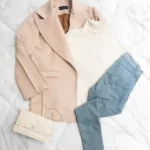

Broad shoulders are a strong frame. They give jackets a clean line, make a coat look intentional, and carry structured clothes the way those clothes were designed to be carried. Learning how to style broad shoulders is not about making them disappear — it is about balance: choosing necklines, sleeves and trouser shapes so the top and bottom of an outfit sit in proportion with each other.
This guide is built on that idea. No hiding, no apologising, no “flaws” to fix. Just fit, proportion and a few choices that make getting dressed easier.
How to style broad shoulders: the quick answer — fit the shoulders, balance the rest
Buy tops and jackets that fit at the shoulder seam, then balance the lower half. A V-neck or scoop neck breaks up the horizontal line across the chest; a structured blazer that follows your shoulder line looks better than a soft, oversized one that adds width; and wider-leg or straight-leg trousers bring the lower half into proportion with the upper half.
The most common mistake is the opposite: buying a size up to fit the shoulders, then living with sleeves that are too long and a body that swims. Fit the shoulders first, and take the rest in — or choose cuts that are designed to be adjusted, like a wrap top or a belted coat.
What broad shoulders actually are
Anatomically, the shoulder is made up of the collarbone, shoulder blade and upper arm bone, with muscle over the top — some people have broad shoulders because of bone structure, others because of muscle built through sport or training.
Necklines: the fastest way to change the balance
The neckline is the quickest lever you have, because it sits right between the shoulders. A high, straight neckline — a crew neck, a boat neck, a wide bandeau — runs parallel to the shoulder line and repeats it, which makes the shoulders look wider. A neckline that cuts diagonally or vertically does the opposite: it breaks the horizontal line and draws the eye down the centre of the body.
V-necks are the most useful option. A V-neck top, a wrap top or a shirt worn open at the collar all create a vertical line down the chest. Scoop necks work too, though less dramatically, because the curve softens the shoulder line without adding a horizontal edge. A soft cowl neck can also work, because the drape pulls the eye inward rather than outward.
Sleeves and shoulders: structure beats volume
Shoulder seams matter more than any other detail. On a well-fitting top, the seam sits at the edge of your shoulder bone. If it droops down the arm, the top is too big; if it pulls toward the neck, it is too small. This is the fit point to check first in every fitting room, before the waist or the length.
Raglan sleeves — where the sleeve seam runs diagonally from the collar to the underarm — are a good friend, because there is no shoulder seam to place wrongly and the diagonal softens the shoulder line. Dolman and batwing sleeves, on the other hand, usually add volume exactly where you do not need it, and are best avoided unless the fabric is very fine and the rest of the outfit is slim.
Set-in sleeves with a little structure are the classic choice: a shirt, a tailored blouse, a blazer. Avoid details that widen the shoulder further: horizontal stripes across the chest, epaulettes, heavy embellishment on the shoulder, and puff sleeves that start at the shoulder seam. None of these are “wrong” in themselves — but if balance is the goal, they work against it.
Blazers and jackets: your strongest layer
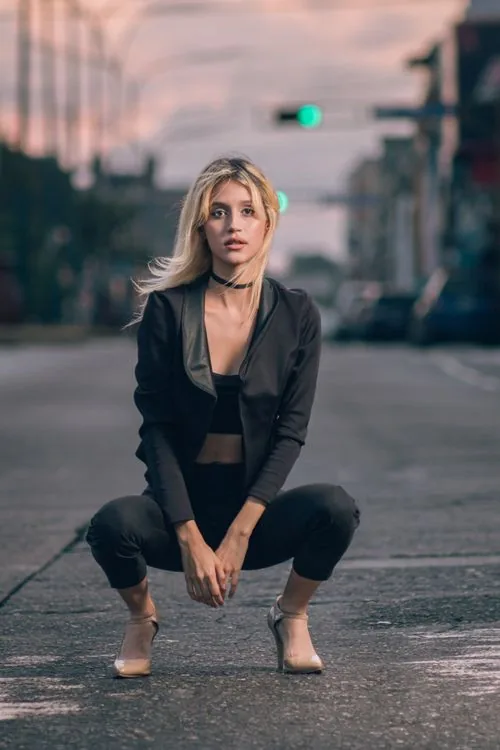
A blazer is the single most useful garment for a broad-shouldered wardrobe, because it is built around the shoulder. The rules are simple. First, fit the shoulders: the seam at the edge of the shoulder, no pulling across the back when you reach forward, no gaping at the button. Second, look for a single-breasted cut with one or two buttons, which creates a V at the chest and narrows the torso visually. Double-breasted blazers can work, but they add a wide horizontal panel across the chest, so they need to be well cut and are best in a dark, plain fabric.
Length matters too. A blazer that ends at the hip bone is the most versatile; a longer one that covers the hip can balance a broad top half by adding length to the torso. A very short, boxy blazer tends to end at the widest part of the chest and emphasise it, so it is the least useful shape for this frame.
For more detail on choosing and wearing blazers, see how to style a blazer — the fit checks there apply doubly when the shoulders are broad.

Coats: belted, A-line and long
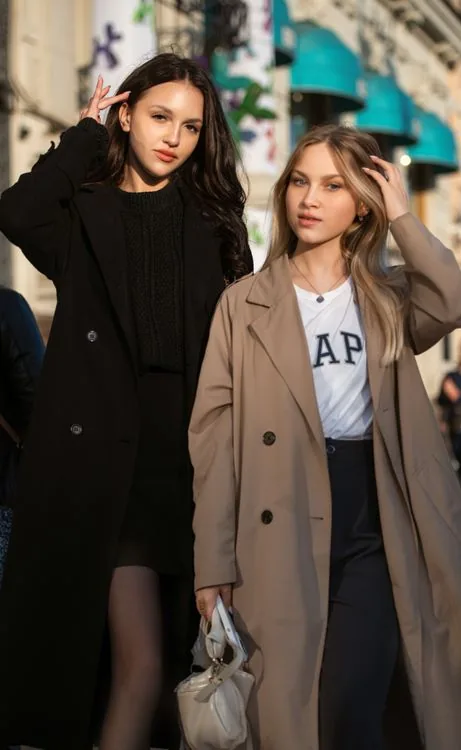
Winter coats follow the same logic as blazers, with one addition: the belt. A belted coat — a trench, a wrap coat, a wool coat with a tie belt — defines the waist and gives the eye a second focal point below the shoulders. That single detail does more for balance than any amount of careful colour choice.
A-line coats, which flare gently from the shoulder to the hem, also work well: the flare adds width at the bottom, which balances width at the top. Straight, boxy coats in heavy fabric are the hardest shape, because they hang from the shoulders in one wide rectangle. If you love a boxy coat, choose one in a softer fabric that drapes, and wear it open over a V-neck top so the vertical line inside the coat does the balancing work.
Trousers and skirts: balance from below
This is the half of the equation people forget. If the shoulders are the widest point, the lower half needs enough presence to match them — otherwise the outfit looks top-heavy. Wide-leg trousers, straight-leg jeans and A-line skirts all do this job. They add a clean line below the waist that echoes the shoulder width without competing with it.
Skinny trousers and pencil skirts are not banned, but they need something else in the outfit to balance them: a longer top, a coat worn open, or a boot with some presence. Worn with a short, fitted top, a very slim bottom can make the shoulders look wider by contrast. The jeans for different waist-to-hip proportions guide is useful here, because the right jean shape depends on your hip and waist as well as your shoulders — fit the whole lower half, not just the leg.
Tops, knits and dresses
For everyday tops, the best shapes are the ones with a V, a wrap, or an asymmetric detail: wrap tops, V-neck T-shirts, shirts with the top buttons undone, and tops with a diagonal hem. These all create a line that runs down or across the body at an angle, which is the opposite of the shoulder’s horizontal line.
Dresses follow the same principles. Wrap dresses, A-line dresses and dresses with a V-neck all work well, because they define the waist and flare gently below it. A straight, wide shift dress with a boat neck is the hardest shape for this frame. And a fit-and-flare dress — fitted at the top, full at the skirt — is one of the easiest, because the skirt does the balancing work for you.
Accessories: draw the eye down and in
Accessories are a quiet way to shift the balance. Long necklaces, scarves worn long and open, and a pendant that sits at the centre of the chest all create a vertical line. Short, chunky necklaces that sit at the collarbone repeat the horizontal shoulder line, so they are less useful here.
Bags matter too. A bag worn on the shoulder adds bulk at the shoulder, so a cross-body bag worn long, or a bag carried in the hand, is usually the easier choice. And a belt — on a dress, a coat or a pair of trousers — is the single most effective accessory for this frame, because it marks the waist and gives the outfit a centre.

Outfit formulas: work, casual, evening and weekend
Work: a single-breasted blazer in navy or charcoal, a V-neck blouse underneath, wide-leg tailored trousers and loafers. Or a wrap dress with a belted coat over it and knee-high boots. For more classic work looks, these old money work outfits are a useful starting point — the tailored, waist-defined shapes suit this frame well.
Casual day: a V-neck T-shirt, straight-leg jeans, an open shirt or a soft blazer, and trainers or ankle boots. Add a long scarf in cold weather.
Evening: a wrap top or a V-neck blouse with wide-leg trousers and heels, or a fit-and-flare dress with a simple pendant necklace. Keep the top half simple and let the trousers or the skirt carry the outfit.
Weekend: a fine knit with a V-neck, wide-leg jeans and boots, with a long belted coat over the top. Comfortable, warm and balanced without any effort.
The pattern in every formula is the same: a vertical line at the top, definition at the waist, and enough shape below the waist to match the shoulders.
Fitting-room checklist: the five checks that matter
- Shoulder seam: sits at the edge of your shoulder bone, not drooping and not pulling in.
- Back: no horizontal pulling lines across the shoulder blades when you reach forward.
- Button: on a blazer or shirt, the button closes without gaping — if it gapes, the size is wrong, not your body.
- Sleeve length: the sleeve ends at the wrist bone, not halfway down the hand.
- Waist: if the shoulders fit but the waist is loose, that is a tailoring job, not a reason to size up or down. A good tailor can take in a waist for far less than the cost of a new jacket.
If a garment fails the shoulder check, put it back. No amount of styling fixes a shoulder seam in the wrong place.
Common mistakes and how to fix them
- Buying a size up to fit the shoulders. Fix: buy for the shoulders and tailor the waist, or choose a wrap or belted cut that adjusts.
- Boat necks and wide crew necks on their own. Fix: add a V underneath — a shirt under a crew-neck jumper, or a necklace that creates a vertical line.
- Puff sleeves and heavy shoulder detail. Fix: choose a raglan sleeve or a clean set-in sleeve instead.
- A very slim bottom with a short, fitted top. Fix: lengthen the top, open a coat over it, or switch to a straight or wide leg.
- Trying to cover the shoulders with oversized, shapeless layers. Fix: structure, not volume. A fitted blazer balances better than a shapeless oversized shirt, because it follows the frame instead of adding to it.
For readers working on overall proportion rather than just the shoulders, how to style a fuller figure and how to dress a slim frame cover the same fit-first principles from other starting points.
Frequently asked questions
What should I wear if I have broad shoulders?
Start with fit: tops and jackets whose shoulder seam sits at your shoulder bone. Add a V-neck or wrap neckline, a structured blazer, and wider-leg or straight-leg trousers to balance the lower half.
Do V-necks help with broad shoulders?
Yes — a V-neck creates a vertical line down the centre of the chest, which breaks up the horizontal shoulder line. Wrap tops and open shirt collars do the same job.
Should I avoid shoulder pads?
Not necessarily. A small, neat pad in a blazer can give a clean line that follows your shoulder. Avoid pads that extend beyond your natural shoulder, or heavy pads in soft knits.
Are broad shoulders a problem to fix?
No. Broad shoulders are a feature of your frame — body shape is defined mainly by skeletal structure and the distribution of muscle and fat. Styling is about balance and comfort, not about hiding your body.
What coats suit broad shoulders best?
Belted coats, wrap coats and A-line coats, in a length that falls to the knee or below. The belt defines the waist and the flare or length balances the shoulder line.
Can I wear off-the-shoulder tops with broad shoulders?
You can — there is no rule against it. An off-the-shoulder top does draw attention to the shoulders, so if balance is your goal that day, pair it with a wide-leg bottom or an A-line skirt.
Conclusion
Styling broad shoulders comes down to three ideas: fit the shoulder seam, add a vertical line at the neckline, and give the lower half enough shape to match the upper half. A V-neck, a well-cut blazer, a belted coat and a wide-leg trouser will take you through work, weekends and evenings without a single garment trying to hide you. Broad shoulders are not a problem to solve — they are a strong frame, and the best outfits are the ones that work with it.